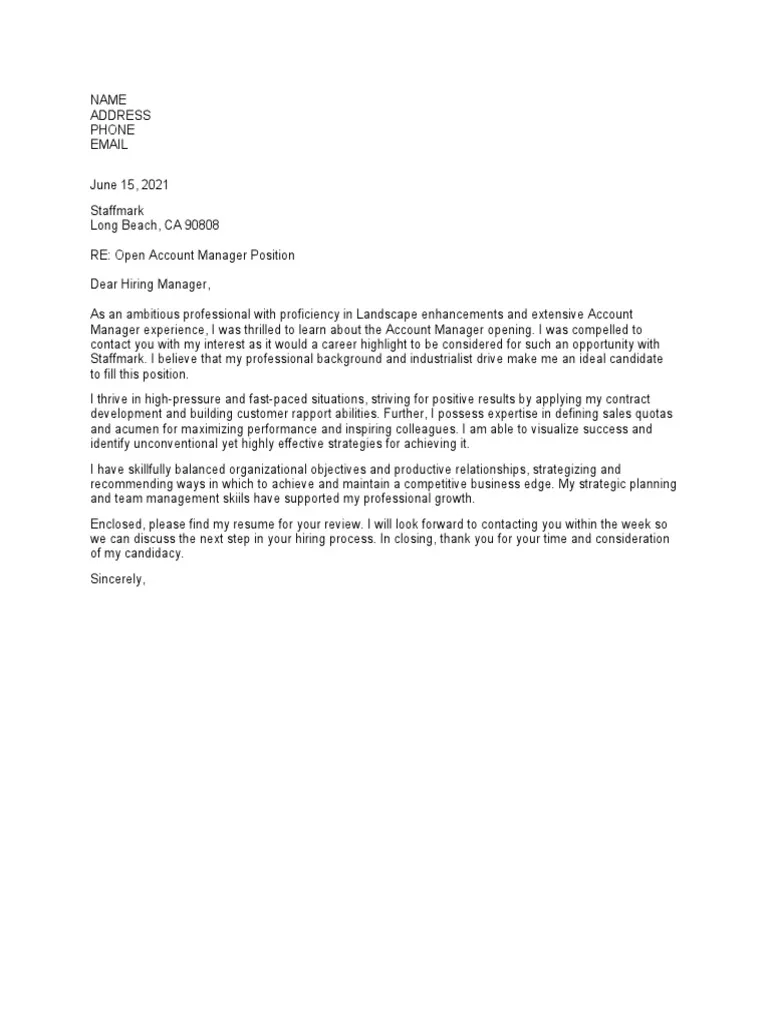
Crafting the Perfect Accounting Manager Cover Letter
A well-crafted cover letter is your first opportunity to make a strong impression on a potential employer. For an Accounting Manager, the cover letter isn’t just a formality; it’s a critical tool to showcase your skills, experience, and personality. It provides a narrative that complements your resume, allowing you to elaborate on your qualifications and demonstrate your suitability for the role. A compelling cover letter can set you apart from other candidates, highlighting your accomplishments and conveying your enthusiasm for the position. This guide provides the top five tips to help you create a cover letter that gets you noticed, increases your chances of landing an interview, and ultimately, securing your dream job.
Highlighting Your Accounting Skills
Your cover letter should be a showcase of your core accounting skills. Focus on the skills most relevant to the Accounting Manager position you’re applying for. This includes technical skills like proficiency in accounting software (e.g., QuickBooks, SAP, Oracle), financial reporting, budgeting and forecasting, and tax compliance. Highlight your experience with financial statement analysis, general ledger management, and month-end/year-end closing procedures. Providing specific examples of how you have applied these skills in previous roles can greatly enhance the impact of your cover letter. Remember, it’s not enough to list these skills; you must demonstrate how you’ve used them to achieve positive outcomes.
Quantifying Your Achievements

To make your skills even more compelling, quantify your achievements whenever possible. Numbers speak louder than words in the world of accounting. Instead of saying “Improved efficiency,” state, “Improved efficiency by 15% through process automation.” Instead of “Managed budgets,” say “Managed budgets totaling $10 million with a 98% accuracy rate.” Quantifying your achievements demonstrates your impact and provides concrete evidence of your abilities. Use metrics to show how you’ve saved money, increased revenue, improved accuracy, or streamlined processes. This approach not only highlights your accomplishments but also provides potential employers with a clear understanding of the value you can bring to their organization.
Tailoring Your Cover Letter to the Job Description
Generic cover letters are easily spotted and often discarded. Tailoring your cover letter to each specific job application is crucial. Carefully review the job description and identify the key requirements and desired skills. Then, customize your cover letter to address these points directly. Demonstrate how your skills and experience align with the company’s needs. Use keywords from the job description throughout your cover letter, but don’t simply copy and paste. Instead, weave these keywords naturally into your narrative, showing how you have successfully utilized these skills in past roles. This personalized approach demonstrates your genuine interest in the position and your understanding of the company’s needs.
Researching the Company
Demonstrating your knowledge of the company is a powerful way to impress potential employers. Before writing your cover letter, research the company’s mission, values, and recent activities. Mention specific projects or initiatives that resonate with you, and explain why you are interested in working for that particular company. This shows that you are genuinely invested in the opportunity and that you’ve taken the time to understand their business. Moreover, this preparation allows you to tailor your cover letter to specifically address how your skills and experience can benefit the company’s goals. Including insights about the company also shows your attention to detail and initiative.
Using Action Verbs and Keywords
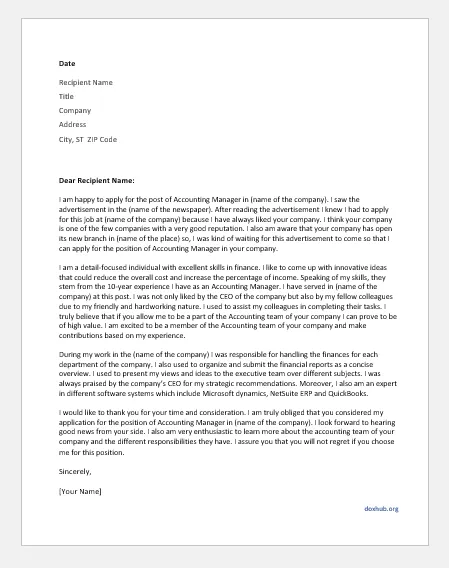
Using strong action verbs is essential for making your cover letter more impactful. Start your sentences with action verbs to describe your accomplishments and responsibilities. Words like ‘managed,’ ’led,’ ‘achieved,’ ‘developed,’ ‘implemented,’ and ‘improved’ can make your statements more dynamic and engaging. Also, incorporate keywords directly from the job description. This doesn’t mean keyword stuffing, which can be counterproductive. Instead, use relevant keywords naturally within your descriptions of your skills and accomplishments. Doing so not only helps your cover letter stand out to hiring managers but also optimizes your application for applicant tracking systems (ATS) that employers use to screen resumes and cover letters.
Showcasing Leadership and Management Experience
As an Accounting Manager, leadership and management skills are paramount. Your cover letter should highlight your experience in leading and managing accounting teams. Provide examples of how you have successfully motivated and mentored team members, delegated tasks effectively, and resolved conflicts. Showcase your ability to create a positive and productive work environment. Describe situations where you successfully implemented process improvements, trained employees, or managed performance reviews. If you have experience in hiring and onboarding accounting staff, be sure to mention it. Your goal is to demonstrate your capacity to not only perform accounting tasks but also to lead and develop a high-performing team.
Demonstrating Your Soft Skills
While technical skills are important, soft skills are equally crucial for an Accounting Manager. In your cover letter, emphasize your communication, problem-solving, and organizational abilities. Provide examples of how you have effectively communicated complex financial information to non-financial stakeholders. Showcase your ability to analyze financial data, identify issues, and propose effective solutions. Highlight your organizational skills by detailing your experience in managing multiple projects, meeting deadlines, and maintaining accuracy. Mention your ability to work collaboratively with other departments. Soft skills often make a difference in the workplace and show how well you fit in and work with others.
Formatting and Proofreading Your Cover Letter

The presentation of your cover letter is just as important as the content. Your cover letter must be well-formatted and easy to read. Use a professional font, such as Times New Roman, Arial, or Calibri, and maintain consistent formatting throughout. Keep your paragraphs concise and avoid large blocks of text. Use bullet points to highlight key accomplishments or skills. Ensure your cover letter aligns with your resume in terms of format and design. Proper formatting shows attention to detail, which is very important to employers. Formatting helps with the flow and keeps the reader engaged.
Using a Professional Tone
Maintain a professional and respectful tone throughout your cover letter. Avoid slang, jargon, and overly casual language. Your writing style should reflect the seriousness and professionalism of the accounting field. Be enthusiastic but not over the top. Use a formal salutation (e.g., ‘Dear Mr./Ms. [Last Name]’) and a professional closing (e.g., ‘Sincerely’ or ‘Best regards’). The tone of your letter sets the first impression, so making sure you have the professional tone is a must. Avoid negativity or complaints about previous employers or jobs.
Proofreading for Errors
Typos, grammatical errors, and inconsistencies can undermine your credibility and give the impression that you lack attention to detail. Before submitting your cover letter, thoroughly proofread it for any errors. Read it aloud to catch any awkward phrasing. Ask a friend, colleague, or career advisor to review your letter as well. Sometimes, another set of eyes can catch errors that you might miss. Ensure that all names, dates, and company information are accurate. Remember, your cover letter is a reflection of your professionalism and attention to detail, so make sure it’s free of errors.
Closing with Confidence

Your closing should leave a lasting positive impression. End your cover letter with a strong statement that reiterates your interest in the position and summarizes your key qualifications. Express your enthusiasm for the opportunity and your confidence in your ability to contribute to the company’s success. Provide a brief call to action, such as expressing your availability for an interview and thanking the reader for their time and consideration. Make sure your closing is clear, concise, and leaves the employer wanting to learn more about you.
Expressing Enthusiasm
Expressing genuine enthusiasm for the position and the company is crucial. Instead of simply stating that you are interested, convey your excitement and passion for the opportunity. Mention specific aspects of the role that excite you, or highlight how your skills align with the company’s mission or values. This demonstrates your genuine interest in the position and can make your application more memorable. Enthusiasm in writing is a fantastic way to show how much you want the job.
Providing Contact Information
Make it easy for the hiring manager to contact you. Provide your phone number and email address in your cover letter, preferably at the beginning or the end. Double-check that your contact information is correct and up-to-date. Consider including a link to your LinkedIn profile or online portfolio if you have one. Ensuring your contact information is easily accessible and accurate simplifies the next steps for the employer and speeds up the hiring process. Always make sure to keep it professional.