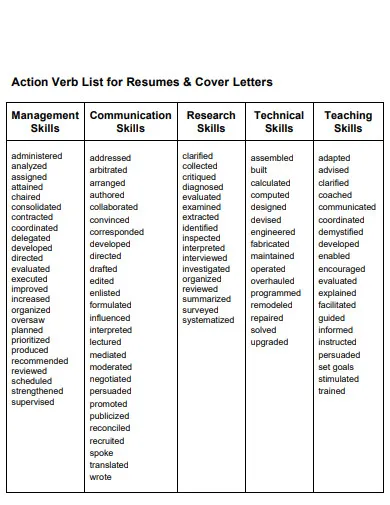
What are Action Verbs in Cover Letters?
Action verbs are powerful words that breathe life into your cover letter. They go beyond simply stating your responsibilities; they illustrate what you did and the impact of your actions. Instead of writing “Responsible for project management,” you could write “Managed multiple projects simultaneously, delivering them 15% under budget and ahead of schedule.” This subtle shift transforms a passive description into an active demonstration of your skills and achievements. Action verbs grab the reader’s attention, making your cover letter more compelling and memorable. They showcase your accomplishments in a dynamic way, making it clear that you are a proactive and results-oriented candidate. Using strong action verbs helps recruiters and hiring managers quickly understand your value and the contributions you can make to their organization. Therefore, mastering the art of incorporating action verbs is a cornerstone of effective cover letter writing.
Why Are Action Verbs Important?
Action verbs are crucial for several reasons. First, they grab the reader’s attention. Hiring managers often have to sift through hundreds of applications, and a cover letter filled with weak or passive language can easily be overlooked. Action verbs immediately signal that you are a proactive and results-oriented individual. Second, they provide concrete evidence of your skills. Instead of simply claiming to have certain abilities, action verbs showcase how you’ve applied those skills to achieve tangible results. This turns generic statements into compelling achievements. Finally, they demonstrate clarity and precision. Action verbs force you to be specific about your accomplishments, eliminating ambiguity and making your cover letter easier to understand. This clarity helps hiring managers quickly assess whether your experience aligns with the job requirements, making action verbs an indispensable tool in the job search process.
Benefits of Using Action Verbs

The advantages of incorporating action verbs into your cover letter are numerous. They make your cover letter more impactful, highlighting accomplishments and demonstrating capabilities. By using strong action verbs, you immediately capture the attention of hiring managers, setting yourself apart from other candidates. Furthermore, action verbs enhance the readability and flow of your cover letter. They contribute to a dynamic narrative, making your experiences more engaging and memorable. Action verbs also help you to quantify your achievements. When you can back up your claims with concrete examples, your cover letter gains credibility and persuasiveness. The strategic use of action verbs can significantly increase your chances of landing an interview by effectively communicating your value proposition. It’s all about showing, not just telling, what you’ve achieved.
Impact of Action Verbs on Hiring Managers
Hiring managers are constantly looking for candidates who can demonstrate tangible results, and action verbs are the perfect way to achieve this. They instantly communicate what you have done and the impact you have made. By using action verbs, you provide concrete evidence of your skills, making your cover letter more persuasive and memorable. Action verbs enable you to clearly articulate your value proposition, showing hiring managers why you are the best fit for the role. They make your cover letter easier to scan and understand, allowing recruiters to quickly assess your qualifications. Moreover, they demonstrate your attention to detail and professionalism. A well-crafted cover letter with strong action verbs suggests that you are dedicated and invested in the application process, which will make hiring managers view your application more favorably.
Top 10 Action Verbs to Use in Your Cover Letter
Choosing the right action verbs is essential for creating a compelling cover letter. Here are ten top-tier action verbs you can use to highlight your accomplishments. Remember, the best verbs will depend on your experiences and the job requirements.
Achieved

Use this verb to highlight your accomplishments. It’s a straightforward and effective way to show results. For instance, you could write “Achieved a 20% increase in sales.”.
Managed
Indicates your leadership and organizational skills. Example “Managed a team of five employees.”
Developed
Use this when you created or built something. For example, “Developed a new marketing strategy.”
Implemented

Showcases your ability to put ideas into action. Example “Implemented new customer service protocols.”
Created
Ideal for illustrating your creativity. Example “Created engaging social media content.”
Led
Demonstrates leadership abilities. Example “Led a project team to successful completion.”
Improved

Showcases your ability to make things better. Example “Improved operational efficiency by 15%.”
Collaborated
Highlights your teamwork skills. Example “Collaborated with cross-functional teams.”
Streamlined
Shows your ability to make processes more efficient. Example “Streamlined the onboarding process.”
Resolved

Indicates your problem-solving skills. Example “Resolved customer complaints effectively.”
How to Choose the Right Action Verbs
The key to selecting the right action verbs lies in understanding your experience and the specific requirements of the job. First, carefully review the job description. Identify the key skills and qualifications that the employer is seeking. Next, brainstorm a list of your relevant accomplishments and experiences. Then, select action verbs that accurately reflect what you did and the impact you made in each situation. Choose verbs that are specific and relevant to the job, avoiding generic or vague language. To make your selection even more effective, use a thesaurus to find synonyms for verbs you’ve already chosen. This will add variety and further enrich your cover letter, preventing repetition and showcasing a wider range of your skills.
Tailoring Verbs to the Job Description
Customization is key when it comes to action verbs. Tailor your verb choices to align with the language used in the job description. If the job emphasizes project management, use verbs like “managed,” “coordinated,” and “executed.” If the role requires strong communication skills, consider verbs like “presented,” “persuaded,” and “negotiated.” Tailoring your cover letter in this way demonstrates that you have read the job description carefully and understand what the employer is looking for. By matching the language, you also increase the chances that your qualifications will resonate with the hiring manager, boosting your overall chances of getting selected. This level of detail shows you are genuinely interested in the role and have tailored your application to fit the specific needs of the organization.
Using Strong Verbs to Highlight Skills

Action verbs allow you to highlight your skills. Match the verbs to the skill you want to emphasize. For leadership, use “led”, “directed”, and “supervised.” For problem-solving, use “resolved”, “analyzed”, and “evaluated.” To showcase your creativity, use “designed”, “created”, and “developed.” Select verbs that communicate your abilities in a clear and powerful way. The right verbs not only describe what you have done but also show the level of proficiency and impact you have made. For example, instead of writing, “Responsible for customer service,” write “Resolved customer complaints, resulting in 90% customer satisfaction.” Make sure that the verbs you choose accurately and effectively reflect your skills and experience.
Formatting Your Cover Letter with Action Verbs
Incorporating action verbs isn’t just about the words you choose; it’s also about how you structure your cover letter. Begin each bullet point or sentence describing your achievements with a strong action verb. Keep your sentences concise and impactful, avoiding jargon. Use a professional and easy-to-read font. The best practice is to vary your word choice, to avoid repetition. Also, use bullet points to clearly present your accomplishments. Each point should begin with a powerful action verb and concisely describe a relevant achievement. Maintain consistency in formatting, ensuring that your cover letter is easy to read and visually appealing. Correct formatting highlights the impact of the action verbs, making them easier for the hiring manager to spot and appreciate.
Integrating Action Verbs into Your Achievements
When you describe your achievements, focus on the “STAR” method - Situation, Task, Action, Result. First, briefly describe the situation or context. Second, explain the task or goal. Third, detail the specific action you took, using strong action verbs. Finally, state the measurable results of your actions. This method will make your achievements memorable and effective, making it easy for the hiring manager to see the value of your experiences. For example, “In my previous role (Situation), I needed to improve customer satisfaction (Task). I implemented new training protocols (Action), which improved customer satisfaction by 30% (Result).” This method ensures your achievements are presented in a concise, focused way.
Cover Letter Action Verbs Examples
To illustrate the impact of action verbs, let’s look at some examples. Instead of writing “Helped with marketing campaigns,” consider “Managed marketing campaigns, increasing brand awareness by 25%.” Instead of writing “Responsible for customer service,” use “Resolved customer complaints, improving customer satisfaction rates by 20%.” Instead of “Worked on projects,” try “Led cross-functional project teams, delivering projects on time and under budget.” The use of action verbs makes a major difference in how hiring managers perceive your abilities. The examples highlight the effectiveness of action verbs in showcasing accomplishments, emphasizing skills, and quantifying impact. Using these examples, tailor them to fit your experiences to make them more relevant and engaging.
Avoid Common Mistakes
While action verbs can significantly improve your cover letter, certain mistakes can diminish their impact. Avoid using generic or weak verbs that fail to convey any specific achievements. Avoid excessive repetition of the same verbs, which can make your writing monotonous. Also, avoid using jargon or overly complex language that may confuse the reader. Ensure your action verbs match the job description and accurately reflect your skills and experience. Most importantly, make sure the accomplishments are supported by evidence. If you state something you did, always provide context to show what you achieved. Therefore, by avoiding these common pitfalls, you can create a compelling and effective cover letter that highlights your unique value proposition to any hiring manager.
Action Verbs to Avoid
Some action verbs are too vague or overused to make a significant impact. Verbs like “helped,” “worked,” and “assisted” don’t provide enough detail about your contributions. Verbs such as “responsible for” or “duties included” are passive and don’t convey specific accomplishments. Avoid using jargon or overly complex language. Always try to be specific and precise to accurately showcase your skills. This will enable hiring managers to readily identify your value. Using more powerful verbs such as “achieved,” “managed,” and “created” will give your cover letter a distinct edge and help you stand out.
Cover Letter Do’s and Don’ts
To maximize the effectiveness of your cover letter, adhere to certain do’s and don’ts. Do: Use strong action verbs, quantify achievements with numbers or percentages, tailor your letter to each job, and proofread carefully for any errors. Don’t: Use generic language, be overly wordy, or include information that is irrelevant to the job. Don’t simply list your responsibilities, instead show what you have accomplished. Always focus on demonstrating your value and making a strong impression on the hiring manager. Make sure it is tailored to the job description. Keep your tone professional and enthusiastic to make the letter more engaging. By following these guidelines, you can improve your chances of landing the job.
Final Thoughts: Action Verbs for Cover Letters
In conclusion, incorporating action verbs into your cover letter is an essential step in the job search process. They immediately catch the hiring manager’s attention and convey your key accomplishments. By using strong verbs and supporting them with data, you’ll make your cover letter more impactful and memorable. Remember to tailor your verbs to the job description, and avoid using vague or passive language. Using action verbs and following these guidelines can boost your chances of landing an interview and ultimately getting the job. Good luck with your job search!