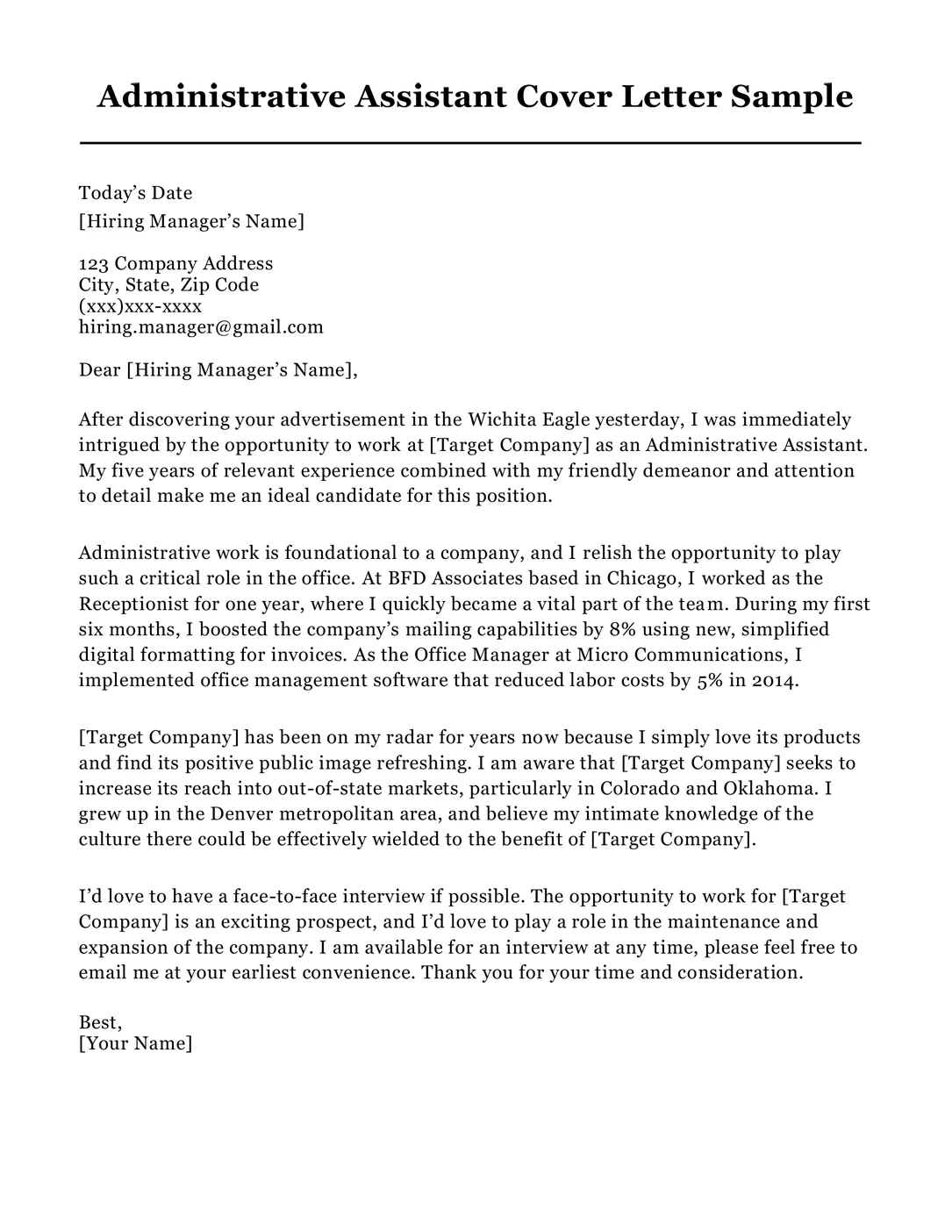
Understanding the Importance of a Cover Letter
In the competitive job market, especially for administrative assistant roles, a well-crafted cover letter is your first impression. It’s your chance to introduce yourself, highlight your relevant skills, and express your enthusiasm for the position. Unlike a resume, which provides a summary of your experience, a cover letter allows you to tell a story, connecting your qualifications to the specific needs of the employer. Ignoring this crucial step could mean missing out on opportunities, as many hiring managers use cover letters to screen candidates.
Why a Cover Letter is Essential
A cover letter serves several vital purposes beyond simply introducing your resume. It allows you to showcase your personality, writing skills, and communication style, all of which are critical for an administrative assistant. It demonstrates your genuine interest in the company and the specific role, which sets you apart from applicants who might be sending out generic applications. Furthermore, a cover letter provides an opportunity to explain any gaps in your employment history or address any potential concerns an employer might have. It’s your chance to proactively manage the narrative and put your best foot forward. For example, If you’ve taken a career break, a cover letter is a place to address it.
Highlighting Your Skills and Experience

The most effective cover letters highlight your skills and experience in a way that’s relevant to the job description. Administrative assistant roles require a diverse set of skills, including strong organizational abilities, excellent communication skills (both written and verbal), proficiency in various software applications (such as Microsoft Office Suite), and the ability to multitask effectively. Your cover letter should explicitly mention these skills and provide specific examples of how you’ve utilized them in previous roles to achieve positive outcomes. Quantify your accomplishments whenever possible; for example, instead of saying you ‘managed schedules’, state that you ‘managed the schedules of a team of 10 professionals, resulting in a 15% increase in meeting efficiency’.
Key Elements to Include in Your Cover Letter
A well-structured cover letter includes several essential components that work together to create a compelling narrative. These elements, when combined, present you as a complete and qualified candidate. Failing to include any of these elements might render your cover letter incomplete, potentially lowering your chances of receiving an interview. Pay close attention to each element to craft a cover letter that will stand out from the competition.
Contact Information
At the top of your cover letter, provide your full name, phone number, email address, and optionally, your LinkedIn profile URL. This information ensures that the hiring manager can easily reach you if they are interested in scheduling an interview. Make sure your email address is professional and appropriate.
Professional Greeting

Address the hiring manager by name, if possible. Research the company or check the job posting to find the name of the hiring manager or recruiter. If you can’t find a specific name, use a professional greeting such as “Dear Hiring Manager” or “Dear [Department Name] Team.” Avoid generic greetings such as “To Whom It May Concern,” which can make your application seem impersonal.
Opening Paragraph
Start with a strong opening that grabs the reader’s attention and clearly states the position you’re applying for. Briefly mention where you saw the job posting and why you’re interested in the role and the company. Highlight one or two key skills or experiences that make you a strong fit for the position. This is your elevator pitch, so make it count. Your goal is to immediately capture the reader’s interest and encourage them to continue reading.
Body Paragraphs
The body paragraphs are where you provide more detail about your qualifications and accomplishments. Use this space to elaborate on the skills and experiences mentioned in your opening paragraph and showcase how they align with the job requirements. Provide specific examples of your achievements and quantify them whenever possible. For instance, instead of saying ‘Improved office efficiency,’ state ‘Streamlined office processes, resulting in a 20% reduction in administrative overhead.’ The goal is to demonstrate your value and how you can contribute to the company’s success.
Highlight Relevant Skills

Administrative assistant roles require various skills, including communication, organization, time management, and technical proficiency. When describing these skills, provide concrete examples of how you’ve used them in past roles. For example, if you’re highlighting your communication skills, mention how you effectively communicated with clients or colleagues, resolved conflicts, or prepared professional correspondence. Tailor the skills you highlight to match the specific requirements mentioned in the job description.
Showcase Achievements
Focus on your achievements rather than just listing your responsibilities. Use the STAR method (Situation, Task, Action, Result) to describe your accomplishments in a clear and concise manner. For example, ‘In a previous role, I identified an inefficient filing system (Situation). I was tasked with reorganizing the files (Task). I implemented a new digital filing system (Action), which led to a 30% reduction in time spent retrieving documents (Result).’ This approach makes your achievements more impactful and demonstrates your ability to deliver results.
Closing Paragraph
In your closing paragraph, reiterate your interest in the position and the company. Express your enthusiasm for the opportunity to contribute to their team. Thank the hiring manager for their time and consideration. Provide a call to action, such as stating that you look forward to hearing from them soon or that you are available for an interview at their earliest convenience.
Express Gratitude

Always express your gratitude for the hiring manager’s time and consideration. A simple ‘Thank you for your time and consideration’ is sufficient. This shows respect and professionalism and leaves a positive final impression.
Call to Action
End with a clear call to action. This could be as simple as stating that you are available for an interview at their earliest convenience or reiterating your interest in the position. A strong call to action encourages the hiring manager to take the next step.
Top 5 Admin Assistant Cover Letter Templates
Choosing the right cover letter template can significantly impact your chances of success. Here are five different templates, each designed to highlight your strengths and align with different job application strategies. Feel free to adapt these templates to meet your specific needs.
Template 1 The Traditional Approach

This template is the most formal and suitable for conservative industries or companies. It follows a standard business letter format, with clear and concise language. It emphasizes your experience and qualifications in a straightforward manner. Include your contact information, the date, the hiring manager’s name and title, and the company’s address. The body should start with a statement of purpose, followed by paragraphs detailing your relevant experience and skills. End with a polite closing and a formal signature. This template is ideal for those who want to convey professionalism and experience. (See admin-cover-letter-traditional.webp)
Template 2 The Skills-Focused Template
If you have specific skills that align directly with the job description, this template is for you. It emphasizes those skills in the body of the letter. Start by mentioning the position you’re applying for and where you found the job posting. Use separate paragraphs to highlight your key skills and provide examples of how you have used these skills in previous roles. The skills-focused template is excellent for applicants with a specific set of skills. (See admin-cover-letter-skills-focused.webp)
Template 3 The Achievement-Oriented Template
This template focuses on your accomplishments rather than just listing your responsibilities. Use the STAR method to describe your achievements, highlighting the situation, task, action, and result. Begin by stating the position you’re seeking and your interest in the company. Then, use paragraphs to describe your achievements, quantifying your successes whenever possible. Close with a statement of your interest and a call to action. This template is useful for demonstrating your impact and value. (See admin-cover-letter-achievements.webp)
Template 4 The Customized Template

This template is all about tailoring your cover letter to a specific job and company. Research the company and tailor your letter to show that you understand their needs. Mention specific projects or initiatives you admire and how your skills can contribute. This is perfect for showing that you’re truly interested in the company and the role. Begin by addressing the hiring manager by name (if possible). Highlight specific aspects of the job description and explain how your skills and experience make you an ideal candidate. Demonstrate your understanding of the company’s values and mission. This template is ideal for demonstrating genuine interest. (See admin-cover-letter-customized.webp)
Template 5 The Modern & Concise Template
This template is designed for efficiency, making it ideal for busy hiring managers. Use a clean font and formatting, and keep the language clear and concise. State the position you’re applying for, your interest in the company, and a brief overview of your skills and experience. Use bullet points to highlight key achievements or skills. End with a call to action and contact information. This template is excellent for making a quick and positive impression. (See admin-cover-letter-formatting.webp)
Tailoring Your Cover Letter to the Job Description
To make your cover letter as effective as possible, carefully tailor it to the specific job description. This involves analyzing the requirements, matching your skills and experience to those requirements, and using the right keywords to get your cover letter noticed. Tailoring your cover letter will significantly increase your chances of being selected for an interview. Always customize your cover letter to match each individual job application.
Analyzing the Job Requirements

Thoroughly read the job description to understand the specific requirements, skills, and qualifications the employer is seeking. Identify the key responsibilities and the desired qualities of the ideal candidate. Pay close attention to the language used in the job description to understand the company’s priorities and values. Make a list of the most important skills and experiences that the employer is looking for. This analysis will guide you in highlighting the most relevant information in your cover letter.
Matching Skills with Requirements
Once you’ve analyzed the job description, match your skills and experience to the requirements. Identify the areas where your qualifications align with the employer’s needs. Use the same keywords and phrases from the job description in your cover letter to show that you’re a good fit. Provide specific examples of how you have used your skills in the past to achieve positive outcomes. Tailor your cover letter to address the specific requirements of the job, highlighting the most relevant skills and experiences. This targeted approach will make your cover letter stand out.
Formatting and Design Best Practices
The formatting and design of your cover letter are just as important as the content. A well-formatted cover letter is easy to read and visually appealing, which increases the chances that a hiring manager will actually read it. Poor formatting can detract from your message and make you appear unprofessional. Ensure your cover letter reflects your attention to detail and commitment to presenting a polished professional image.
Font and Readability
Choose a professional and easy-to-read font, such as Times New Roman, Arial, or Calibri. Use a font size between 10 and 12 points to ensure readability. Avoid using overly decorative fonts or fonts that are difficult to read. Use consistent formatting throughout your cover letter, including the font, font size, and spacing. This will make your cover letter appear neat and professional. Poor formatting can deter a hiring manager. (See admin-cover-letter-formatting.webp)
Layout and Structure
Use a clear and logical layout with adequate white space to enhance readability. Use standard business letter format, with your contact information at the top, followed by the date, the hiring manager’s name, and the company’s address. Divide your cover letter into clear sections, such as an opening paragraph, body paragraphs highlighting your skills and experience, and a closing paragraph. Use headings and bullet points to break up large blocks of text and make it easier for the reader to scan the document. A well-structured layout will guide the reader through your qualifications and make a positive impression. Make sure your cover letter can be easily read at a glance. (See admin-cover-letter-formatting.webp)
Proofreading and Editing Your Cover Letter
Before submitting your cover letter, carefully proofread and edit it to eliminate any errors. Errors in your cover letter can undermine your credibility and make you appear unprofessional. Taking the time to proofread and edit your cover letter is essential. Ask someone else to review your cover letter. A fresh pair of eyes can catch errors that you might miss. Also, consider reading your cover letter aloud to help identify any awkward phrasing or grammatical errors. A polished cover letter demonstrates your attention to detail and professionalism.
Common Mistakes to Avoid
Be aware of common mistakes that can negatively impact your cover letter. Avoid these errors to ensure that your cover letter effectively presents your qualifications.
Grammar and Spelling Errors
Proofread your cover letter carefully to avoid grammar and spelling errors. Use spell-check and grammar-check tools, but don’t rely on them completely. A mistake can make you appear careless and unprofessional. Errors can give the wrong impression and hinder your chances of getting an interview. Ensure your cover letter is free of errors. (See admin-cover-letter-proofreading.webp)
Generic Content
Avoid using a generic cover letter that is not tailored to the specific job or company. Customize your cover letter to show that you understand the employer’s needs and have researched the company. Generic cover letters fail to make a strong impression, indicating a lack of effort and interest. Your cover letter must be unique and tailored to the job. Show the hiring manager that you understand the job and the company. Tailor your cover letter to show that you understand the needs and priorities of the company. (See admin-cover-letter-writing.webp)
Conclusion Recapping the Importance of a Strong Cover Letter
In conclusion, a well-crafted cover letter is essential for securing an administrative assistant position. It’s your opportunity to make a strong first impression, highlight your relevant skills and experience, and demonstrate your enthusiasm for the role. By following the guidelines and examples provided, you can create a cover letter that will make you stand out from the competition and increase your chances of landing an interview. Remember to tailor your cover letter to each job description and carefully proofread it before submitting your application. Your cover letter is often the first impression you make on a potential employer, so it is worth taking the time to ensure it is well-written, professional, and tailored to the specific job. (See admin-cover-letter-writing.webp)