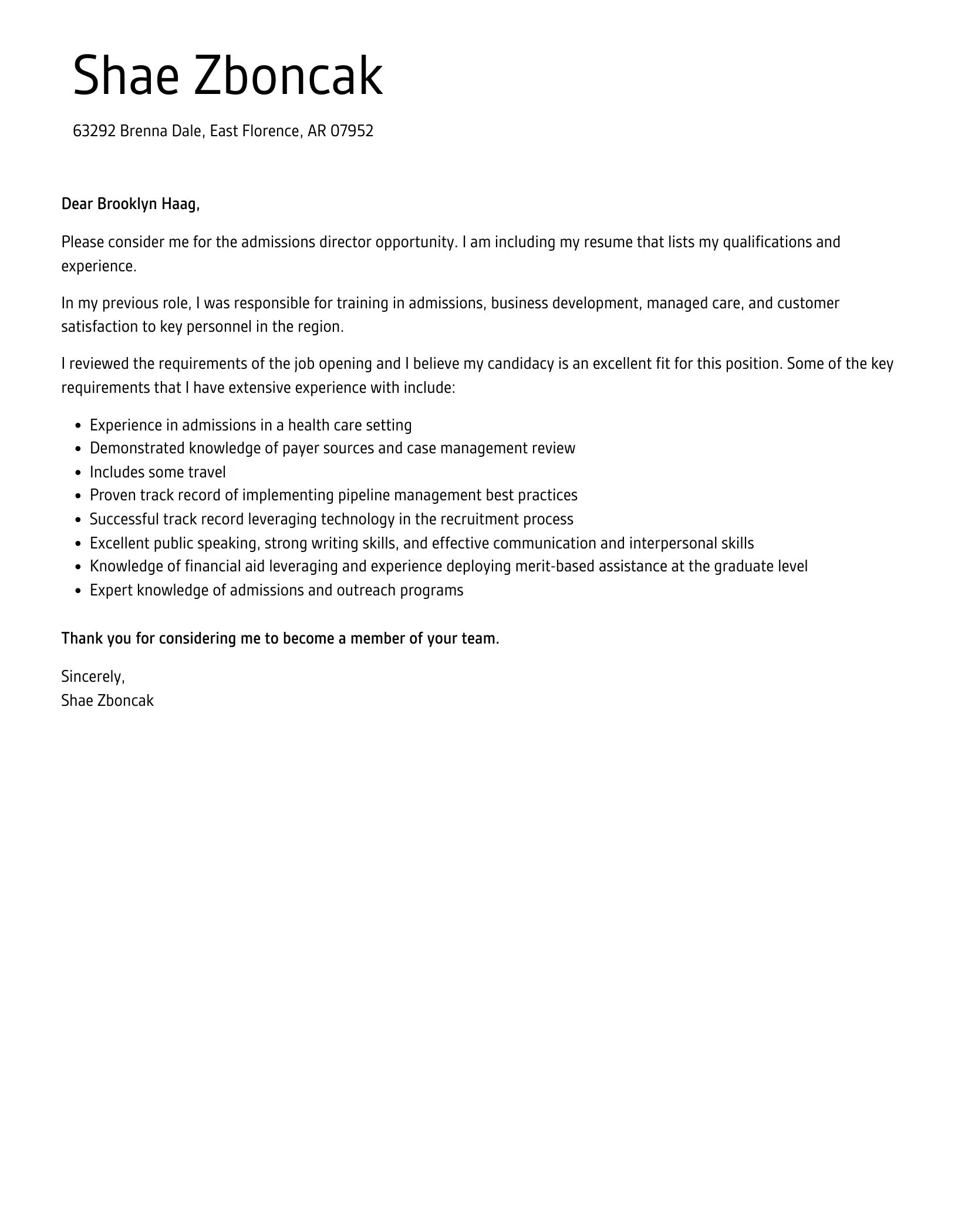
Key Elements of a Strong Cover Letter
A compelling cover letter is your first opportunity to make a strong impression on an Admissions Director. It serves as a vital introduction to your application, providing context and personality that a resume alone cannot convey. The most important elements include a professional salutation addressing the specific director if possible, a concise yet engaging introduction that immediately grabs attention, a body that showcases your relevant experiences and skills, and a compelling conclusion that reiterates your enthusiasm and invites further consideration. Remember to highlight your achievements with quantifiable results whenever possible, demonstrating the impact of your previous roles. Ensure your letter adheres to a professional tone, free from jargon or casual language. This careful approach shows attention to detail and a genuine interest in the opportunity.
Formatting Your Cover Letter for Admissions Directors
Proper formatting can significantly impact the readability and professionalism of your cover letter. Adhere to standard business letter formats with a clear, concise layout. Begin with your contact information, followed by the date and the Admissions Director’s details. Use a professional font like Times New Roman, Arial, or Calibri, and maintain a font size between 10 and 12 points for optimal readability. Ensure consistent spacing throughout the document. Employ short paragraphs and bullet points to break up large blocks of text, making it easier for the reader to digest information quickly. Be mindful of the length; aim for a single page, as Admissions Directors are often overwhelmed with applications. The layout and organization of your cover letter are as critical as the content, illustrating your attention to detail and organizational skills.
Personalize Your Cover Letter for Success

Generic cover letters are easily identifiable and often lead to immediate rejection. Personalization is a key component of a successful cover letter. Research the institution, the Admissions Director, and the specific role to tailor your letter. Show that you understand the institution’s values, mission, and recent initiatives. Mention specific programs, events, or initiatives that resonate with your goals and demonstrate your genuine interest. When possible, address the letter to the individual hiring manager or Admissions Director by name. This personalized approach highlights your dedication and initiative, setting you apart from other applicants who submit generic templates. The effort you put into personalization demonstrates that you are not just seeking any job but are specifically interested in this opportunity and institution.
Highlight Relevant Experiences and Skills
Your cover letter is the perfect place to elaborate on your relevant experiences and skills. Focus on experiences that align with the requirements of the Admissions Director role. Showcase achievements, using action verbs to describe your responsibilities and accomplishments. Quantify your achievements whenever possible; for example, ‘Increased application processing efficiency by 20%’ or ‘Managed a team of five admissions counselors.’ Highlight skills such as leadership, communication, data analysis, problem-solving, and any specific experience with admissions software or systems. Tailor the examples to match the institution’s needs and the job description. This detailed explanation gives the Admissions Director a clear picture of your capabilities and how you can contribute to their team’s success.
Demonstrating Your Passion for Education
Admissions Directors are seeking individuals who genuinely care about education and student success. Use your cover letter to convey your passion for education and your commitment to the institution’s mission. Share personal anecdotes, experiences, or philosophies that illustrate your dedication to fostering an inclusive, supportive learning environment. Mention your understanding of the challenges and rewards of higher education and your alignment with the institution’s values. Express your desire to contribute to the success of students and the institution. Your enthusiasm for education is infectious, and demonstrating this in your cover letter will help you connect with the Admissions Director on a deeper level, showing that you are not just qualified, but also a great fit for the institution.
Showcasing Your Communication Abilities

Strong communication skills are crucial for an Admissions Director. Your cover letter should be a showcase of your written communication abilities. Ensure that the letter is well-written, concise, and easy to understand. Use proper grammar, punctuation, and spelling. Vary your sentence structure and tone to maintain the reader’s interest. The clarity and professionalism of your letter will directly reflect your ability to communicate effectively with prospective students, parents, and other stakeholders. Pay careful attention to the tone of your letter; maintain a professional yet engaging approach. Demonstrate your written communication prowess, as it is an essential skill for success in an Admissions Director role, and your cover letter is your first opportunity to demonstrate it.
Proofreading and Editing for Perfection
Before submitting your cover letter, proofread and edit it meticulously. Errors, no matter how small, can undermine your credibility. Use grammar and spell-check tools, but also read the letter aloud to catch any awkward phrasing or errors that might be missed visually. Ask a trusted friend or colleague to review your cover letter for a second opinion. They might identify things you have overlooked. Verify all the details, including the Admissions Director’s name, the institution’s name, and the job title. Ensure that your contact information is correct and up-to-date. A flawless cover letter demonstrates your attention to detail, a critical quality for an Admissions Director. This final review step is essential for presenting yourself as a polished and professional candidate. The perfect cover letter shows respect and professionalism.