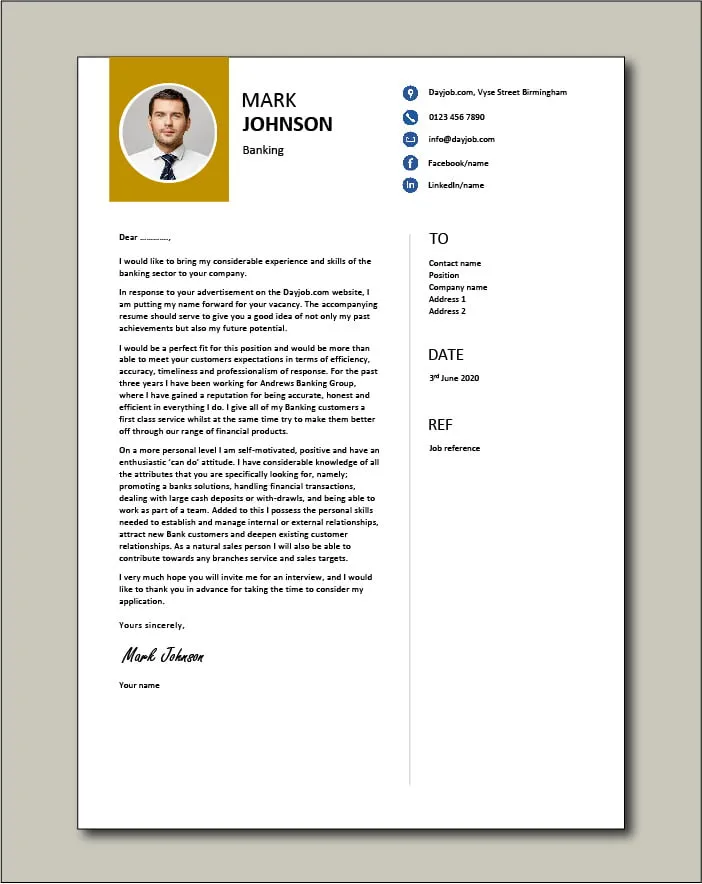
What is a Bank Job Cover Letter?
A bank job cover letter is a crucial document accompanying your resume when applying for a position within a financial institution. It serves as your first introduction to the hiring manager, providing an opportunity to showcase your personality, skills, and qualifications in a way that a resume alone cannot. This letter allows you to elaborate on your relevant experiences, demonstrate your understanding of the bank’s values and the specific role, and express your enthusiasm for the opportunity. A well-crafted cover letter is essential for making a positive first impression and increasing your chances of securing an interview. It’s your chance to highlight why you’re the perfect fit and what unique contributions you can bring to the table. It is a sales pitch aimed at convincing the recruiter that you are the ideal candidate.
Why is a Cover Letter Important?
In the competitive world of banking, a cover letter is more than just a formality it’s a strategic tool. It allows you to personalize your application, demonstrating that you’ve taken the time to understand the specific job and the bank’s culture. It allows you to connect your experiences and skills directly to the job requirements, making it clear how you can add value to the team. A well-written cover letter also reveals your communication skills, attention to detail, and professionalism, all of which are highly valued in the banking sector. While a resume provides a snapshot of your professional history, a cover letter tells the story of who you are and why you are the best fit for the role, increasing your chances of standing out from other applicants. It is often the deciding factor when comparing otherwise similar candidates.
Key Components of a Bank Job Cover Letter

A successful bank job cover letter comprises several key components, each serving a specific purpose. It must be properly formatted and clearly written. A well-structured letter will guide the reader through your qualifications and motivations logically. Starting with your contact information and the recipient’s details sets the stage, followed by a compelling opening paragraph that grabs the reader’s attention. The body of the letter should highlight your relevant skills and experiences, quantifying your achievements whenever possible. Conclude with a strong closing paragraph that reiterates your interest and includes a call to action. Each element plays a vital role in presenting a polished and persuasive application.
Your Contact Information
At the top of your cover letter, begin with your contact information. This typically includes your full name, address, phone number, and email address. Ensure that your email address is professional (e.g., your.name@email.com) and that your phone number is readily available for contact. This information allows the hiring manager to easily reach you if they wish to schedule an interview or request additional details. Make certain all of your information is accurate and up to date. Use a simple, clear font and formatting for easy readability.
Date
Directly below your contact information, include the date on which you are sending the cover letter. This helps the reader quickly understand when the application was submitted. The date also helps in record-keeping within the bank’s human resources department. The standard format for the date is typically month, day, and year, or month/day/year. Consistency in formatting is essential for maintaining a professional appearance. Ensure the date is aligned with the rest of your contact information, maintaining a clean and structured look. Use the current date for your submission.
Recipient’s Information

Following the date, you should include the recipient’s information. Ideally, you’ll address the letter to the hiring manager or the specific person responsible for reviewing applications. If possible, research and find out the hiring manager’s name. Address the letter by name if you can. If you are unable to find a specific name, you can use a general title, such as “Hiring Manager.” Including the recipient’s name shows that you have taken the time to personalize your application, demonstrating your interest and attention to detail. This part of the letter enhances the professional tone and makes a positive impression.
Salutation
The salutation is your formal greeting. If you know the hiring manager’s name, use “Dear Mr./Ms. [Last Name].” If you don’t know the name, use “Dear Hiring Manager.” Avoid generic salutations like “To Whom It May Concern.” A personalized salutation immediately captures the reader’s attention and indicates you have researched the role and the company. This opening sets the tone for your cover letter, communicating your respect and professionalism. Ensure you spell the name correctly. This is crucial for demonstrating your attention to detail.
The Opening Paragraph
Your opening paragraph should immediately capture the reader’s attention. State the position you’re applying for and where you saw the job posting. Briefly mention why you are interested in the role and the bank. Your goal is to create a compelling first impression, conveying your enthusiasm and highlighting your key qualifications. Keep it concise and focused, setting the tone for the rest of your cover letter. This introduction should intrigue the reader, encouraging them to continue reading. Use strong, active verbs to showcase your engagement with the role. Make it clear that you have taken the time to understand the requirements and the company’s mission.
Highlighting Your Skills and Experience

In the body of your cover letter, focus on highlighting your skills and experiences relevant to the bank job you are applying for. Provide specific examples of your accomplishments and skills. Describe how your skills and experiences align with the job requirements, using the job description as a guide. The purpose is to demonstrate your competence and suitability for the position. This section allows you to delve deeper into your background, showing how your past experiences have prepared you for the new role. Make a clear connection between your abilities and the needs of the bank. Tailor this section to each specific job.
Quantifiable Achievements
Whenever possible, quantify your achievements to make your accomplishments more impactful. Instead of saying “I improved customer service,” say “I increased customer satisfaction scores by 15%.” Use numbers, percentages, and specific data to demonstrate the tangible results you have achieved in previous roles. Quantifiable achievements provide concrete evidence of your skills and abilities. This is a way to show you’re not just stating what you did but also the positive impact you had. Quantifiable results make your application more compelling and memorable. Including quantifiable achievements increases your credibility. Show specific results.
Tailoring to the Specific Bank and Position
Customize your cover letter for each bank job application. Tailor the content to match the specific requirements of the position and the values of the bank. Research the bank’s mission, values, and culture, and incorporate these elements into your letter. Show that you understand the bank’s specific goals and how you can contribute to them. This shows the hiring manager that you’ve put in the effort to learn about the bank. Avoid using a generic cover letter; instead, personalize each one. It helps demonstrate your genuine interest in the role and the bank. This can include mentioning recent news or company initiatives, showing you pay attention to the industry.
Demonstrating Knowledge of the Bank

Show your knowledge of the bank by mentioning its services, recent achievements, or community involvement. This research demonstrates your genuine interest in the bank and your desire to work there. Refer to specific bank initiatives or programs that resonate with your values. Mentioning a specific bank initiative shows that you have researched the bank and are genuinely interested in working with them. This knowledge sets you apart from applicants who submit generic letters. Research the bank’s website and recent news to gain insights into their operations and values. Show your understanding of the bank’s market position.
Expressing Enthusiasm for the Role
Throughout your cover letter, express your enthusiasm for the role and the opportunity to work at the bank. Convey your passion for the banking industry and your eagerness to contribute. Show your excitement by using enthusiastic language and positive statements about the role and the bank’s mission. Demonstrate your interest in learning and growing within the company. This will make a positive impression and will give the hiring manager the idea that you are genuinely excited about the opportunity. Emphasize how the role aligns with your career goals. This passion will increase your chances of securing an interview.
The Closing Paragraph
Your closing paragraph should summarize your key qualifications and reiterate your interest in the position. Thank the hiring manager for their time and consideration. Restate your enthusiasm for the role, and leave the reader with a strong, positive impression. This is your final chance to convince the hiring manager that you are the right person for the job. The closing paragraph offers a concise recap of the value you bring to the table. This concluding statement reinforces your qualifications and shows appreciation for the time spent reviewing your application.
Call to Action

Include a clear call to action in your closing paragraph. Indicate your availability for an interview and provide your contact information again. This encourages the hiring manager to take the next step in the hiring process. Clearly state your availability to meet and discuss your qualifications. Provide your phone number and email address. This easy next step increases the likelihood of a quick response. This demonstrates initiative and interest.
Formal Closing and Signature
Use a formal closing, such as “Sincerely,” or “Best regards,” followed by your typed name. If you are submitting a printed cover letter, leave space for your handwritten signature above your typed name. This formal closing adds to the professional tone of your letter. It shows respect for the recipient. Always sign off with a professional closing. This adds a personal touch while maintaining professionalism. Ensure your name is clearly visible.
Proofreading and Editing
Before submitting your cover letter, carefully proofread and edit your work. Check for grammatical errors, typos, and any inconsistencies. Ensure your cover letter is free from errors. A polished cover letter reflects your attention to detail and professionalism. Ask a friend or family member to review your letter for a second opinion. Reading aloud can help you catch errors. Proofreading is an essential step in making sure your cover letter stands out. This will ensure a flawless and professional presentation.
Common Mistakes to Avoid

Avoid common mistakes that can damage your application. Do not use generic cover letters. Never send a cover letter full of typos or grammatical errors. Do not include irrelevant information that does not relate to the job description. Steer clear of exaggerating your skills or lying about your experience. Avoid sounding too casual or informal. Also, do not include a salary expectation unless requested. Make sure to research the bank thoroughly before applying. Avoid negative comments about previous employers.
Formatting Guidelines
Follow standard formatting guidelines to create a professional-looking cover letter. Use a clear and easy-to-read font, such as Times New Roman or Arial, size 11 or 12. Keep your cover letter to one page in length. Use single spacing within paragraphs and double spacing between paragraphs. Use standard margins (1 inch on all sides). Ensure proper alignment and spacing. Maintain consistency throughout the document. A well-formatted cover letter is professional and readable.
Example Cover Letter Snippets
Here are a few example snippets you can use to get started. “I am writing to express my keen interest in the [Job Title] position at [Bank Name], as advertised on [Platform].” “With my proven track record in [relevant skill], I am confident I can make a significant contribution to your team.” “I was particularly drawn to [Bank Name] because of [specific reason], and I am eager to contribute to your mission.” “My experience in [relevant area] has equipped me with the skills to excel in this role.” Tailor these snippets to your specific experience and the job requirements. Use these as a starting point to draft your personalized cover letter. Modify these examples to reflect your own skills and experiences.
Cover Letter for Entry-Level Bank Positions
For entry-level bank positions, highlight your education, any relevant coursework, and any internships or volunteer experiences. Emphasize your skills, such as customer service, communication, and attention to detail. Mention any certifications or training programs you have completed. Showcase your enthusiasm and willingness to learn and grow in the banking industry. Focus on demonstrating your potential. Show your transferable skills that can be used within the banking industry. Mention any relevant projects, volunteer work, or extracurricular activities. Be sure to highlight your interpersonal skills and your eagerness to build a career in banking. “I am confident I can excel in this role because of my strong work ethic and eagerness to learn”.
Cover Letter for Experienced Bank Professionals
For experienced bank professionals, focus on your accomplishments and results. Quantify your achievements with specific numbers and data. Highlight your leadership experience and your ability to manage teams. Mention any specific projects or initiatives you have led that have benefited your previous employers. Focus on how you can add value to the bank immediately. Showcase your expertise in banking operations, sales, or management. Demonstrate how your experience has prepared you for the role. Highlight your skills. Be sure to mention your professional experiences in relevant areas. “My experience in managing complex projects and building strong client relationships has equipped me to excel in this role”.