Understanding the Career Change Cover Letter
Embarking on a career change can be both exciting and daunting. One of the most critical tools in your job-seeking arsenal is the cover letter, especially when you lack direct experience in your desired field. A career change cover letter is your opportunity to articulate your reasons for the transition, highlight transferable skills, and demonstrate your enthusiasm and suitability for the role. It’s not just a formality; it’s a strategic document that can significantly increase your chances of landing an interview. This guide will walk you through the essential steps to crafting a compelling cover letter that effectively communicates your potential to prospective employers, even without direct experience.
Why a Cover Letter is Crucial for Career Change
In a career change scenario, a cover letter plays a vital role that goes beyond a typical job application. It serves as your primary vehicle to explain your transition and address any gaps in your experience. It allows you to contextualize your background, showcase transferable skills, and articulate your motivations for the career shift. Employers often seek candidates who are adaptable, and a well-written cover letter provides evidence of your adaptability and commitment. Without a strong cover letter, you might miss the opportunity to present your value proposition and be overlooked in favor of candidates with more conventional experience. The cover letter provides the space to tell your story, which the resume may not allow.
Highlighting Transferable Skills

Transferable skills are the bedrock of a successful career change cover letter. These are skills you’ve acquired in previous roles, education, volunteer work, or personal projects that are applicable to the new role. They bridge the experience gap and demonstrate your capacity to perform the job. Identifying these skills is the first step in crafting a compelling narrative. Focus on skills that align with the job description’s requirements to show the employer you’ve done your homework. Transferable skills make up for the lack of direct experience and provide the foundation of your career change.
Identifying Your Transferable Skills
To identify your transferable skills, start by making a comprehensive list of all the skills you’ve developed. Consider skills like communication, problem-solving, time management, leadership, teamwork, and technical skills. Review the job description for your target role and pinpoint the skills that are most relevant. Match your existing skills to the job requirements to find the common ground, then categorize your skills based on relevance, this process will help you tailor your cover letter and present yourself as the best fit.
Showcasing Skills with Examples
Once you’ve identified your transferable skills, provide specific examples of how you’ve used them. Use the STAR method (Situation, Task, Action, Result) to illustrate your skills. For example, instead of simply stating that you’re a good communicator, describe a situation where you used your communication skills to achieve a specific outcome. Quantify your achievements whenever possible. For example, state that your communication skills led to a 20% increase in team efficiency. Providing concrete examples makes your claims more believable and demonstrates your abilities in action.
Addressing the Lack of Direct Experience

The elephant in the room when changing careers is the lack of direct experience. Acknowledge this proactively in your cover letter without dwelling on it. Frame it positively by explaining why you’re making the career change and how your transferable skills and enthusiasm will enable you to quickly get up to speed. Focus on your willingness to learn, your adaptability, and your eagerness to contribute. This approach helps shift the employer’s focus from what you haven’t done to what you can do. Be upfront but positive and don’t apologize for not having direct experience, instead, position yourself as a motivated learner ready to tackle a new challenge.
Emphasizing Your Motivation and Enthusiasm
Your motivation and enthusiasm can be the most compelling parts of your career change cover letter. Explain why you’re interested in the new field and company. Show genuine excitement for the opportunity and demonstrate that you have researched the role and the company. Passion can be contagious, and employers want to hire people who are genuinely interested in their work. Highlight any relevant projects, courses, or personal experiences that demonstrate your dedication. Conveying your passion is essential for making a memorable impression and convincing the employer to take a chance on you, even without direct experience. Make your cover letter a reflection of your excitement.
Researching the Target Role and Company
Before you start writing your cover letter, thorough research is essential. Understand the specific requirements of the role and the values of the company. Tailor your cover letter to address these specifics. Look at the company’s website, social media profiles, and recent news articles to learn more about its mission, culture, and recent projects. Use the job description as a blueprint to identify the key skills and qualifications the employer is seeking. This research will allow you to address the employer’s needs and show that you have a real interest in the position and the company.
Demonstrating Your Understanding of the Role

Demonstrate your understanding of the role by aligning your skills and experience with the requirements outlined in the job description. Explain how your transferable skills apply to the tasks and responsibilities of the position. Highlight any relevant projects, coursework, or volunteer experiences that showcase your abilities. Use keywords from the job description to ensure your cover letter aligns with the employer’s expectations. Providing specific examples and quantifiable achievements proves your ability to contribute to the company’s goals.
Tailoring Your Cover Letter to Each Application
Generic cover letters are easily spotted and are often discarded. Each cover letter must be tailored to the specific job and company. Customize your cover letter to reflect the requirements and values of each employer. This requires more time and effort but greatly increases your chances of success. Review the job description carefully and incorporate relevant keywords. Mention the company by name and show you understand its mission and goals. Demonstrating that you have taken the time to research the company and the role will make your application stand out.
Structuring Your Career Change Cover Letter
A well-structured cover letter is easy to read and highlights your most important qualifications. Follow a standard business letter format. Your letter should include an introduction, body paragraphs, and a conclusion. Each section should serve a clear purpose and contribute to your overall message. A logical and organized structure will make your cover letter more impactful and demonstrate your attention to detail and professionalism.
Formatting Your Cover Letter Professionally

Professional formatting is essential. Use a readable font like Times New Roman, Arial, or Calibri in a size between 10 and 12 points. Ensure your cover letter is well-spaced, with consistent margins and alignment. Avoid overly creative fonts or designs. Keep your cover letter to one page. A clean and professional layout enhances readability and reflects your professionalism. Proofread the document to eliminate any formatting errors.
Writing a Compelling Opening Paragraph
The opening paragraph is your first opportunity to capture the reader’s attention. Start with a strong hook that introduces your enthusiasm for the role or company. Briefly state the position you are applying for and how you learned about it. Clearly state your career change and explain why you are making the transition, if applicable. Make it clear from the start what you want to achieve. This paragraph should set the tone for the rest of the letter and encourage the reader to continue.
Crafting the Body Paragraphs Effectively
The body paragraphs are the core of your cover letter, where you present your qualifications and skills. Use these paragraphs to elaborate on your transferable skills and provide specific examples of your achievements. Use the STAR method to describe situations, tasks, actions, and results. Quantify your achievements whenever possible to demonstrate the impact of your skills. Highlight any relevant experiences or projects that align with the job requirements. Connect your past experiences with the new role, showing how you can apply your skills to be successful.
Creating a Strong Closing Paragraph

Your closing paragraph should summarize your key qualifications and reiterate your interest in the position. Reiterate your enthusiasm for the role and the company. Thank the hiring manager for their time and consideration. End with a call to action, indicating your availability for an interview and your willingness to discuss your qualifications further. A strong close leaves a lasting impression and encourages the hiring manager to take the next step.
Including a Call to Action
A call to action is a crucial element of your closing paragraph. It tells the employer what you want them to do next. Examples of a good call to action include expressing your interest in an interview, stating your availability to discuss your qualifications, and thanking the hiring manager for their time and consideration. Make it clear that you are eager to take the next step in the hiring process and that you are available to discuss the position further.
Showcasing Your Accomplishments and Achievements
Focusing on your accomplishments is vital when changing careers. Instead of simply listing your responsibilities in previous roles, highlight what you achieved. Use action verbs to describe your accomplishments and quantify your results whenever possible. Demonstrating tangible achievements is a powerful way to convince the hiring manager of your abilities. Your achievements are the best proof of your ability to perform well in the new role.
Quantifying Your Achievements Whenever Possible
Quantifying your achievements makes your claims more credible and helps employers understand the impact of your work. Use numbers, percentages, and specific data to illustrate your accomplishments. For example, instead of saying you improved customer service, say you increased customer satisfaction by 20% or reduced customer complaints by 15%. Providing concrete data makes your accomplishments more impactful and shows the potential you can deliver in the new role.
Providing Relevant Examples
Use examples from your past experiences to support your claims and demonstrate your skills. Use the STAR method (Situation, Task, Action, Result) to provide context for your achievements. Describe a situation where you faced a challenge, the task you were assigned, the actions you took, and the results you achieved. Select examples that are relevant to the target role and highlight the skills and experience that will make you a valuable asset to the company. These examples help you to give substance to your claims.
Proofreading and Editing Your Cover Letter
Proofreading and editing are essential steps in the cover letter writing process. Errors in grammar, spelling, or punctuation can create a negative impression and undermine your credibility. Take the time to carefully review your cover letter for any mistakes. Use a grammar checker and spell checker. Proofread the document multiple times and get feedback from others.
Checking for Grammar and Spelling Errors
Carefully check your cover letter for any grammatical and spelling errors. Use online tools like Grammarly or Microsoft Word’s spell checker, but don’t rely on them completely. Read your cover letter aloud to catch any awkward phrasing or errors. Pay special attention to commonly misspelled words. Small mistakes can distract from your message, so take the time to make sure your cover letter is polished and professional.
Getting Feedback on Your Cover Letter
Ask a trusted friend, family member, or career counselor to review your cover letter. Get feedback on its clarity, structure, and overall impact. Ask them if your qualifications are clear and if your enthusiasm for the role is apparent. Another perspective can help identify areas for improvement that you might have missed. Consider the feedback and make revisions to your cover letter based on the suggestions. This is an essential step in improving your cover letter.
Common Mistakes to Avoid in Career Change Cover Letters
Several common mistakes can diminish the effectiveness of your cover letter. Being aware of these pitfalls can help you avoid them. Avoid using a generic template, as it suggests you haven’t taken the time to tailor your application. Don’t focus on what you lack. Instead, focus on what you can offer. Also, avoid rambling or using jargon and clichés. A well-crafted cover letter requires avoiding some common missteps.
Focusing on What You Can Offer
Rather than dwelling on your lack of direct experience, focus on what you can bring to the table. Highlight your transferable skills, your enthusiasm, and your willingness to learn. Emphasize your accomplishments and the value you can provide to the company. Shift the focus from your past to your future contributions. This approach positions you as a capable candidate, ready to contribute from day one.
Not Addressing the Career Change Directly
Avoid avoiding your career change. Procrastination is the thief of time. Not addressing it head-on can create uncertainty and confusion for the hiring manager. Acknowledge your career change, explain your reasons for the shift, and highlight your commitment to your new field. Being transparent and honest builds trust and shows that you’re prepared to make a new commitment. Be upfront about your career change, and use it as a strength to showcase your dedication.
Using Generic Cover Letters
Using a generic cover letter is a surefire way to get your application overlooked. Recruiters want to see that you’ve invested time and effort in tailoring your application to their specific needs. Customize each cover letter to the specific role and company. Address the hiring manager by name, if possible. Research the company, and mention its mission, values, and recent projects. Tailoring your cover letter demonstrates your genuine interest and makes your application more memorable.
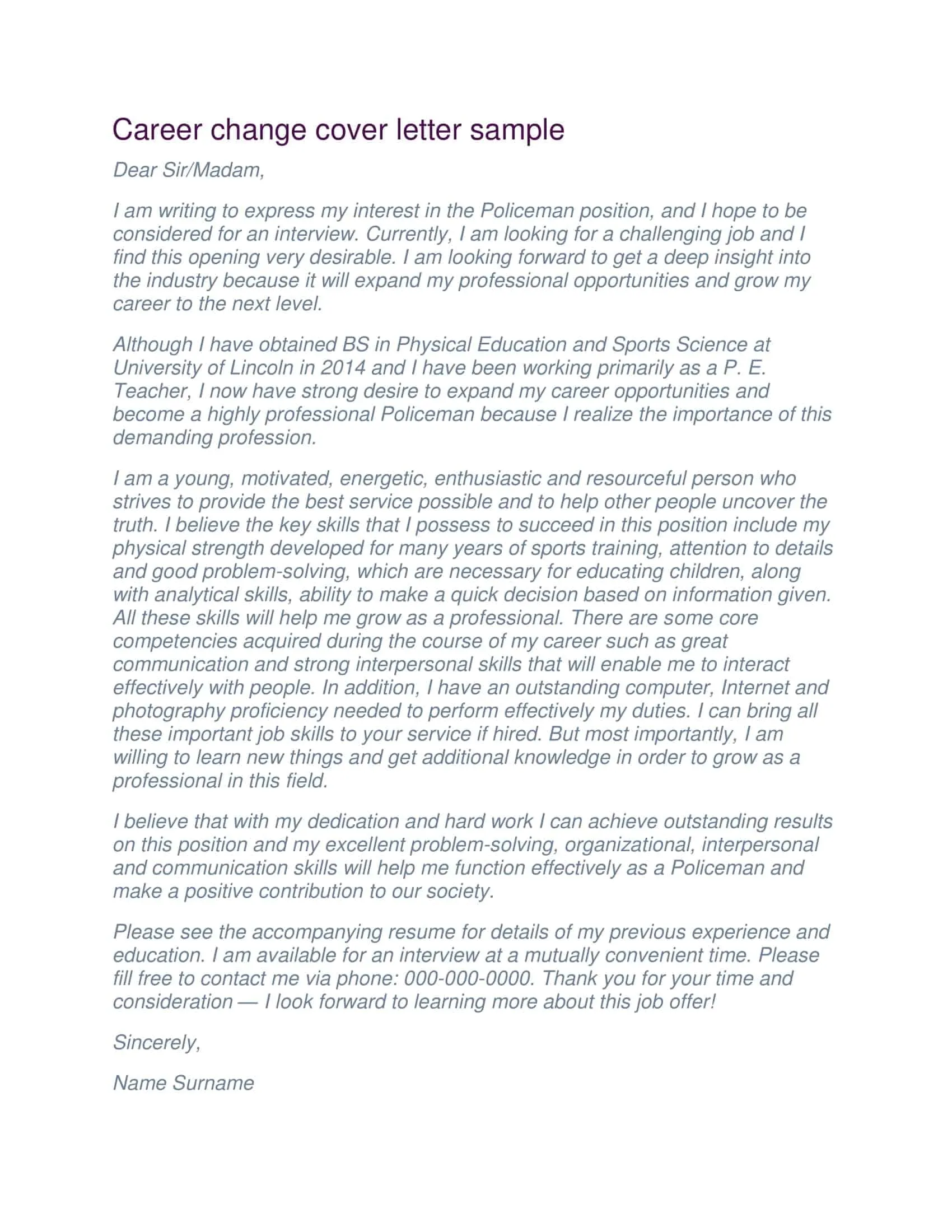
Example Career Change Cover Letter
Here’s an example to guide you on how to approach your career change cover letter. Remember to customize it for your circumstances, but the format and tone can be adapted to help you with your application. Please be aware, this is just a guideline. Always personalize it based on the requirements of the role you apply for.
Key Takeaways for Your Career Change Cover Letter
Crafting a compelling career change cover letter requires highlighting transferable skills, addressing the lack of direct experience with a positive approach, and demonstrating your motivation and enthusiasm. Research the target role and company, tailor your letter to each application, and showcase your accomplishments. Proofread and edit carefully, and avoid common mistakes like using generic templates. By following these guidelines, you can create a cover letter that effectively communicates your potential and increases your chances of landing an interview in your desired new career.