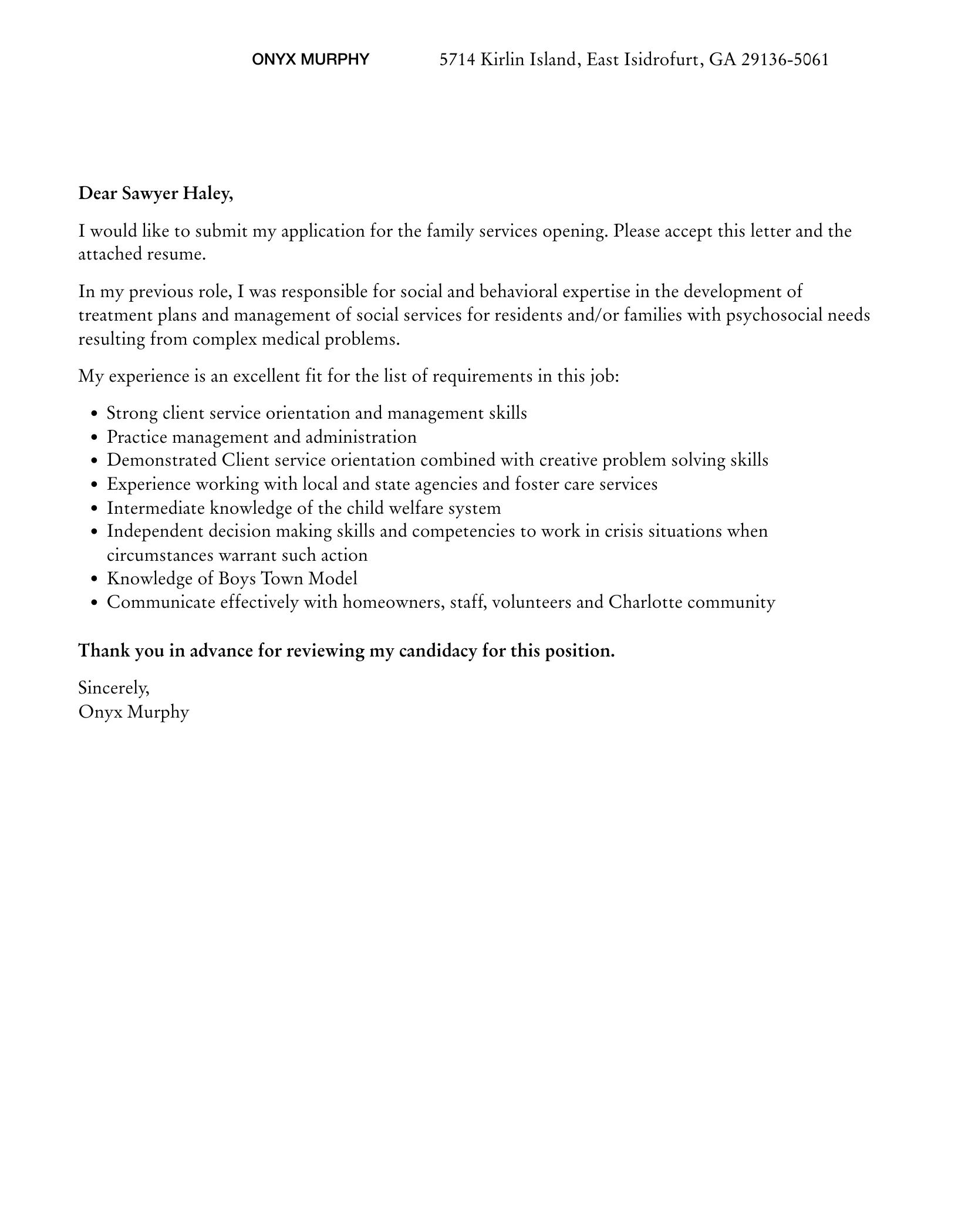
Understanding the Child and Family Services Cover Letter
A child and family services cover letter is your first impression. It’s a critical document that accompanies your resume and aims to persuade a hiring manager that you are the ideal candidate for a specific role. The purpose of the cover letter is to demonstrate your understanding of the position, showcase your relevant skills and experience, and express your genuine interest in the organization. It is not just a repetition of your resume; instead, it should provide context, personality, and a compelling narrative that makes you stand out from other applicants. A well-crafted cover letter can significantly increase your chances of securing an interview by providing a clear and concise overview of your qualifications and aspirations within the field. The cover letter should reflect your understanding of the values of the organization and how you can contribute to their mission.
Key Components of a Child and Family Services Cover Letter
Every child and family services cover letter should include certain key components to be effective. Start with a professional header that contains your contact information, including your full name, phone number, email address, and potentially your LinkedIn profile link. Following this, address the hiring manager by name if possible; this personal touch immediately shows you’ve done your research. Then, you will write an opening paragraph that clearly states the position you are applying for and where you saw the job posting. The body of the letter should then highlight your skills and experiences relevant to the job description. The closing paragraph should reiterate your enthusiasm for the role, express your availability for an interview, and include a call to action. Finally, ensure your letter has a professional closing, such as “Sincerely” or “Best regards”, followed by your typed name.
Your Contact Information and Header

The header is the first thing a hiring manager sees, so it needs to be clear and professional. Begin by placing your full name at the top, using a slightly larger font size. Below your name, list your contact information, which should include your phone number and a professional-looking email address. It’s essential to ensure that the email address is appropriate for a professional setting. If you have a LinkedIn profile, include the URL as well, as it provides an easy way for the hiring manager to learn more about your professional background. Make sure that all of this information is well-formatted and easy to read. Consider using a simple, clean font like Arial or Times New Roman to make your header look polished. Avoid using any distracting colors or graphics in the header, as it is meant to convey professionalism and ease of contact. This is the potential employer’s first point of contact with you.
Professional Formatting Techniques
Formatting is key to making your cover letter easy to read and visually appealing. Use standard margins (1 inch on all sides) and a readable font, such as Times New Roman or Arial, at a size between 11 and 12 points. The letter should be single-spaced within paragraphs and double-spaced between paragraphs. This creates a clear visual separation and makes the content easier to digest. Keep paragraphs concise, aiming for no more than five or six sentences each. Break up long blocks of text to maintain the reader’s interest. Use bullet points to highlight key skills or achievements, which aids readability. Ensure consistent alignment throughout the document, choosing either left-aligned or justified text. Finally, save your cover letter in a widely compatible format, such as a PDF, to preserve the formatting when the hiring manager opens it.
Opening with Impact and Purpose
The opening paragraph is your opportunity to grab the reader’s attention and set the tone for the rest of the letter. It should immediately state the position you are applying for and where you saw the job posting. If you know the name of the hiring manager, address them directly, which adds a personal touch. Briefly mention your relevant skills and experience to show why you are a good fit for the role. Also, express your enthusiasm for the position and the organization. Avoid generic openings. Tailor your first paragraph to the specific job and the organization’s mission. This shows that you are genuinely interested in the opportunity and have done your homework. Your goal is to capture the reader’s interest and encourage them to continue reading. Ensure that your opening paragraph is concise, professional, and conveys your passion for child and family services.
Highlighting Relevant Skills and Experience

The body of your cover letter should focus on showcasing your skills and experiences that align with the job description. Carefully review the job posting and identify the key requirements and desired qualifications. Provide specific examples of how your past experiences have prepared you for the role. Quantify your achievements whenever possible, using numbers and data to demonstrate the impact of your work. Explain how your skills and experiences have benefited previous employers or clients. When describing your experience, focus on the responsibilities and accomplishments that demonstrate your ability to succeed in the child and family services role. Be specific and use the STAR method (Situation, Task, Action, Result) to structure your examples. This demonstrates that you not only have the skills but also understand how to apply them effectively. Tailor your examples to the specific needs of the organization.
Showcasing Your Passion for the Field
Your cover letter should convey your genuine passion for child and family services. Express your deep commitment to helping families and children. Share your reasons for wanting to work in this field and what motivates you. You can also discuss your understanding of the challenges and rewards associated with the work. It’s important to showcase your empathy, patience, and dedication to the well-being of children and families. Your passion can set you apart from other applicants. Show your knowledge of the specific organization’s values and how those align with your personal values. This helps demonstrate that you are not just looking for a job but are genuinely interested in contributing to their mission. Explain your understanding of the organization’s mission and how your goals align with theirs. This will show the hiring manager you have taken time to research the company.
Quantifying Your Achievements
When describing your achievements, always use numbers, data, and specific metrics to quantify your impact. Instead of saying you improved client outcomes, state by what percentage. Instead of stating you managed a caseload, explain how many cases you managed concurrently. These quantifiable achievements help the hiring manager see the direct value you would bring to the role. For example, you might say you “increased client engagement by 20% through the implementation of a new counseling strategy.” Or, “Managed a caseload of 40 families, ensuring timely and effective service delivery.” Be sure to provide specific examples of your achievements in previous roles. By quantifying your accomplishments, you provide concrete evidence of your ability to excel in the position. Use numbers and data to back up your claims and show the hiring manager the tangible results you have achieved.
Demonstrating Knowledge of Child and Family Services

Demonstrate your understanding of the field by mentioning relevant legislation, ethical considerations, and best practices. If you have experience with specific programs or interventions, be sure to mention them. Provide examples of how you have addressed complex cases or challenging situations. Highlight your knowledge of child development, family dynamics, and cultural sensitivity. Make sure to reflect that you’re aware of the specific needs of the organization’s clients. Demonstrate your knowledge of the legal and ethical standards governing child and family services. By showcasing your knowledge, you’ll show the hiring manager that you’re knowledgeable about the field and its challenges. Research the organization and demonstrate how your skills align with their mission.
Concluding with a Strong Call to Action
Your concluding paragraph should reiterate your interest in the position and the organization. Clearly state your availability for an interview. Make sure to thank the hiring manager for their time and consideration. Include a strong call to action, such as “I look forward to discussing my qualifications further in an interview.” Express your enthusiasm for the role and your eagerness to contribute to their team. Avoid vague or passive language. Reiterate your key qualifications and how they align with the job requirements. End on a positive note, leaving the hiring manager with a clear understanding of your suitability for the role and your eagerness to move forward in the hiring process.
Proofreading and Editing Your Cover Letter
Before submitting your cover letter, carefully proofread and edit it for any errors. Check for grammatical mistakes, spelling errors, and typos. Ensure your writing is clear, concise, and easy to understand. Read the letter aloud to catch any awkward phrasing or sentences. Have someone else review your letter to get a fresh perspective. This person can provide helpful feedback and catch any errors that you may have missed. Pay close attention to the tone and style of your writing to make sure it is professional and appropriate for the field. A polished and error-free cover letter demonstrates attention to detail and professionalism, which are essential in child and family services. The best impression is made when the cover letter is free of any errors and shows that it was written with care and attention.
Tailoring Your Cover Letter to the Job Description

Always tailor your cover letter to the specific job description and the organization’s needs. Carefully review the job posting and identify the key requirements and desired qualifications. Customize your letter to emphasize the skills and experiences most relevant to the role. Use keywords from the job description to show that you understand the employer’s needs. If possible, address the specific requirements or challenges mentioned in the job posting. This shows the hiring manager that you have carefully considered the role and are a good fit for the organization. Use specific examples from your experience to illustrate your ability to meet the employer’s needs. Avoid sending a generic cover letter; instead, demonstrate how your unique skills and experiences align with what the employer is looking for.
Common Mistakes to Avoid
There are several common mistakes to avoid when writing a child and family services cover letter. Don’t use generic templates or phrases that do not speak to the organization’s values. Avoid simply repeating your resume; the cover letter should expand on your qualifications, offering context and detail. Don’t include irrelevant information or personal details that are not pertinent to the job. Steer clear of negative language or complaints about past employers. Avoid typos, grammatical errors, and formatting issues. Poor formatting can make your letter difficult to read and negatively impact your chances of getting the job. Do not submit a cover letter that is too long; aim for a maximum of one page. Keep your tone professional, enthusiastic, and positive.
Dos and Don’ts of Child and Family Services Cover Letters
Here are some quick tips to guide your cover letter writing process. Do tailor your cover letter to the specific job. Do highlight your relevant skills and experience. Do showcase your passion for child and family services. Do quantify your achievements whenever possible. Do proofread and edit your letter carefully. Don’t use a generic template. Don’t simply repeat your resume. Don’t include irrelevant information. Don’t use negative language. Don’t make any typos or formatting errors. By following these dos and don’ts, you can create a compelling cover letter that will make a positive impression on hiring managers and help you get your dream job.