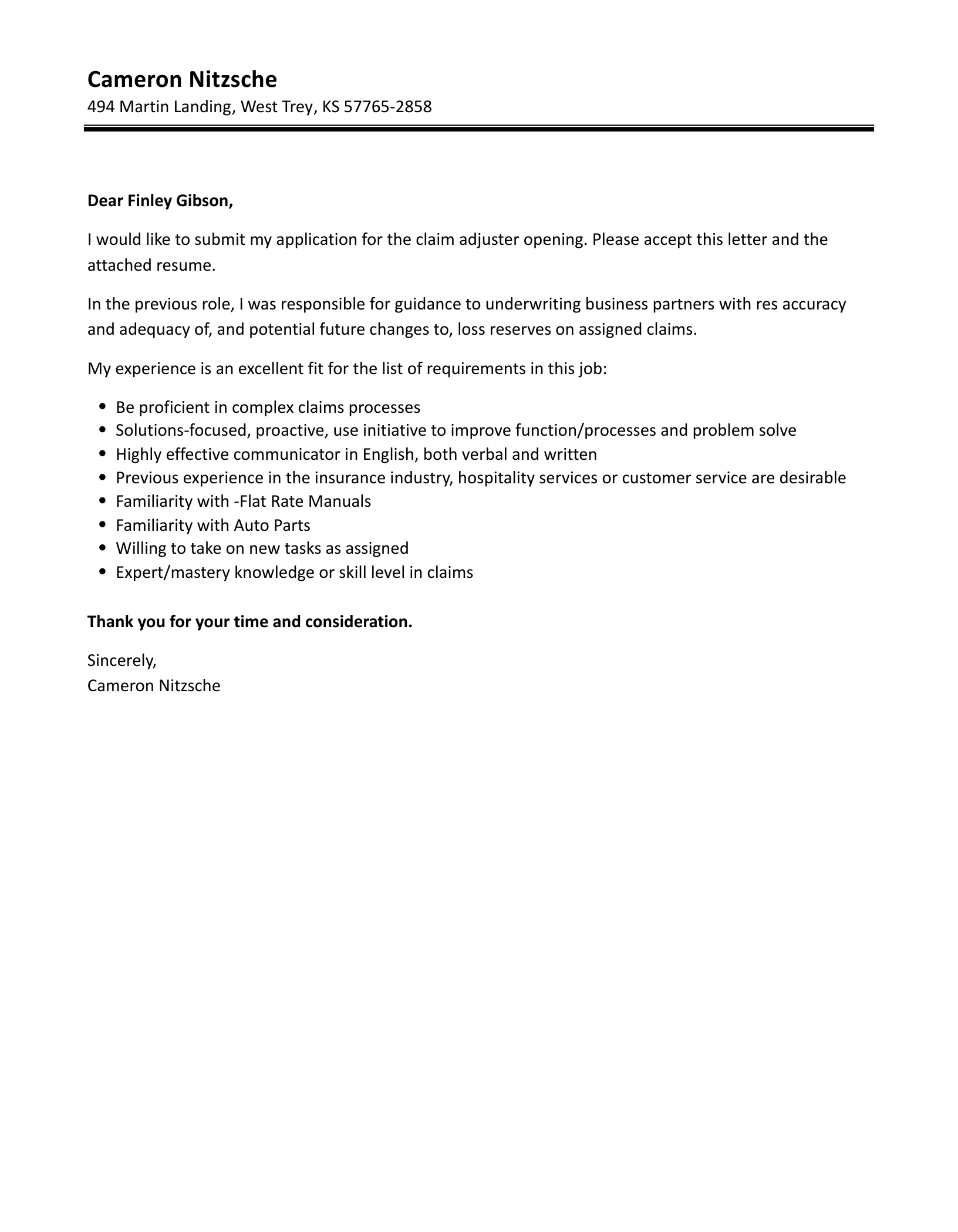
Crafting a Compelling Claim Adjuster Cover Letter
A well-crafted claim adjuster cover letter is your first opportunity to make a strong impression on a potential employer. It’s your chance to showcase your skills, experience, and personality in a way that a resume alone cannot. By taking the time to create a compelling cover letter, you significantly increase your chances of landing an interview and ultimately securing the job. The cover letter is more than just a formality; it’s a vital tool in your job-seeking arsenal, and it’s critical to get it right from the start. Your cover letter should be seen as a marketing document, selling your abilities and suitability for the specific claim adjuster role you’re applying for.
Understanding the Purpose of Your Cover Letter
The primary goal of your claim adjuster cover letter is to persuade the hiring manager to read your resume and consider you for the position. It serves as a bridge between your qualifications and the employer’s needs. The cover letter gives you an opportunity to explain your motivation for applying, highlight relevant experiences not readily apparent on your resume, and express your enthusiasm for the role and the company. It should also briefly explain your most relevant skills and accomplishments, and why you’re a great fit for the specific job requirements. It is also your chance to highlight your understanding of the company and the industry, demonstrating that you’ve done your research and are genuinely interested in the opportunity. A cover letter should not just reiterate your resume but should expand on it, painting a more complete picture of who you are and what you can bring to the table.
Highlighting Relevant Skills and Experience

When writing your cover letter, it’s crucial to focus on the skills and experience that are most relevant to the claim adjuster position. Start by reviewing the job description carefully and identify the key requirements and qualifications. Then, align your cover letter’s content to address these specific needs. Use the body of your cover letter to showcase the skills and experiences that directly match the job requirements. Instead of simply listing your past responsibilities, provide concrete examples of how you successfully applied your skills in previous roles. Quantify your achievements whenever possible, using numbers and data to demonstrate the impact you had. Emphasize any specialized knowledge or certifications that are relevant to the position, and show how your skills and expertise would benefit the employer.
Analyzing the Job Description
Before you start writing, carefully analyze the job description. This is a critical step in tailoring your cover letter to the specific requirements of the role. Identify the key skills, experiences, and qualifications that the employer is seeking. Look for keywords and phrases that are used throughout the job description. Use these keywords strategically in your cover letter to demonstrate that you possess the necessary skills and experience. It is helpful to break down the job description into separate sections. Identify the key responsibilities, required qualifications, and desired skills. This will help you create a cover letter that directly addresses the employer’s needs. Make sure you understand not just what the job requires but also the values and culture of the company. This understanding will enable you to write a cover letter that demonstrates your genuine interest and your suitability for the organization.
Key Skills to Showcase
A successful claim adjuster must possess a range of skills to effectively manage claims and satisfy customers. Your cover letter should showcase these abilities, providing concrete examples of how you’ve applied them in previous roles. Highlight the following skills, ensuring you provide specific examples to support your claims. Remember to use action verbs and quantify your accomplishments whenever possible to make your skills more impactful to the hiring manager.
Communication Skills

Excellent communication skills are essential for claim adjusters. You must be able to communicate clearly and effectively with a variety of stakeholders, including policyholders, claimants, attorneys, and colleagues. Your cover letter should highlight your ability to communicate both verbally and in writing. Provide examples of how you’ve successfully communicated complex information in a clear, concise, and empathetic manner. Show how you’ve handled difficult conversations and resolved disputes through effective communication. Examples include successful negotiations with claimants, clear explanation of policy details, and producing detailed, accurate reports.
Analytical Skills
Claim adjusters must possess strong analytical skills to evaluate claims, assess damages, and determine liability. Your cover letter should emphasize your ability to analyze complex information, identify patterns, and draw logical conclusions. Describe instances where you’ve thoroughly investigated claims, gathered evidence, and made sound decisions based on your analysis. Quantify the results of your analytical skills, such as how you reduced claim costs or improved accuracy in claims processing. Showcase your proficiency in reviewing and interpreting policy language, investigating claims, and gathering evidence.
Attention to Detail
Attention to detail is critical in the insurance industry, where even small errors can lead to significant consequences. In your cover letter, highlight your ability to pay close attention to detail and ensure accuracy in all aspects of your work. Provide specific examples of how you’ve meticulously reviewed documents, identified discrepancies, and avoided errors. Demonstrate your commitment to accuracy and your ability to work with precision under pressure. Emphasize your ability to manage a large volume of information while maintaining a high level of accuracy, and how your attention to detail has prevented errors or minimized potential financial losses.
Customer Service Skills

Claim adjusters often interact with policyholders and claimants during stressful times. Your cover letter should showcase your customer service skills, including your ability to empathize with others, resolve issues, and provide excellent service. Describe instances where you’ve gone above and beyond to help customers, showing your ability to build rapport and resolve issues effectively. Highlight your ability to handle difficult situations with professionalism and provide a positive customer experience. Showcase your skills in building trust and rapport with customers, actively listening to their concerns, and offering effective solutions that meet their needs.
Formatting and Structure Best Practices
The formatting and structure of your claim adjuster cover letter can make or break your chances of getting noticed. A well-formatted cover letter is easy to read, professional, and shows that you pay attention to detail. Use a clear, professional font, such as Times New Roman, Arial, or Calibri, in a size between 10 and 12 points. Ensure your letter is well-organized with clear headings, subheadings, and bullet points to make it easy to scan and understand. Maintain consistent formatting throughout the document, including spacing, margins, and font styles. Avoid unnecessary graphics, colors, or other distractions, focusing on a clean and professional appearance that highlights your professionalism and attention to detail.
Header and Contact Information
Start your cover letter with a professional header that includes your name, address, phone number, and email address. Ensure this information is accurate and up-to-date, and use a professional email address. The header should be at the top of the page, aligned either left or right, and should match the information on your resume. Include the date and the hiring manager’s name and address below your contact information. If you can’t find the hiring manager’s name, use a general title like “Hiring Manager” or “Recruiting Team” to personalize the letter.
Personalized Salutation

Always address your cover letter to a specific person if possible. Research the company’s website or LinkedIn to find the hiring manager’s name. A personalized salutation, such as “Dear Mr./Ms. [Last Name],” immediately grabs the reader’s attention and shows that you’ve taken the time to research the company and the position. Avoid generic salutations like “To Whom It May Concern” or “Dear Sir/Madam” unless you absolutely cannot find a specific name. If you are unsure of the hiring manager’s name, a more general, but still respectful, salutation such as “Dear Hiring Manager” is acceptable.
Body Paragraphs that Sell Your Value
The body paragraphs are the heart of your cover letter. Here, you’ll elaborate on your skills, experience, and accomplishments. This is your opportunity to convince the hiring manager that you are the best candidate for the job. The most effective approach is to divide the body into distinct paragraphs, each focusing on a different aspect of your qualifications. Make sure each paragraph is focused and makes a specific point, and support your claims with evidence from your past experiences. The body of your cover letter should be well-organized, easy to read, and filled with information that demonstrates your suitability for the role. Use strong action verbs, quantify your achievements, and tailor the content to match the specific requirements of the job.
The Opening Paragraph
The opening paragraph of your cover letter is crucial because it sets the tone and captures the reader’s attention. It should immediately state the position you are applying for and how you learned about the opportunity. Briefly mention your most relevant qualifications or a compelling reason for your interest in the role and the company. Create a positive impression and make the reader want to learn more. The opening paragraph should be concise, enthusiastic, and tailored to the specific job, reflecting your genuine interest and understanding of the company’s needs. This is your first and best chance to make a positive impression.
Demonstrating Your Value Proposition

In the body paragraphs, you should elaborate on your qualifications and provide specific examples of how your skills and experience align with the job requirements. Focus on the skills that are most important to the position. Provide concrete examples to support your claims. Instead of simply stating that you have excellent communication skills, describe a situation where you used those skills to successfully resolve a complex issue. Use the STAR method (Situation, Task, Action, Result) to structure your responses and provide context, details, and quantifiable results. Show, don’t just tell, the hiring manager why you’re the best candidate for the job.
Quantifying Achievements
Whenever possible, quantify your achievements using numbers and data. This makes your accomplishments more impactful and demonstrates the value you can bring to the company. For example, instead of saying that you improved customer satisfaction, state that you “Increased customer satisfaction scores by 15% within six months.” Quantify your achievements to demonstrate the tangible impact you’ve had in previous roles. Numbers provide concrete evidence of your abilities, such as the number of claims processed per day, the percentage reduction in claim processing time, or the amount of money saved through effective negotiations. This data provides a clear and persuasive picture of your skills and experience.
The Closing Paragraph
The closing paragraph should reiterate your interest in the position and thank the hiring manager for their time and consideration. Express your enthusiasm for the opportunity and state that you look forward to hearing from them soon. Include a call to action, such as inviting them to contact you for an interview or providing your availability for a follow-up conversation. Keep it concise and professional, and proofread it carefully to avoid any errors. A strong closing reinforces your desire for the job and leaves a lasting positive impression, encouraging the hiring manager to take the next step.
Proofreading and Editing Your Cover Letter

Proofreading and editing your claim adjuster cover letter is a critical step that ensures your professionalism and attention to detail. Carefully review your cover letter for any grammatical errors, spelling mistakes, and typos. Errors can create a negative impression and undermine your credibility. Read your cover letter multiple times, and consider reading it aloud to catch any awkward phrasing or sentence structure. Ask a friend, family member, or career counselor to review your cover letter for feedback. A fresh pair of eyes can often spot errors that you may have missed. Ensure that the formatting is consistent throughout the document and that the text is easy to read. Proofreading is an essential step to making a great first impression.
Common Mistakes to Avoid
There are common mistakes that can significantly decrease your chances of getting hired. Avoid generic cover letters that are not tailored to the specific job and company. Use the wrong salutation or fail to address the letter to a specific person, or use a long, rambling cover letter that is difficult to read. Make sure to avoid errors, which can easily diminish your chances of getting hired. A well-written, tailored cover letter is a critical tool for your job search. Proofread carefully, and seek feedback before submitting it.
Using Action Verbs
Using action verbs can make your cover letter more dynamic and engaging. Action verbs help you convey your accomplishments and skills in a clear and compelling manner. Use strong action verbs at the beginning of your sentences to highlight your abilities and achievements. Examples include “Managed,” “Negotiated,” “Investigated,” “Resolved,” “Analyzed,” and “Communicated.” Avoid using passive voice and weak verbs that can make your cover letter seem less impactful. Choose action verbs that are relevant to the job description and accurately reflect your skills. By using action verbs, you show the hiring manager exactly what you’ve done in past roles and how you can contribute to their company.
Tailoring to the Specific Job

Tailoring your cover letter to each specific job application is crucial. Generic cover letters often fail to impress hiring managers because they don’t demonstrate that you’ve taken the time to understand the company and the role. Customize your cover letter by carefully reviewing the job description and highlighting the skills and experience that directly match the requirements. Research the company’s values, mission, and culture to demonstrate your genuine interest. Address the specific needs and challenges outlined in the job description. By tailoring your cover letter, you show the employer that you are a good fit for the position and are genuinely interested in the opportunity. This will make your application stand out from the competition.
Call to Action
Include a clear call to action in your closing paragraph. This tells the hiring manager what you want them to do next. Encourage them to contact you for an interview or let them know you’re available for a follow-up conversation. Make it easy for the hiring manager to take the next step by providing your contact information and expressing your enthusiasm for the opportunity. Your call to action should be concise, confident, and professional, reinforcing your interest and eagerness to move forward in the hiring process. This is your final opportunity to reiterate your interest and guide the hiring manager toward the next steps.