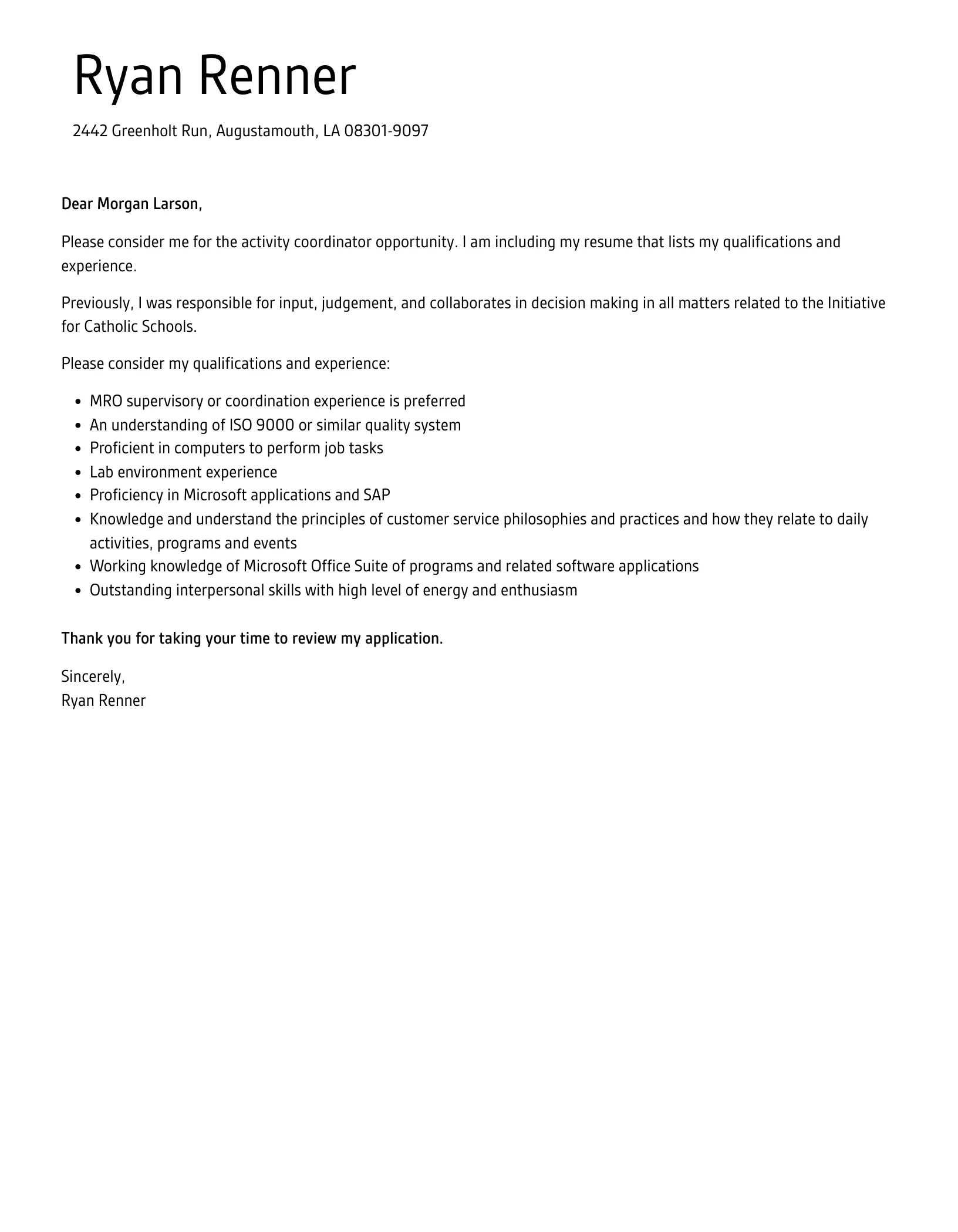
Crafting a Compelling Cover Letter
A well-crafted cover letter is your first opportunity to make a positive impression on a potential employer. For activity coordinators, this is particularly crucial, as it showcases your personality, organizational skills, and passion for engaging others. It is not merely a formality; it’s a critical tool to differentiate yourself from other applicants. When crafting your cover letter, think of it as an introduction to your professional self, highlighting what makes you uniquely qualified and excited about the role. The best cover letters capture the hiring manager’s attention from the start and maintain their interest throughout, leading them to want to learn more about you. A strong cover letter shows you’ve taken the time to understand the position and are genuinely interested in contributing to the organization’s mission.
Highlighting Relevant Skills
Activity coordinator roles demand a diverse skill set. Your cover letter is the ideal space to emphasize the skills most relevant to the job description. Skills to highlight include communication, organizational abilities, leadership, creativity, and the capacity to work with diverse populations. Provide specific examples of how you have utilized these skills in the past. For instance, instead of simply stating “I have excellent communication skills,” describe a time when you successfully communicated complex information to a group, or mediated a conflict. Quantifiable achievements, such as the number of successful events you organized or the percentage of participation you achieved, significantly enhance your credibility and make your application more compelling. This demonstrates a track record of success and provides concrete evidence of your capabilities.
Showcasing Experience Effectively

Your experience is a cornerstone of your cover letter. Clearly and concisely describe your relevant work history, focusing on accomplishments rather than just responsibilities. Use the STAR method (Situation, Task, Action, Result) to structure your experience descriptions. Explain the situation, the task you were assigned, the actions you took, and the positive results you achieved. For instance, if you organized a fundraising event, explain the challenge (the situation), your role in it (the task), the actions you took to ensure its success (action), and the amount of money raised or the increased community engagement (result). This approach transforms your experience into a compelling narrative that captures the reader’s attention and highlights your value to the prospective employer. Focus on experiences that directly relate to the job you are applying for.
Tailoring Your Letter to the Job
Generic cover letters are easy to spot and rarely make a lasting impression. Take the time to customize your cover letter for each job you apply for. Carefully review the job description and identify the specific skills, experiences, and qualifications that the employer is seeking. Then, tailor your letter to address these requirements directly. Use keywords from the job posting, and highlight how your skills and experiences align with the employer’s needs. This personalization demonstrates that you have done your homework and are genuinely interested in the specific role and organization. It signals that you are a thoughtful and engaged candidate who is capable of meeting the challenges of the role.
Emphasizing Passion and Enthusiasm
Your cover letter is an opportunity to showcase your passion for activity coordination. Share your enthusiasm for creating engaging and enriching experiences for others. Express your interest in the specific organization and its mission, showing that you are not just looking for a job but are genuinely motivated to contribute to their team. Mention specific programs or activities that you find particularly appealing or relevant to your interests. Convey your enthusiasm through a positive and energetic tone, making it clear that you are excited about the possibility of joining their team. Let your personality shine through to make your letter memorable.
Structuring Your Cover Letter

Proper Formatting and Length
Proper formatting is essential for a professional cover letter. Keep your letter concise, typically within one page. Use a standard font, such as Times New Roman or Arial, and maintain consistent formatting throughout the document. Use clear and concise language, and break up large blocks of text with bullet points or short paragraphs to improve readability. Ensure your letter has a clear structure with an introduction, body paragraphs, and a conclusion. Avoid grammatical errors and typos by proofreading meticulously. Formatting errors, typos, and lengthy paragraphs can quickly deter a hiring manager from considering your application.
Using Strong Action Verbs
Enhance your cover letter by using strong action verbs to describe your accomplishments and skills. Instead of saying “I was responsible for,” use verbs like “managed,” “organized,” “coordinated,” “implemented,” “developed,” or “achieved.” Action verbs make your descriptions more dynamic and engaging, bringing your experiences to life. For example, instead of saying “I helped plan events,” say “I planned and executed successful events that increased participant engagement by 20%.” Choose verbs that accurately reflect your contributions and highlight the results of your actions. This not only makes your letter more interesting to read but also provides concrete evidence of your abilities.
Proofreading and Editing Meticulously

Proofreading and editing are critical steps in the cover letter writing process. Typos, grammatical errors, and formatting inconsistencies can undermine your professionalism and negatively impact your application. After you have finished writing your cover letter, take the time to proofread it carefully. Read your letter aloud to catch any awkward phrasing or errors that you might have missed. It is also useful to have a friend, family member, or career advisor review your letter for clarity and accuracy. A fresh pair of eyes can often identify mistakes that you have overlooked. Ensure that your cover letter is free of errors and presents you as a polished and detail-oriented professional.
Demonstrating Knowledge of the Organization
Researching the Company and its Values
Demonstrate your interest in the position by showing that you have researched the company and understand its mission and values. Visit the company’s website, read their “About Us” section, and check their social media presence. Identify their key values and priorities, and tailor your cover letter to show how your skills and experience align with their goals. Mention any specific programs, initiatives, or events that resonate with you, demonstrating that you are genuinely interested in working for that particular organization. This shows that you are not just sending out a generic cover letter, but have taken the time to understand their culture and values.
Connecting Your Skills to the Organization’s Needs

In your cover letter, explicitly connect your skills and experiences to the specific needs of the organization. Explain how you can contribute to their success and address the challenges that they may face. Review the job description carefully and identify the key requirements. Then, describe how your skills and experiences align with these requirements, providing specific examples of how you have addressed similar needs in the past. Emphasize how you can bring value to the team and help the organization achieve its goals. By connecting your skills to their needs, you show that you are a strong candidate who is well-suited to the role.
Including a Call to Action
Expressing Interest in an Interview
Conclude your cover letter with a clear call to action. Express your interest in an interview, and indicate your availability. Thank the hiring manager for their time and consideration. Reiterate your enthusiasm for the role and the organization, and make it easy for them to contact you. For example, you could say something like, “I am very enthusiastic about the opportunity to join your team and would welcome the chance to discuss my qualifications further in an interview. I am available for an interview at your earliest convenience and can be reached at [your phone number] or [your email address]. Thank you for your time and consideration.” A strong call to action ensures that the hiring manager knows you are eager to move forward in the hiring process.
Providing Contact Information Clearly

Make it easy for the hiring manager to contact you. Include your full name, phone number, and professional email address at the top of your cover letter. Ensure that your contact information is accurate and up-to-date. Double-check that your email address is professional and suitable for professional correspondence. If you have a LinkedIn profile, you can also include the link to your profile. Ensure that your contact information is readily accessible and clearly visible, so the hiring manager can contact you without any difficulty. A clear and professional presentation of your contact information is essential for a successful application.