What Is a Cover Letter and Why Do Recruiters Care?
A cover letter is a crucial document that accompanies your resume when applying for a job. It serves as an introduction to your qualifications, experiences, and your interest in the specific role and company. Recruiters care about cover letters because they provide a glimpse into your personality, communication style, and how well you understand the job requirements. Unlike a resume, which is a factual summary of your skills and experience, a cover letter allows you to tell your story, elaborate on your accomplishments, and demonstrate why you are the perfect fit for the position. A well-written cover letter can significantly increase your chances of getting noticed by a recruiter and landing an interview. It’s your first opportunity to make a positive impression and stand out from the crowd of other applicants. So many candidates submit the same kind of resume. However, cover letter can show the recruiter your personality.
Recruiters often use cover letters to assess a candidate’s writing skills, attention to detail, and overall professionalism. The letter should be tailored to the specific job and highlight how your skills and experiences align with the company’s needs. It’s a chance to show genuine interest in the role and demonstrate that you’ve done your research on the company. Additionally, the cover letter helps recruiters quickly determine whether a candidate has the required qualifications and the soft skills that are important for success in the role. This includes communication, problem-solving, and teamwork abilities. When recruiters assess the applications they receive, a strong cover letter is an essential element. A cover letter helps them understand if the candidate can convey the value they will bring to the team and the company. A bad cover letter can be the instant reason why a candidate isn’t being considered.
Key Elements Recruiters Look for in a Cover Letter
When crafting your cover letter, there are several key elements that recruiters look for to assess your suitability for a job. These elements demonstrate your attention to detail, communication skills, and your understanding of the job and company. The first and most important element is a personalized opening. A generic “To Whom It May Concern” is a red flag. Instead, address the hiring manager by name if you know it. If not, use a specific title, such as “Hiring Manager.” This immediately shows that you have taken the time to research the company and the role. The next element is a clear statement of your purpose. Briefly state the position you are applying for and how you found the job. This helps the recruiter quickly understand the context of your application. Recruiters are not always going to spend much time reading the cover letters. Therefore, they need to understand the context and the position quickly.
After introducing yourself, you’ll want to showcase your relevant skills and experiences. Highlight the skills and experiences that align with the job requirements and explain how they have prepared you for the role. Use specific examples and quantifiable achievements to demonstrate your capabilities. In addition, demonstrate your knowledge of the company and the role. Show that you have researched the company’s mission, values, and recent activities, and explain how your goals align with theirs. Explain why you are interested in the specific position and what you hope to achieve in this role. Finally, end with a call to action. Express your interest in an interview and provide your contact information. Thank the recruiter for their time and consideration. Proofread your cover letter carefully for any errors in grammar, spelling, or punctuation. A polished cover letter shows that you pay attention to details. It reflects well on your professionalism. Proofreading is an essential element of a cover letter.
Cover Letter Examples Recruiters Need

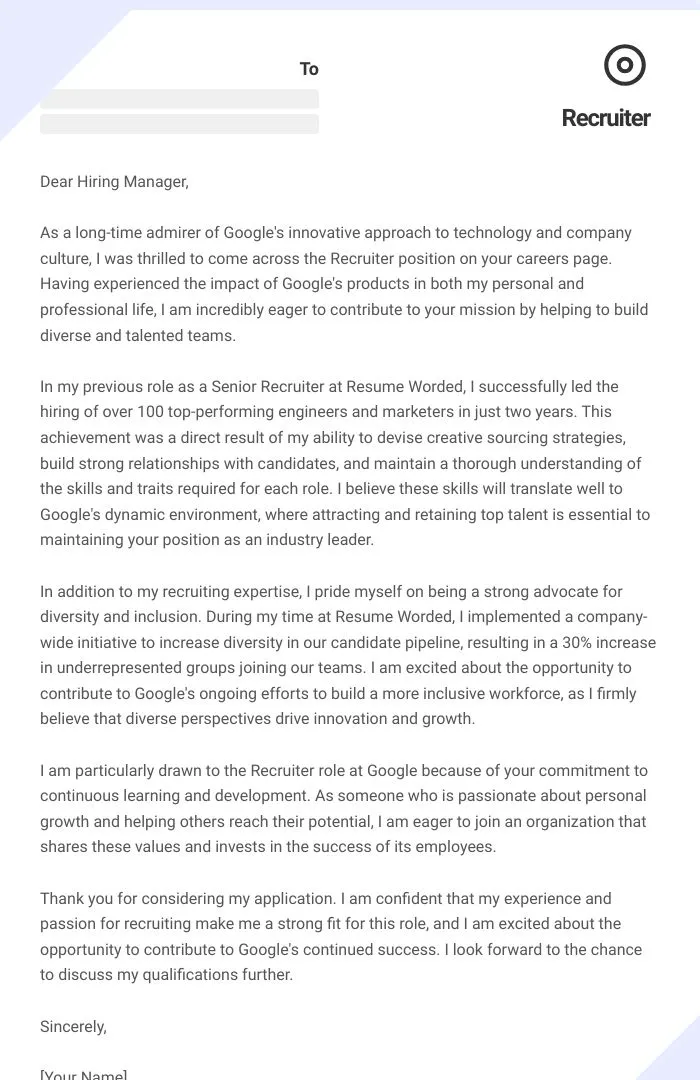
Below are examples of different cover letter formats. These are examples that a recruiter may want to read. There are different types of cover letters. Recruiters read cover letters every day, and the best cover letters always have the right tone and the right structure. Make sure your cover letter meets the standards that recruiters want. The examples below should help you get a better idea of what kind of cover letter will work for you. You need to have the right format, but also show your personality. The examples provided will give you a better idea of how to approach the letter.
Example 1: The Enthusiastic Professional
This cover letter highlights your passion for the role and the company. It is suitable for candidates who are genuinely excited about the opportunity and can convey their enthusiasm through their writing. The tone should be positive, engaging, and demonstrate a strong desire to contribute to the company’s success. Begin by expressing your excitement about the job and company. Use a tone that shows you have done your research. Show that you understand the company’s mission and values. You should always reference a specific achievement that is relevant to the job requirements. Be genuine. Provide quantifiable results whenever possible. Highlight your skills, and always showcase your enthusiasm for the opportunity. The letter should end with a strong call to action. This is how to let the recruiter know you want the job. Let them know that you are looking forward to an interview.
Example 2: The Skills-Focused Applicant
This cover letter emphasizes your key skills and how they align with the job requirements. It is perfect for candidates with a strong skillset and a proven track record of success in their field. Start by identifying the job requirements and skills listed in the job description. Then, highlight your skills. Provide specific examples of how you have used those skills to achieve results. Use numbers and data to quantify your achievements. Show how your skills have translated into success in previous roles. Make sure to match the skills. Be specific, and highlight the alignment between your abilities and the job requirements. You should tailor your letter to match the skills they are looking for. It is important to demonstrate your accomplishments. Include results of your work, and provide a brief summary of your qualifications. Use the letter to sell yourself. The purpose is to demonstrate your qualifications.
Example 3: The Career Changer

This cover letter is designed for individuals seeking a career change. The goal is to show how your transferable skills and experiences from previous roles can be applied to the new position. The first step is to clearly state your career change objective. Address why you are transitioning and what interests you about the new field or role. Then, identify the skills and experiences from your previous roles that are relevant to the new position. Highlight the transferable skills. Provide specific examples of how you have used these skills in the past. Show how they can be applied in your new role. Explain how you are actively working to bridge any skill gaps through education, training, or networking. This proves your commitment to the new field. Make sure to express your enthusiasm for the new career path. Show your motivation and your willingness to learn. Include a personal touch to make your letter stand out.
Example 4: The Recent Graduate
This cover letter is designed for recent graduates who may lack extensive work experience. The focus is on your academic achievements, relevant coursework, internships, and any other experiences. Begin by highlighting your academic background, including your degree, major, and any specializations. Mention any relevant coursework, projects, or research that aligns with the job requirements. Then, describe your internships, volunteer experiences, or any other activities. Detail your roles, responsibilities, and accomplishments. If you have limited professional experience, showcase your soft skills and transferable skills, such as communication, teamwork, and problem-solving. The letter should end with a call to action and express your enthusiasm for the opportunity. Show that you are eager to learn and contribute to the company. Tailor your letter to highlight the skills and experiences that are most relevant to the job requirements.
Common Mistakes to Avoid in Your Cover Letter
There are many things you need to avoid when writing a cover letter. Your goal is to catch the recruiter’s eye. Make sure to avoid the most common mistakes that can lead to rejection. Never send a generic cover letter. Do not use a template that does not relate to the job description. Generic cover letters that are not tailored to the job are often an instant rejection. You also want to avoid grammatical errors. Proofread for any errors in grammar, spelling, and punctuation. Errors show a lack of attention to detail. You should also avoid being too vague. Avoid overly general statements. Always provide specific examples to support your claims. Do not make the cover letter too long. Keep it concise. Recruiters are busy, so you need to make your letter clear and easy to read. Avoid sounding arrogant or overly confident. Show humility. Focus on how you can contribute to the company’s success. Do not be negative. Avoid complaining or criticizing past employers. Focus on your positive attributes and experiences.
Tailoring Your Cover Letter to the Specific Job

To impress recruiters, you must tailor your cover letter to each job you apply for. Customizing your cover letter shows that you are genuinely interested in the position and have taken the time to understand the job requirements. To tailor your letter, start by carefully reviewing the job description. Identify the key skills, experiences, and qualifications that the employer is seeking. Then, highlight how your skills and experiences align with these requirements. Provide specific examples of how you have demonstrated these skills in the past. In addition, research the company. Understand its mission, values, and recent activities. Use this information to demonstrate your interest in the company and how you can contribute to its success. Customize your letter by addressing the hiring manager by name, if possible. Show that you have taken the time to find out who you are addressing. Adapt your letter to match the tone and style of the job description. Match their vocabulary and keywords.
How to Follow Up After Sending Your Cover Letter
Following up after sending your cover letter is a crucial step in the job application process. It shows your continued interest in the position and helps you stay top of mind with the recruiter. The best time to follow up is typically within one to two weeks after submitting your application. However, this timeframe can vary depending on the company and the hiring process. You can follow up by sending a polite email to the hiring manager or recruiter. Reiterate your interest in the position. Reiterate why you are a good fit. Keep the email brief and professional. Refer to the job posting and mention specific skills or experiences you have that align with the requirements. You can also reach out to the recruiter by phone. Be prepared to answer any questions. Always be polite and show enthusiasm.
When following up, make sure you have been patient. Recruiters are busy. Following up too soon can come off as impatient or pushy. Be professional and courteous. The purpose is to show you are interested, not to become a nuisance. Keep your message focused on your qualifications and interest in the role. Be prepared to answer questions about your experience and skills. Thank the recruiter for their time and consideration. Whether you follow up by email or phone, the goal is the same. Demonstrate your continued interest in the position. Reiterate your qualifications. Remind the recruiter why you are a strong candidate. Following up can help you stand out from the competition.