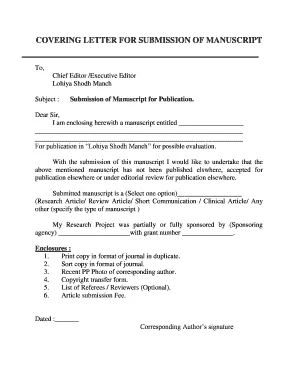
What is a Cover Letter for Paper Submission
A cover letter for paper submission is an essential document that accompanies your manuscript when you send it to an academic journal. Think of it as your first introduction to the editor, and a persuasive argument for why your work deserves publication. It’s your opportunity to make a strong initial impression and convince the editor that your research aligns with the journal’s scope and is worthy of consideration. Unlike a formal research paper, a cover letter is more personal and conversational, allowing you to highlight the significance of your work and its potential impact. A well-crafted cover letter can significantly increase your chances of getting your paper accepted for review, which is the first critical step in the publication process. Therefore, taking the time to write a compelling cover letter is an investment that can pay off handsomely in the long run. This document is your advocate, and it needs to be constructed well. Consider this as the initial handshake in the publication process. A strong first impression matters.
Why Is a Cover Letter Important?
The cover letter serves multiple vital functions. Primarily, it provides context for your research, explaining to the editor why your work is important and why it should be of interest to the journal’s readership. It also gives you the chance to address any potential issues, such as limitations in your study or any conflicts of interest. Additionally, a cover letter offers a platform to demonstrate your understanding of the journal’s focus and how your paper fits within its scope. It also shows you’ve taken the time to carefully consider the journal’s audience. Furthermore, it allows you to highlight your key findings and contributions, making them easily accessible to the editor. Finally, a cover letter is a professional courtesy that can enhance your reputation as a researcher, making the editor more likely to view your work favorably. A well-written cover letter is not just an optional extra; it is an essential component of a successful submission. The cover letter bridges the gap between your research and the editor’s perspective.
Key Components of a Cover Letter

Address the Editor and Journal
Start your cover letter by addressing the editor, preferably by name. This personalizes your communication and demonstrates that you’ve taken the time to learn about the journal and its editorial staff. Use the correct title (e.g., Dr., Professor) and be sure to spell the name correctly. If the journal’s website doesn’t explicitly list an editor, search for the editor-in-chief or the editor of the specific section of the journal most relevant to your work. Additionally, make sure to specify the journal to which you are submitting. This seems obvious, but it’s easy to overlook when submitting to multiple journals simultaneously. Double-check the journal’s preferred method of addressing the editor and follow that style to show your attention to detail and respect for the journal’s standards. Showing that you care about these details shows your professionalism and increases the likelihood of a favorable review. Make sure to include the journal’s full name.
State Your Purpose Clearly
The opening paragraph should immediately state the purpose of your letter: to submit your manuscript for consideration for publication in the journal. Clearly state the title of your manuscript. This should be the exact title as it appears on the manuscript itself. Include a concise sentence or two summarizing the main subject of your paper. This gives the editor an immediate grasp of what your research is about. Also, mention if the manuscript is original work and has not been submitted elsewhere, or if parts of it have been previously presented at a conference, with appropriate citations. This establishes the foundation for a transparent and professional communication. You can briefly express your enthusiasm for the journal and your belief that your work is a good fit for its audience. A clear and concise opening sets a positive tone for the rest of the letter. Start off strong and get your point across.
Highlight Key Findings

Briefly summarize your key findings. This is where you showcase the core contributions of your research. Use clear, non-technical language that will be accessible to an editor who may not be an expert in your specific field. Avoid jargon. Instead, explain the most important results and the implications of your work. Focus on what makes your research novel, significant, and impactful. Quantify your findings where possible to provide concrete evidence. Highlight the key outcomes that support your research questions and objectives. Remember, the aim is to quickly communicate the essence of your research, making it easy for the editor to grasp the significance and to justify sending the manuscript for review. Keep this section concise; the full details will be in the manuscript. Make sure that the key findings stand out. Give the reader a taste of your hard work.
Emphasize the Novelty and Significance
Clearly articulate the novel aspects of your research and its significance. Why is your work different from what has been done before? What new knowledge or insights does it offer? Explain how your research contributes to the field and its impact on the area. Detail the implications of your findings, emphasizing how they address relevant problems or advance understanding. Highlight the broader implications and any potential applications of your work. Demonstrate how your research aligns with current trends and debates within the field. Be clear about why your research matters and why it will be of interest to the journal’s readership. This is an opportunity to set your paper apart and convince the editor of its value. Emphasize the unique contribution to the scientific community. This is your chance to shine and demonstrate the value of your work.
Adhere to Journal Guidelines
Make sure your cover letter complies with the specific guidelines of the journal. Many journals have detailed instructions on what to include in a cover letter, the required length, and how it should be formatted. Check the journal’s website, typically under the ‘Instructions for Authors’ section. Some journals may have a specific template or style guide for cover letters. Follow any instructions meticulously. Confirm that the manuscript follows all formatting and stylistic requirements. For example, check the word count limits and the required referencing style. If the journal has specific formatting requirements for figures or tables, ensure your manuscript complies with them. Addressing these details shows that you are thorough and respectful of the journal’s processes. Failure to follow guidelines can lead to immediate rejection, so ensure you comply carefully. Paying attention to detail is crucial.
Formatting and Structure

Your cover letter should be professional and easy to read. Use a clear, concise writing style. Avoid jargon. Keep the letter to a single page, unless the journal specifies otherwise. Use a standard font, such as Times New Roman or Arial, and use a reasonable font size (e.g., 11 or 12 points). The letter should be well-organized, with distinct paragraphs for each section. Use short, clear sentences and active voice whenever possible. Employ headings and subheadings to structure the information logically, making it easy for the editor to scan and find the key points. Proofread carefully for any spelling and grammar errors. Ensure the letter is free of typos and formatting inconsistencies. A well-formatted and structured letter shows your attention to detail and respect for the editor’s time. This is a very important aspect of the cover letter. Structure helps with readability.
Essential Elements to Include
Your Contact Information
Start with your full name, affiliation, and contact details. Include your email address, telephone number, and mailing address. Make sure your email address is professional. If you have a professional website or a link to your research profile (e.g., Google Scholar, ORCID), include it. This allows the editor to easily contact you and verify your information. The contact information should be prominently displayed at the top of the cover letter. This quick access to your details ensures efficient communication throughout the submission process. Double-check that your contact details are up-to-date and accurate. Ensure all the contact information is accessible.
The Title of Your Manuscript

Clearly state the full title of your manuscript, exactly as it appears in the document. This helps the editor identify your submission quickly and match it with the correct files. Ensure the title is clear, concise, and accurately reflects the subject matter of your paper. If your manuscript has a subtitle, include that as well. This clarity avoids any potential confusion and confirms that the editor has the correct manuscript. Place the title in a prominent position, typically in the first paragraph. The title should also match the title on your manuscript. Use correct capitalization and formatting. Matching titles reduce any confusion.
Brief Summary of Your Research
Provide a brief, high-level overview of your research. This is not the same as the abstract, but a concise summary highlighting the main objectives, methods, and key results. Aim for a few sentences that clearly convey the essence of your work, its contributions, and the significance. Keep the language non-technical to ensure accessibility. Highlight the key findings to showcase what makes your research important and innovative. Focus on the impact of your research. This summary should grab the editor’s attention and encourage further review. Make it compelling to demonstrate the value of your work. The overview will set the stage for the rest of the cover letter.
Why the Journal is a Good Fit
Explain why you chose this particular journal for your submission. Highlight how your research aligns with the journal’s scope, audience, and aims. Show that you’ve researched the journal and understand its focus. Mention specific articles or topics recently published in the journal that are related to your work, demonstrating your awareness of the journal’s current interests. Address how your findings contribute to the existing literature published in this journal. This will make the editor see that you’ve considered the journal’s audience. This tailoring increases your chances of a positive outcome. By demonstrating a good fit, you increase your chances of having your manuscript considered, as you clearly show you’ve selected the journal because of its relevance to your research. Prove that you’ve done your homework.
Confirmation of Originality

Include a statement confirming that your manuscript is original work and has not been published previously. This statement assures the editor of the integrity of your submission. You might include a sentence confirming that the work is not under consideration by any other journal. If parts of the work have been presented at conferences, acknowledge this with the dates and locations of the presentations. Be transparent about your previous work. This confirms your commitment to ethical research practices. Failure to do so can lead to serious consequences, including retraction of your paper. This protects the reputation of both you and the journal. Honesty is the best policy.
Acknowledgements and Conflict of Interest
Include a brief acknowledgement of any funding sources that supported your research. If the journal has specific guidelines for how acknowledgements should be formatted, follow those. This ensures transparency in the funding of your study. Disclose any conflicts of interest (COIs). State any potential conflicts clearly. COIs can include financial, professional, or personal relationships that could bias your research. If there are no conflicts of interest, state that as well. Transparency about conflicts of interest is essential to maintain the credibility of your research and demonstrate ethical research practices. Be upfront about conflicts.
Request for Reviewers or Exclusions
Some journals allow authors to suggest potential reviewers or to request the exclusion of certain reviewers. If you are allowed to suggest reviewers, provide the names, affiliations, and contact information of individuals who are experts in your field and who would be suitable to review your work. These suggestions might speed up the review process, but it is important to show that you understand the guidelines. If you have conflicts with specific researchers who you believe should not review your paper, you can also request their exclusion. Provide a brief explanation of why you’re making this request. Remember, the final decision on reviewers rests with the editor, but your suggestions can be helpful. Following these guidelines shows you’ve taken the submission process seriously. Follow the journal’s rules.
Closing and Signature

Conclude your cover letter with a polite closing, such as “Sincerely” or “Best regards”. Sign the letter with your full name and, if required by the journal, the names of all co-authors. Provide any additional information the journal requests, such as a statement about copyright or transfer of copyright. Reiterate your gratitude to the editor for considering your manuscript. Provide your contact details again. Show your appreciation for the editor’s time and consideration, and express your enthusiasm for having your work considered by the journal. A professional closing leaves a positive impression. Thank the editor for their time and consideration.
Writing Style and Tone
Use Formal Language
Maintain a professional tone throughout the cover letter. Use formal language and avoid slang, contractions, and overly casual expressions. Ensure your writing is grammatically correct and free of errors. Avoid using jargon. Write in clear, concise sentences. Strive to make the letter easy to read and understand. Use active voice instead of passive voice where possible, as it makes your writing more direct and engaging. This shows respect for the editor and helps you make a positive first impression. Proper use of formal language is crucial for a successful submission.
Be Concise and Clear

Keep your cover letter brief and to the point. Focus on the most important information about your manuscript. Avoid unnecessary details or lengthy explanations. Highlight the key findings and their significance. Use concise language. Aim for clarity in every sentence. Avoid overly complex sentence structures. Make every word count. The editor is likely reviewing many submissions. A concise, clear cover letter demonstrates your respect for their time and makes your work easier to assess. Time is valuable, keep the information clear and concise.
Proofread Carefully
Proofread your cover letter meticulously before submitting it. Check for any spelling mistakes, grammatical errors, or typos. Review the formatting to ensure it meets the journal’s requirements. Have a colleague or co-author review the letter for you. Use spell-checking software or online grammar checkers. A cover letter filled with errors reflects poorly on your attention to detail and undermines your credibility. Proofreading ensures your professionalism. Taking the time to proofread helps you make a positive impression. A polished cover letter increases the chances of your work being taken seriously. Double-check the final version before submission. Proofreading is a critical step.
Cover Letter Examples
Example 1 Science Paper Submission
In the example, the cover letter starts with a clear address to the editor, the title of the manuscript, and a brief summary of the research’s main findings. It goes on to highlight the novelty and significance of the research, specifying how the study advances existing knowledge in the field. A clear statement on the manuscript’s originality and compliance with journal guidelines is included. The closing states appreciation and provides contact information. This example is tailored to a science journal’s requirements, emphasizing the experimental methods and the importance of the results in the field. It is kept brief and informative, showcasing the research’s value. Focus on the specific needs of the journal.
Example 2 Medical Journal
This cover letter example starts with a formal salutation and clearly states the intent to submit a manuscript for consideration. It includes the manuscript’s title and author details, and then concisely describes the main findings and their implications for medical practice. The letter highlights the study’s importance and potential impact on patient care. The letter confirms originality, details conflict of interest disclosures, and gives information on ethical considerations. This ensures the journal is compliant with all regulatory guidelines. The conclusion reiterates the manuscript’s importance and expresses appreciation. Focus on key medical practice.
Example 3 Social Science Paper
The cover letter for the social science paper begins with a formal salutation to the editor, followed by the manuscript’s title and author details. The letter summarizes the research objectives, methodology, and key results in the area. The letter emphasizes the novelty of the research and its contribution to the social sciences. It highlights the research’s relevance to current debates. Originality, acknowledgements, and ethical compliance are confirmed. The closing thanks the editor and expresses enthusiasm for the possibility of publication. This example demonstrates the social science paper’s relevance. It also addresses the needs of the journal and its audience. Tailor the letter to fit your audience.
Tips for a Successful Submission
Tailor to Each Journal
Customize your cover letter for each journal you submit to. Don’t send a generic cover letter. Take the time to understand the journal’s specific requirements, scope, and audience. Mention the journal by name and address the editor by name. Explain why your research is a good fit for that particular journal. This level of customization shows that you respect the journal. Personalizing your cover letter helps make your submission stand out. Avoid generic phrases. Demonstrate that you have taken the time to understand the journal’s values. This shows professionalism and that you care about the process.
Review the Journal’s Scope
Before submitting, carefully review the journal’s scope and aims. Visit the journal’s website and read the “Instructions for Authors” section. Check recent publications to see the types of articles the journal typically publishes. Ensure your research aligns with the journal’s scope. Highlight the aspects of your research that match the journal’s focus. Emphasize how your research contributes to the topics, themes, and areas of interest. This will significantly increase your chances of getting your manuscript considered. A clear understanding of the journal’s scope increases the odds of a favorable response. Make sure your work fits the journal’s scope.
Keep it Concise
Be clear and to the point. Avoid being overly wordy. The editor is likely reviewing numerous submissions and has limited time. Get straight to the key points. Summarize your research in a clear and concise manner. Use short, easy-to-understand sentences. Avoid jargon or technical terms. Make the main points immediately apparent. A well-written concise cover letter is more likely to capture the editor’s attention. Respect the editor’s time by delivering the important information efficiently. Cut the fluff and go straight to the point.
Show Enthusiasm
Express your enthusiasm for the journal and your research. Show your interest in the journal’s subject. State how your research contributes to the existing literature in this field. Demonstrate that you’re excited about the possibility of having your work published. Make your passion clear. A positive, enthusiastic tone makes the cover letter more appealing and memorable. You want the editor to see your paper as important. Your excitement will motivate the editor to consider the submission with more care. A positive tone will make the letter more persuasive. The reader will better understand your research. Show how much your work means to you.
Common Mistakes to Avoid
Typos and Grammatical Errors
Avoid typos and grammatical errors. These errors are easily fixed with proofreading. Errors can undermine your credibility. Proofread your cover letter multiple times. Use a spell checker and a grammar checker. Have a colleague review your letter. A cover letter filled with errors reflects poorly on your attention to detail. Careful proofreading shows that you are professional and care about the quality of your work. Proofreading reduces the chances of a rejection. Proofread, proofread, proofread.
Generic Cover Letters
Avoid sending generic cover letters. Each journal has its unique requirements, scope, and audience. Personalize your cover letter for each submission. Mention the journal by name. Explain why your research is a good fit for that particular journal. Make sure it is tailored to the specific journal. A generic cover letter shows that you don’t care about the specifics of the journal. Tailoring the letter to each journal increases your chances of publication. This makes your submission stand out. It shows that you value their time and consideration. Don’t send the same letter to multiple journals.
Ignoring Journal Guidelines
Always adhere to the journal’s guidelines. Review the “Instructions for Authors” section of the journal’s website. Follow the journal’s formatting and stylistic requirements. If a journal requests particular information, make sure it’s included. If there is a word count limit, respect it. Ignoring guidelines may lead to rejection. Showing that you respect their guidelines demonstrates your attention to detail. Compliance with the journal’s guidelines will increase your chances of a successful submission. Pay attention to the details requested.