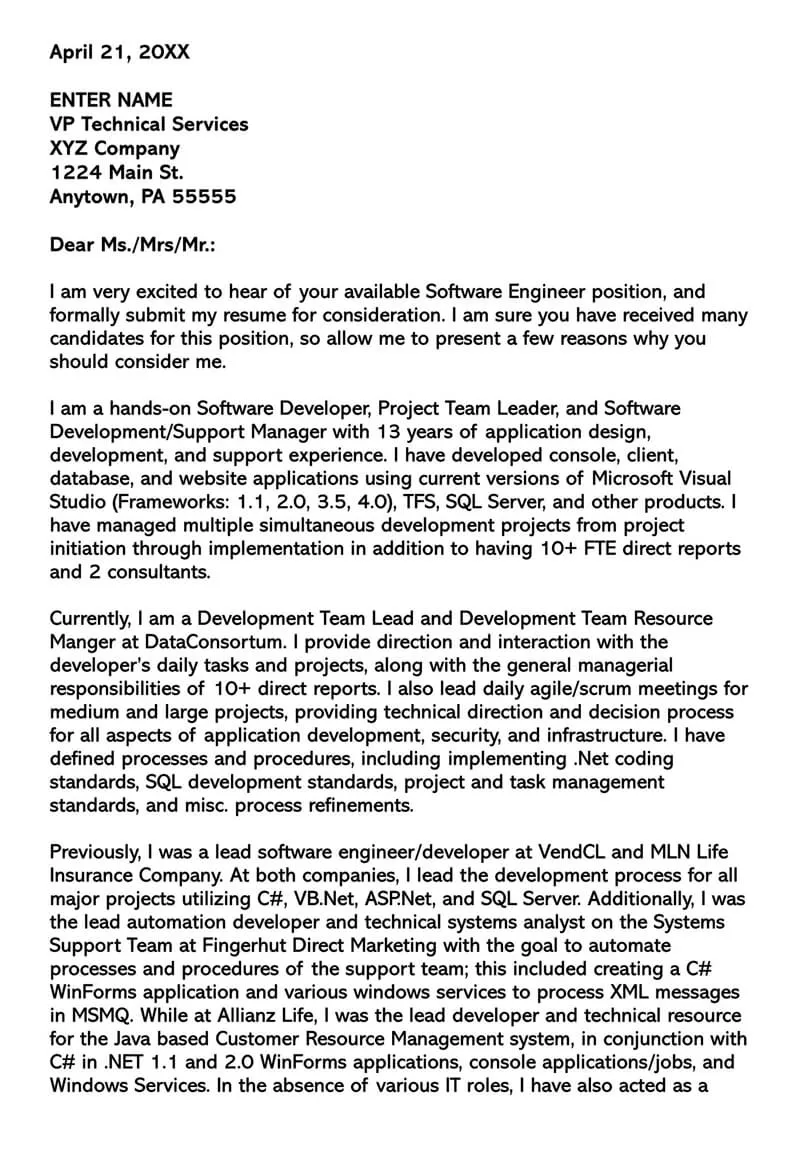
Crafting the Perfect Software Developer Cover Letter
A software developer cover letter is your first opportunity to make a lasting impression on potential employers. It’s more than just a formality it’s a crucial tool in your job search arsenal. Unlike your resume, which provides a factual overview of your skills and experience, the cover letter allows you to inject personality, demonstrate genuine interest, and connect with the hiring manager on a more personal level. A well-crafted cover letter can set you apart from other applicants, highlighting your unique value proposition and increasing your chances of landing an interview. The goal is not just to list your qualifications but to tell a compelling story that showcases why you are the perfect fit for the role and the company.
Researching the Company and Role
Before you even start writing, thorough research is paramount. Understanding the company’s mission, values, and culture is essential. Visit their website, explore their social media profiles, and read articles about their recent projects and achievements. This will enable you to tailor your cover letter to their specific needs and demonstrate that you’ve taken the time to learn about their organization. Similarly, carefully analyze the job description. Identify the key requirements, both technical and soft skills, and consider what the employer is really looking for in a candidate. This detailed research will allow you to align your skills and experience with the company’s expectations, demonstrating that you are a well-informed and enthusiastic applicant. This targeted approach significantly increases your chances of capturing the hiring manager’s attention.
Tailoring Your Cover Letter

Generic cover letters are easily spotted and often end up in the rejection pile. Your cover letter must be tailored to each specific job application. Start by addressing the hiring manager by name if possible. A personalized salutation immediately grabs their attention and shows you’ve taken the effort to learn about them. Next, customize the content to match the specific requirements of the job description. Highlight the skills and experiences most relevant to the role, and provide specific examples that demonstrate your abilities. Avoid simply restating your resume instead, elaborate on your achievements and explain how your skills align with the company’s needs and goals. The goal is to make a clear and compelling case for why you are the ideal candidate for that particular position and company.
Highlighting Relevant Skills and Experience
This is where you showcase your expertise and demonstrate why you are a valuable asset. Begin by clearly stating your qualifications and the specific role you are applying for. Then, highlight your most relevant skills and experiences, making sure to align them with the requirements outlined in the job description. Use action verbs to describe your accomplishments, and whenever possible, provide quantifiable results to demonstrate your impact. For instance, instead of saying “Managed projects,” you could say “Successfully managed and delivered five software projects, resulting in a 15% increase in user engagement.” This approach not only showcases your skills but also demonstrates your ability to achieve tangible results.
Technical Skills
Software development is a technical field, so you need to highlight your programming languages, frameworks, and tools. Mention any specific technologies the job description mentions and your proficiency level with each. For example, “Proficient in Java, Python, and JavaScript, with experience using React and Angular frameworks.” Be specific, mentioning any certifications or training you have received. If you have experience working with specific databases, cloud platforms, or development environments, be sure to include those details as well. Your technical skills are the foundation of your abilities, so showcasing your expertise in a clear and concise manner is essential to make an impact.
Project Experience

Provide a brief overview of your most relevant projects, emphasizing the technologies you used, your role, and the results you achieved. If possible, link to your GitHub profile or personal portfolio to allow the hiring manager to view your work. Describe your contributions to the project, highlighting your problem-solving skills and your ability to work both independently and collaboratively. Focus on projects that align with the requirements of the target job to show how your past experiences have prepared you for the role. Use the STAR method (Situation, Task, Action, Result) to structure your project descriptions. This allows you to tell a clear and concise story of how you contributed to the project’s success.
Quantifying Your Achievements
Don’t just tell employers what you did; show them the impact of your work. Quantify your accomplishments whenever possible, using numbers and data to support your claims. For example, instead of saying “Improved website performance,” say “Improved website loading speed by 30%, resulting in a 20% increase in user conversion rates.” Quantifiable results are far more impactful than vague statements. They demonstrate your ability to achieve tangible outcomes and showcase your value as a software developer. Use metrics like percentage improvements, time saved, or the number of users impacted. This will provide employers with a clear picture of your skills and experience. By providing tangible evidence of your successes, you make your cover letter far more persuasive and memorable.
Showcasing Your Passion for Software Development
Let your enthusiasm for software development shine through. Explain what excites you about the industry and the specific role you are applying for. This could involve mentioning your interest in a particular technology, your appreciation for the company’s mission, or your desire to solve challenging problems. Mention any personal projects or contributions to open-source projects, demonstrating your dedication and initiative. Passion is contagious, and it can make your cover letter much more engaging. Show how your professional goals align with the company’s. By demonstrating genuine interest and enthusiasm, you make yourself a more compelling candidate and increase your chances of making a positive impression on the hiring manager.
Emphasizing Soft Skills

While technical skills are important, soft skills are equally crucial for success. Highlight your ability to communicate effectively, work collaboratively, and solve problems creatively. Give specific examples of how you have demonstrated these skills in the past. For example, describe a time you successfully resolved a conflict, collaborated with a team on a complex project, or communicated a technical concept to a non-technical audience. Soft skills are key to thriving in a team environment and contributing to a positive work environment. Tailor your soft skills to the company culture. Show how your personal attributes complement your technical skills.
Communication and Teamwork
Software development is a collaborative process. Highlight your ability to communicate clearly and effectively, both verbally and in writing. Give examples of how you have successfully collaborated with others on projects. Describe how you resolved conflicts, shared information, and contributed to a positive team environment. Mention any tools or methodologies you use to facilitate collaboration, such as Agile or Scrum. Illustrate your teamwork skills by describing situations in which you had to work together with others to achieve a common goal. Your ability to work well with others is essential for any software development role.
Problem-Solving Abilities
Software developers are, at their core, problem solvers. Provide examples of how you have successfully overcome challenges. Describe a complex problem you faced and how you approached it, the steps you took to identify the root cause, and the solution you implemented. Showcase your analytical skills and your ability to think critically. If you have experience with debugging or troubleshooting, be sure to highlight those skills as well. Show how you utilized various problem-solving techniques. Your ability to think on your feet and find solutions is a highly valued asset in the field.
Formatting and Structure for Success

A well-formatted cover letter is easy to read and visually appealing. Use a professional font, such as Arial or Times New Roman, and maintain a consistent font size throughout. Keep the letter concise, ideally no more than one page. Use clear headings and subheadings to break up the text and make it easy to scan. Use bullet points to highlight key achievements and skills, and maintain a professional tone throughout. Proper formatting helps show that you take pride in your work. Ensure your letter is well-organized and easy to navigate. It demonstrates attention to detail and professionalism, both of which are crucial for a software developer.
Formatting Tips
Use a professional and readable font. Maintain consistent margins and spacing. Use clear headings and subheadings to break up the text. Keep the tone professional and respectful. Avoid excessive use of bold or italicized text. Ensure the letter fits on one page. Proofread the entire letter carefully before submitting. A clean, well-organized cover letter will impress the hiring manager and showcase your professionalism.
Proofreading and Editing
Typos, grammatical errors, and inconsistencies can damage your credibility. Always proofread your cover letter multiple times. Use a spell checker and grammar checker, but don’t rely on them completely. Read the letter out loud to catch any awkward phrasing or sentence structure. Ask a friend, mentor, or career advisor to review your cover letter for feedback. The final step is to ensure your cover letter is free of errors. Proofread your letter multiple times. Errors can negatively impact your candidacy. Ask for help if needed.
Call to Action and Closing

End your cover letter with a clear call to action. Express your enthusiasm for the opportunity and reiterate your interest in the position. State that you look forward to hearing from them and are available for an interview at their earliest convenience. Provide your contact information, including your phone number and email address. Thank the hiring manager for their time and consideration. A strong closing reinforces your interest and makes it easy for the hiring manager to contact you. A well-written closing will leave a lasting positive impression and increase your chances of getting the job.
Following Up
After submitting your cover letter and resume, it’s appropriate to follow up. If you haven’t heard back within the timeframe specified in the job description or within a reasonable period (e.g., one to two weeks), send a brief follow-up email. Reiterate your interest in the position and express your eagerness to learn more about the opportunity. A follow-up email is a polite way to check in on your application and show continued interest in the role. Avoid being overly persistent. A short, professional email is all that is needed.