Key Components of a Data Analyst Cover Letter
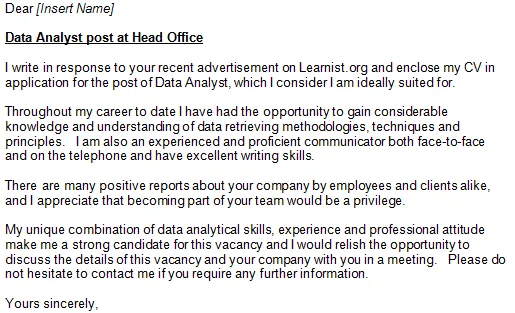
A compelling cover letter is your first chance to make a strong impression on a potential employer. For data analysts, it’s not just about listing your skills; it’s about showcasing your ability to communicate complex information clearly and concisely. A well-structured cover letter acts as a roadmap, guiding the hiring manager through your qualifications and demonstrating your enthusiasm for the role and the company. It’s your opportunity to go beyond your resume and tell a story, highlighting how your unique experiences and skills align with their specific needs. The key components include your contact information and salutation, a strong opening, highlighting your skills and experience, tailoring to the job description, and a strong closing that expresses your enthusiasm and includes a call to action. Remember to proofread and edit carefully to ensure a professional and polished final product.
Contact Information & Salutation
Begin your cover letter by providing your contact information. This should include your full name, phone number, email address, and optionally, your LinkedIn profile URL or personal website. This information should be clearly presented at the top of your cover letter. The salutation is the next crucial element. Avoid generic greetings such as ‘To Whom It May Concern.’ Instead, research the hiring manager’s name or the specific person in charge of the hiring process. Addressing the letter to a specific person shows you have taken the time to learn about the company and the role. A personalized greeting can significantly increase the likelihood of your application being noticed and considered seriously.
Formatting your contact info

When formatting your contact information, clarity is key. Use a clean, professional font and ensure the information is easy to read. Avoid overly elaborate designs or styles. The goal is to make it effortless for the hiring manager to contact you. Place your contact information at the top left or right of the letter. Use a consistent font size and style throughout your cover letter to create a cohesive and professional appearance. Double-check your phone number and email address to ensure they are accurate and up-to-date.
Addressing the Hiring Manager
If you can find the hiring manager’s name, start your cover letter with ‘Dear Mr./Ms. [Last Name]’. If you are unable to find a specific name, try to find a department or team responsible for the position. In this case, use a greeting like ‘Dear Hiring Team’ or ‘Dear [Department Name] Hiring Manager’. Avoid generic greetings such as ‘To Whom It May Concern.’ If you’re really stuck, it’s better to use a professional title like ‘Dear Data Analyst Hiring Manager’ than a generic greeting. Personalizing your greeting makes it immediately clear that you have taken the time to learn about the company and the specific role you are applying for.
Highlighting Your Skills and Experience
This is where you showcase your relevant skills and experience. Start by briefly mentioning the specific role you are applying for and where you saw the job posting. Then, clearly and concisely highlight the skills and experiences that align with the job requirements. Focus on what makes you stand out. Mention specific projects, accomplishments, or situations where you applied your data analysis skills to solve problems or achieve results. Use action verbs and quantify your achievements whenever possible. Avoid simply restating your resume; instead, provide context and demonstrate the value you brought to previous roles. This section should convey your understanding of data analysis and your ability to use it effectively.
Quantifying Achievements

Quantifying your achievements is a crucial element in a data analyst cover letter. Instead of simply stating you have experience in data analysis, provide specific examples that demonstrate the impact of your work. Use numbers, percentages, and other measurable data to showcase your accomplishments. For example, instead of saying ‘Improved data accuracy,’ you could write ‘Improved data accuracy by 15% through the implementation of a new validation process.’ Similarly, instead of ‘Analyzed large datasets,’ consider ‘Analyzed datasets containing over 1 million records to identify key trends.’ Quantifying your achievements gives the hiring manager a clear understanding of your capabilities and the value you can bring to their organization.
Showcasing relevant projects
Detailing relevant projects is an excellent way to showcase your skills and demonstrate your capabilities. When discussing projects in your cover letter, focus on those that are most relevant to the job you are applying for. Describe your role in the project, the tasks you performed, the tools and technologies you used, and, most importantly, the results you achieved. For instance, you could mention a project where you built a predictive model, highlighting the accuracy of your model and how it helped improve decision-making. Another example is a project where you performed data cleaning and manipulation, specifying the methods you used and the impact on data quality. Always emphasize the outcomes and how your contributions made a difference.
Tailoring to the Job Description
Tailoring your cover letter to the specific job description is vital. This shows the hiring manager you have taken the time to understand the role and the company’s needs. Read the job description carefully, and identify the key skills, qualifications, and experiences the employer is looking for. Use the job description as a guide to structure your cover letter, highlighting the skills and experiences that match the requirements. Avoid using a generic cover letter. Make sure to adjust your letter to each job application. The goal is to demonstrate a clear alignment between your qualifications and the role’s responsibilities. Use keywords from the job description. Customization makes a great impression.
Researching the Company

Researching the company is crucial to showing your genuine interest and dedication. Spend some time on the company’s website, read their ‘About Us’ section, and review their social media profiles. This will give you a better understanding of their mission, values, and recent projects. You can also research the company’s products or services and their market position. When you write your cover letter, use this information to demonstrate how your skills and experience align with the company’s goals and culture. Mention specific aspects of the company that resonate with you. This helps make the letter feel personal and tailored to the specific job and company.
Matching Skills to Requirements
A key step in tailoring your cover letter is matching your skills to the job requirements. Identify the most important skills and qualifications listed in the job description. Then, review your own skills and experience and find specific examples that demonstrate your proficiency in those areas. Don’t just list your skills; provide context and examples of how you have used these skills in previous roles or projects. For example, if the job description requires experience with SQL, mention a project where you used SQL to extract, analyze, and report on data. If the job mentions data visualization tools, describe your experience using those tools to create insightful dashboards and reports. Make sure your examples are concrete and specific.
Writing a Strong Closing
The closing of your cover letter is your final opportunity to make a positive impression. This section should summarize your key qualifications and reiterate your interest in the role and the company. Keep it concise and to the point. Avoid simply restating information; instead, emphasize what makes you the ideal candidate. Make sure to express your enthusiasm for the position and reiterate your interest in the role. A strong closing includes a call to action, such as inviting the hiring manager to contact you for an interview or to discuss your qualifications further.
Expressing Enthusiasm and Call to Action

Expressing enthusiasm is a must for data analyst cover letters. Show your passion for data analysis and the company. State how excited you are about the opportunity and why you are a good fit for the role. A call to action is essential for a strong closing. This could be a simple request, such as ‘I look forward to the opportunity to discuss my qualifications further’ or ‘I am eager to learn more about this opportunity.’ Consider adding your contact information at the end of the letter again to make it easy for the hiring manager to reach you. Always thank the hiring manager for their time and consideration, and end with a professional closing such as ‘Sincerely’ or ‘Best regards’.
Proofreading and Editing
Proofreading and editing are critical steps in the cover letter writing process. Errors in grammar, spelling, and punctuation can negatively impact your chances of getting hired. Always proofread your cover letter multiple times. Review it for any typos, grammatical errors, or awkward phrasing. Reading your letter aloud can help you catch errors. Consider having a friend, family member, or career counselor review your cover letter for clarity and accuracy. Use grammar and spell-check tools, but don’t rely on them completely. Ensure the tone of your letter is professional and enthusiastic. A well-written and error-free cover letter shows your attention to detail.