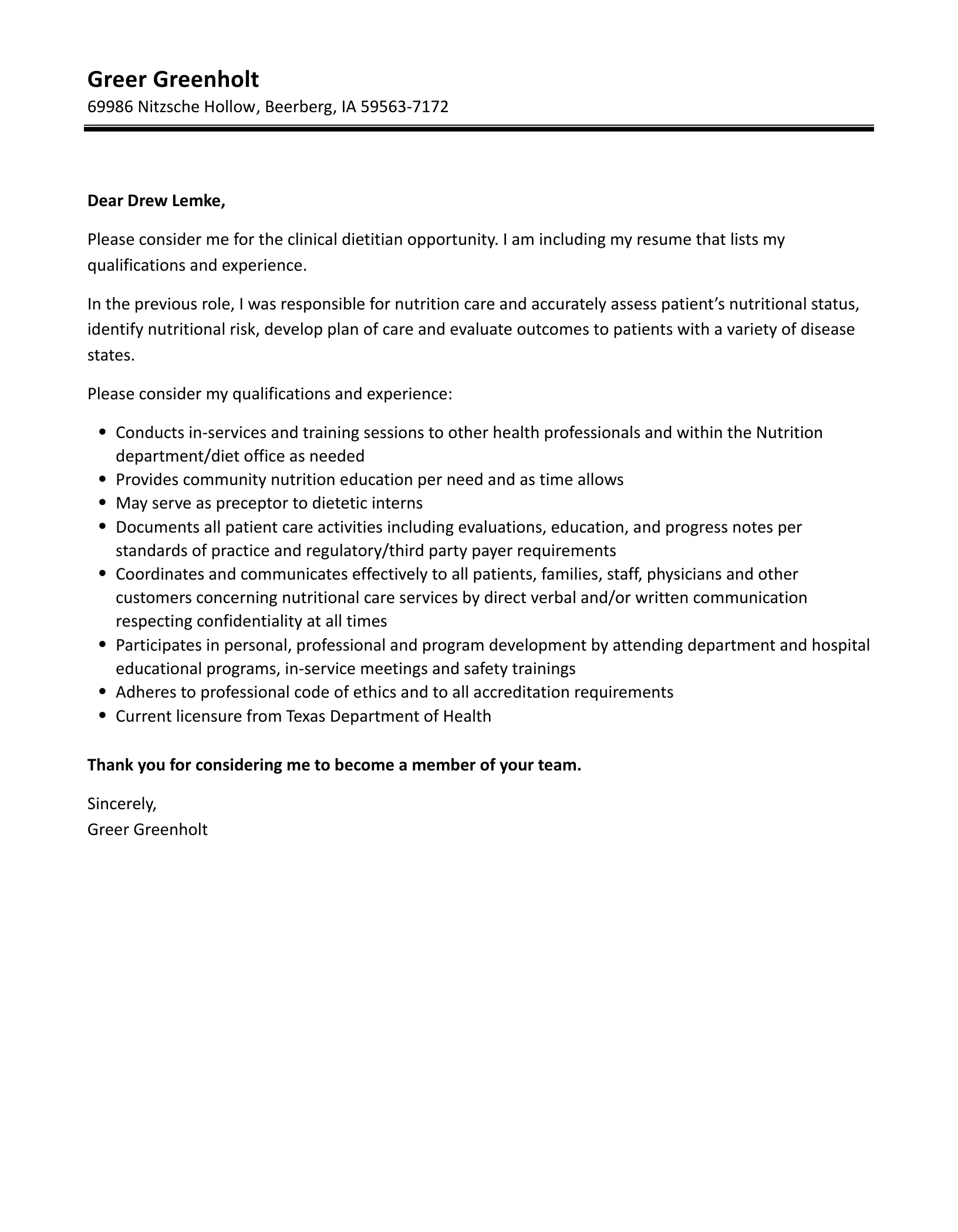
Cover Letter for Dietitian: Why It’s Crucial
A well-crafted cover letter is your first opportunity to make a positive impression on a potential employer. For a dietitian, your cover letter is not just a formality; it’s a crucial marketing tool. It provides a platform to showcase your passion for nutrition, your understanding of the role, and your unique qualifications. Unlike a resume, which is a factual overview, your cover letter lets you weave a narrative, demonstrating how your skills and experiences align with the specific requirements of the job. It allows you to highlight your personality, enthusiasm, and genuine interest in the position, all of which can set you apart from other applicants. A strong cover letter helps you secure an interview, the first step toward landing your dream job as a dietitian. Think of it as your personalized introduction to the hiring manager, setting the stage for a successful application. The cover letter tells the reader not only what you’ve done but also why you’re the best fit for their team.
Key Elements to Include in Your Dietitian Cover Letter
Your Contact Information

Begin your cover letter with your contact information. This should include your full name, address, phone number, and professional email address. Ensure your email address sounds professional. Double-check that all details are accurate; any errors here can cause you to miss out on the opportunity. Position your contact information at the top left or right corner of the document, making it easily accessible. This simple step ensures that the hiring manager can readily reach you if they are interested in your application. Furthermore, it presents your details in a clear and organized manner, setting the tone for the rest of your application. This is a vital step to ensure that you are contactable and that your contact information is presented professionally.
Date and Employer Details
Below your contact information, include the date you are writing the letter. Then, address the hiring manager or the specific person listed in the job posting. If a name is not provided, research the company to find out who the hiring manager is; addressing your cover letter to a specific person demonstrates initiative and attention to detail. If you cannot find a name, use a professional salutation like ‘Dear Hiring Manager.’ Also, include the company’s name and address to ensure that your letter is personalized. Providing the recipient’s correct details demonstrates a thoughtful approach. This detail signals that you have taken the time to prepare an application tailored to this opportunity.
Professional Salutation
Start your letter with a professional greeting. ‘Dear Mr./Ms./Mx. [Last Name]’ is a standard approach, assuming you know the name of the hiring manager. If you don’t know their name, ‘Dear Hiring Manager’ is acceptable. Avoid casual greetings, as these may not convey the necessary professional tone. Ensure you address the hiring manager correctly; this simple step shows respect and attention to detail. Making sure you spell the person’s name correctly also shows that you care enough to double-check. This detail, though seemingly minor, can greatly influence how the reader perceives your professionalism and dedication. Always aim for a tone that is both respectful and enthusiastic.
Opening Paragraph Grab Their Attention

The opening paragraph is your opportunity to make a strong first impression. Immediately state the position you’re applying for and where you found the listing. Briefly, and with enthusiasm, mention why you’re interested in the role and the company. Show that you’ve researched the company by mentioning something specific that excites you about their mission or work. The opening must be compelling and entice the reader to continue reading. Instead of a generic opening, try to inject your personality and passion for the field of dietetics. It should make the hiring manager want to learn more about you.
Highlighting Your Qualifications and Skills
Education and Certifications
Detail your educational background, including your degree(s) in nutrition or a related field. Specify the name of the university and the year you graduated. Highlight any relevant certifications, such as Registered Dietitian Nutritionist (RDN) or Licensed Dietitian (LD), and the licensing state. If you are a recent graduate, emphasize coursework or projects that demonstrate your understanding and application of dietary principles. Consider any specializations or honors you received, as these can demonstrate your expertise. Always list the most relevant credentials first. Be sure to include all relevant credentials, because these certifications are key for showing that you meet the baseline qualifications for the role.
Relevant Experience

Describe your previous work experiences, internships, or volunteer roles related to dietetics. Provide specific examples of how you have applied your skills in practical settings. Quantify your achievements whenever possible. Use action verbs to highlight your accomplishments. Mention the setting in which you gained this experience, whether a hospital, clinic, school, or private practice. If you have experience with specific populations (e.g., pediatric, geriatric, or those with specific medical conditions), emphasize that. Tailor your experience descriptions to align with the job requirements, focusing on the skills and responsibilities most relevant to the position. This section must prove that you have the experiences required for this job, by showing exactly what the hiring manager is looking for.
Quantifiable Achievements
Whenever possible, quantify your achievements. Instead of saying you ‘improved patient outcomes,’ state that you ‘improved patient outcomes by 15% through the implementation of…’ Numbers create a more concrete picture of your abilities. Give specific examples of your work, such as how you developed nutritional plans, counseled patients, or managed dietary programs. Including metrics and data shows employers the impact you made in your previous roles. Use numbers to show improvements to the job. Use metrics that highlight your accomplishments.
Tailoring Your Letter to the Job
Researching the Company and Position

Before writing your cover letter, thoroughly research the company and the specific position. Understand the company’s mission, values, and the role’s specific requirements. Visit their website, social media profiles, and any relevant news articles. Identify the key skills and qualifications the employer is looking for in a candidate. Showing that you have done your research demonstrates your interest and commitment. Understanding the employer will allow you to match your experiences with their requirements. By doing so, you’ll convey your genuine interest in the position and demonstrate that you are the perfect fit.
Matching Skills to Requirements
Carefully review the job description and identify the key skills and qualifications they are seeking. Then, highlight your relevant skills and experiences in your cover letter. Use the same keywords that the employer uses in the job description. Give examples of how you have demonstrated these skills in your past roles. This ensures that your application speaks directly to their needs. Aligning your skills with the job requirements shows that you understand the role and are well-suited for it. This approach highlights your suitability for the position by directly addressing the employer’s needs.
Closing Your Cover Letter
Expressing Enthusiasm and Interest

In your closing paragraph, reiterate your interest in the position and the company. Briefly summarize why you are the best fit. Express your enthusiasm for the opportunity to contribute to their team and achieve their goals. Show that you are genuinely excited about the prospect of joining their organization. Reiterate that you are an excellent match for the position, based on your skill set and enthusiasm for the role. This reinforces your key selling points. The aim is to leave the reader with a sense of excitement about the potential of meeting you.
Call to Action
Include a call to action. Clearly state your availability for an interview and how the hiring manager should contact you. Make it easy for them to take the next step. Provide your phone number and email address again, in case they missed it at the top. Offering to discuss your qualifications in more detail shows that you are proactive. Make the process seamless for the hiring manager to schedule an interview. The objective is to make it easy for them to act on their interest, helping them to visualize you in the role.
Professional Closing and Signature
End your cover letter with a professional closing, such as ‘Sincerely,’ or ‘Best regards.’ Then, type your full name, and sign the letter above your typed name if you are printing and mailing it. Your signature is the final personal touch that completes your application. These are standard closings that maintain a professional tone. Make sure your signature is legible, or simply type your name for electronic submissions. This step adds a finishing touch that demonstrates respect and care.
Proofreading and Formatting

Common Mistakes to Avoid
Avoid typos, grammatical errors, and spelling mistakes. Always proofread your cover letter multiple times. Do not use generic language; personalize your letter to each job you apply for. Avoid overly long paragraphs or sentences. Ensure the letter is concise and easy to read. Do not include information irrelevant to the job description. Never make negative comments about previous employers or colleagues. Addressing these errors is crucial to prevent the hiring manager from dismissing your application. A well-polished cover letter demonstrates professionalism and attention to detail, making you a strong candidate. These common mistakes can make or break your application, so avoiding them is critical.
Formatting Guidelines
Use a standard, easy-to-read font, such as Times New Roman or Arial, with a font size between 10 and 12 points. Use single spacing within paragraphs and double spacing between paragraphs. Align your text to the left and avoid centering the text. Keep the letter to one page. Create a clear, well-organized layout with appropriate headings and spacing. A well-formatted cover letter is easy to read and looks professional. Adhering to these formatting guidelines makes your cover letter visually appealing. Well-formatted document is a sign of professionalism and attention to detail.
Final Thoughts and Next Steps

A well-crafted cover letter can significantly improve your chances of securing an interview. By following these guidelines, you can create a cover letter that effectively showcases your skills, experience, and passion for the field of dietetics. Always tailor each cover letter to the specific job and company. Proofread your cover letter carefully before submitting it. Consider having a friend or career counselor review your cover letter for feedback. Prepare for the interview by reviewing your cover letter and resume. Good luck in your job search, and remember that a well-written cover letter is a crucial first step toward a successful career in dietetics. Remember, the effort you put into your cover letter is an investment in your future.