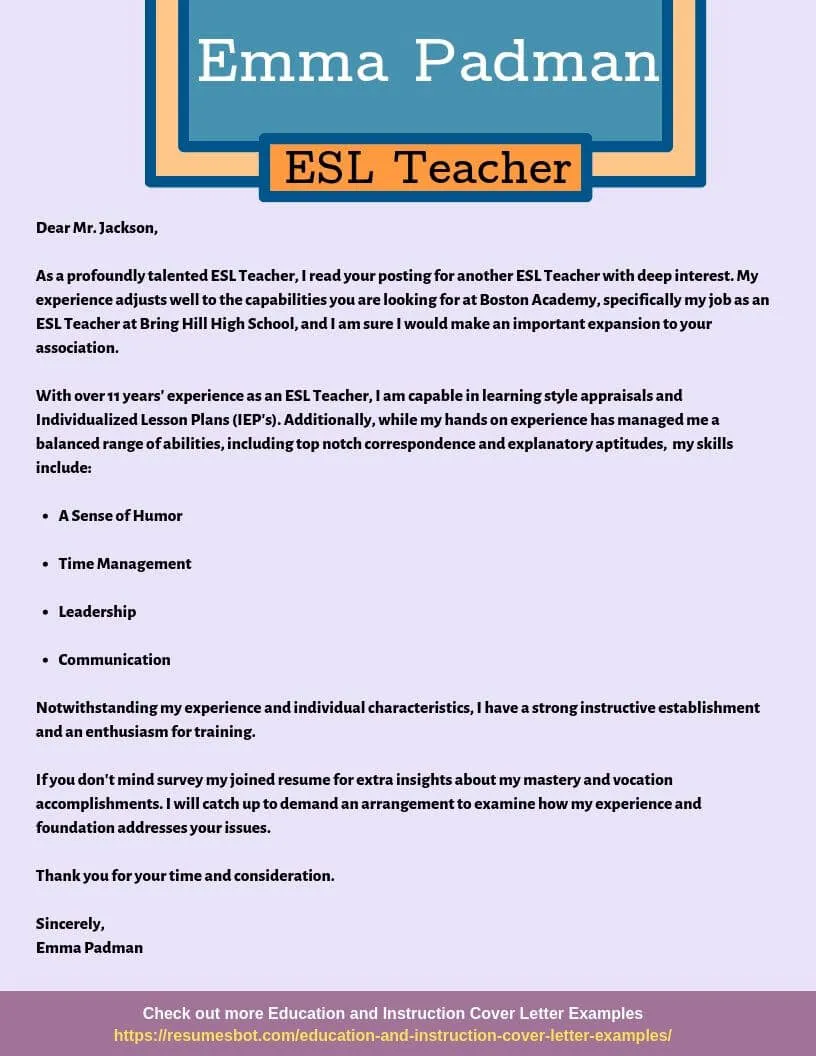
What is an ESL Cover Letter (Definition)
An ESL cover letter is a formal document that you submit with your resume when applying for a job related to teaching English as a Second Language. This could include positions such as ESL teacher, tutor, curriculum developer, or even roles that require strong English communication skills. The purpose of the cover letter is to introduce yourself to the hiring manager, highlight your relevant skills and experiences, and express your interest in the specific position. It’s your first chance to make a strong impression and convince the employer that you are a suitable candidate for the role. Unlike a resume, which provides a summary of your qualifications, the cover letter allows you to elaborate on specific experiences, explain your motivations, and demonstrate your personality.
Why You Need an ESL Cover Letter
In the competitive field of ESL, a cover letter is often a must-have. It complements your resume by providing context, showcasing your communication skills, and demonstrating your genuine interest in the position and the school or organization. Your resume lists your qualifications; your cover letter explains why those qualifications make you the perfect fit. It allows you to address any potential gaps in your resume, such as career changes or periods of unemployment, and to emphasize the skills and experiences that are most relevant to the job description. In addition to this, it enables you to articulate your teaching philosophy, your approach to working with students, and your understanding of the challenges and rewards of teaching ESL. Sending a well-crafted cover letter demonstrates professionalism and attention to detail, which can significantly increase your chances of securing an interview.
Key Components of an ESL Cover Letter

A successful ESL cover letter follows a standard structure, ensuring that key information is presented clearly and effectively. It consists of several crucial elements, each contributing to a complete and persuasive presentation of your qualifications and interest. Understanding these core components is essential for creating a cover letter that captures the attention of hiring managers and effectively showcases your skills and experiences. By paying attention to the details of each section, you can significantly enhance the impact of your cover letter and increase your chances of landing an interview. The key components collectively work to provide a clear and comprehensive overview of your suitability for the ESL position.
Header Information
The header of your ESL cover letter should include your contact information. This is the first thing a recruiter or hiring manager will see, so it is essential to ensure it’s clear, accurate, and professional. This section should include your full name, address, phone number, and email address. Ensure your email address is professional (e.g., firstname.lastname@email.com) and not a personal or informal address. Also, if you have a LinkedIn profile, consider including the URL in your header as well. The header’s purpose is to make it easy for the recruiter to reach you if they are interested in your application. Therefore, accuracy and completeness in this section are crucial, setting the tone for the rest of your letter.
Your Contact Information
Place your contact information at the top left or right corner of your cover letter. Include your full name, address, phone number, and professional email address. This ensures the recruiter can easily reach you. Using a clear and simple format, such as a modern font like Arial or Calibri, can make this information easy to read at a glance. Make sure all the details are current and accurate to avoid any missed opportunities due to incorrect contact information. Your contact information should be clearly distinguishable from the rest of the letter, possibly in a slightly larger font size. Presenting your contact details in a clean and organized manner reflects professionalism and attention to detail.
The Recipient’s Contact Information

Directly below your contact information, include the recipient’s details. If you know the name of the hiring manager, address the letter to them directly (e.g., ‘Dear Mr. Smith’). If you are unsure, use a general greeting such as ‘Dear Hiring Manager’. Include the recipient’s title, the company’s name, and their address. This shows that you’ve done your research and are genuinely interested in the specific role and organization. Checking the company’s website or job posting often provides this crucial information. Always double-check the spelling of the recipient’s name and the company’s name. Addressing the letter correctly is a sign of respect and attention to detail.
The Salutation
The salutation sets the tone for your entire cover letter. As mentioned above, if you know the hiring manager’s name, use it (e.g., ‘Dear Ms. Johnson’). If you do not know the name, use a formal greeting like ‘Dear Hiring Manager’ or ‘Dear [Company Name] Hiring Team’. Avoid generic greetings like ‘To Whom It May Concern,’ as they can make your letter seem impersonal. Ensure the salutation matches the overall tone of your letter. A well-chosen salutation shows that you’ve taken the time to personalize your application. Using the correct salutation is a small but impactful detail that can set a positive first impression.
Body of the ESL Cover Letter
The body of your ESL cover letter is the heart of your application. It’s where you tell your story, highlight your qualifications, and express your interest in the position. This section typically consists of three or four paragraphs, each serving a specific purpose in conveying your suitability for the role. The body is where you demonstrate your ability to communicate effectively and persuasively. It is an opportunity to make a compelling case for why you are the ideal candidate. Make sure that your language is clear, concise, and tailored to the job description. This section is critical for capturing the recruiter’s attention and making a lasting impression.
First Paragraph Introduce Yourself

In the first paragraph, introduce yourself and state the position you are applying for. Mention where you saw the job posting (e.g., the company website, a job board). Briefly mention your background, experience, and any key qualifications that make you a good fit for the role. This paragraph should grab the reader’s attention and make them want to read more. Clearly stating your intention at the outset demonstrates professionalism. Tailor your opening to the specific job requirements mentioned in the job posting. You want to quickly capture the reader’s attention and demonstrate your suitability. Make sure to keep it concise and engaging.
Second Paragraph Highlight Relevant Skills
The second paragraph is where you highlight the skills and experiences that are most relevant to the job. Review the job description carefully and identify the key requirements. Provide specific examples of how you have demonstrated these skills in previous roles. Quantify your achievements whenever possible to show your impact (e.g., ‘Increased student test scores by 15%’). This is your chance to show the employer what you can do. Be specific and provide examples; don’t just list skills. Connect your experience to the specific needs of the school or organization. This paragraph should make a strong case for why you are a good fit based on your previous experiences.
Third Paragraph Express Enthusiasm
In the third paragraph, express your enthusiasm for the specific position and the organization. Explain why you are interested in working for them. Research the company and mention something specific that appeals to you (e.g., their teaching philosophy, their commitment to professional development). Show that you have done your research and genuinely want to be a part of their team. Emphasize how your goals align with the organization’s mission. This demonstrates your genuine interest and helps to establish a connection with the reader. Expressing your passion for teaching and your enthusiasm for the opportunity can make a lasting impression.
Closing and Call to Action

Conclude your cover letter with a strong closing paragraph. Reiterate your interest in the position, and express your eagerness to discuss your qualifications further in an interview. Thank the hiring manager for their time and consideration. Include a call to action, such as ‘I look forward to hearing from you soon’ or ‘Thank you for your time, and I am available for an interview at your earliest convenience.’ Reiterate your contact information at the end. This final paragraph should be concise and confident, leaving the reader with a positive impression. A well-crafted closing ensures that you leave a lasting impression and makes it easy for the hiring manager to take the next step.
Common Mistakes to Avoid
Avoiding common mistakes is crucial for making a positive impression. One of the most significant errors is sending a generic cover letter. Always tailor your letter to each specific job. Another common mistake is grammatical errors and typos, which can undermine your credibility. Ensure your writing is clear, concise, and free of errors. Don’t simply repeat your resume; instead, elaborate on your qualifications and show how they align with the job requirements. Being too informal is also a mistake; maintain a professional tone throughout your letter. Finally, failing to proofread your cover letter can lead to easily avoidable errors. Proofreading is an important step, double-check everything, and ask a friend or colleague to review it as well. Be meticulous about the details to ensure your letter is polished and professional.
Proofread and Edit Your ESL Cover Letter
Proofreading and editing are essential steps. Thorough proofreading ensures that your cover letter is polished and professional. Start by checking for grammatical errors, spelling mistakes, and typos. Use a spell checker, but don’t rely solely on it; sometimes, it won’t catch everything. Ensure your writing is clear, concise, and easy to understand. Read your letter aloud to catch any awkward phrasing or sentence structures. Ask a friend or colleague to review your letter as a fresh set of eyes can often spot errors you may have missed. Make sure the formatting is consistent and professional. Proofreading is your final chance to make sure your cover letter is impeccable and reflects positively on your professionalism and attention to detail.
ESL Cover Letter Examples for Different Situations

Different ESL positions require slightly different approaches in your cover letter. If you’re applying for a teaching position, emphasize your teaching experience, your ability to create lesson plans, and your classroom management skills. If you’re applying for a tutoring position, highlight your experience working with individual students and your ability to adapt to different learning styles. When applying for a position in a specific country or culture, tailor your letter to reflect your understanding of that culture and your willingness to adapt. Each application should be customized. Review the job description carefully to ensure that you’re addressing the specific requirements and expectations of the role. Use the examples as inspiration and tailor your cover letter to showcase your unique skills and experiences for each opportunity.