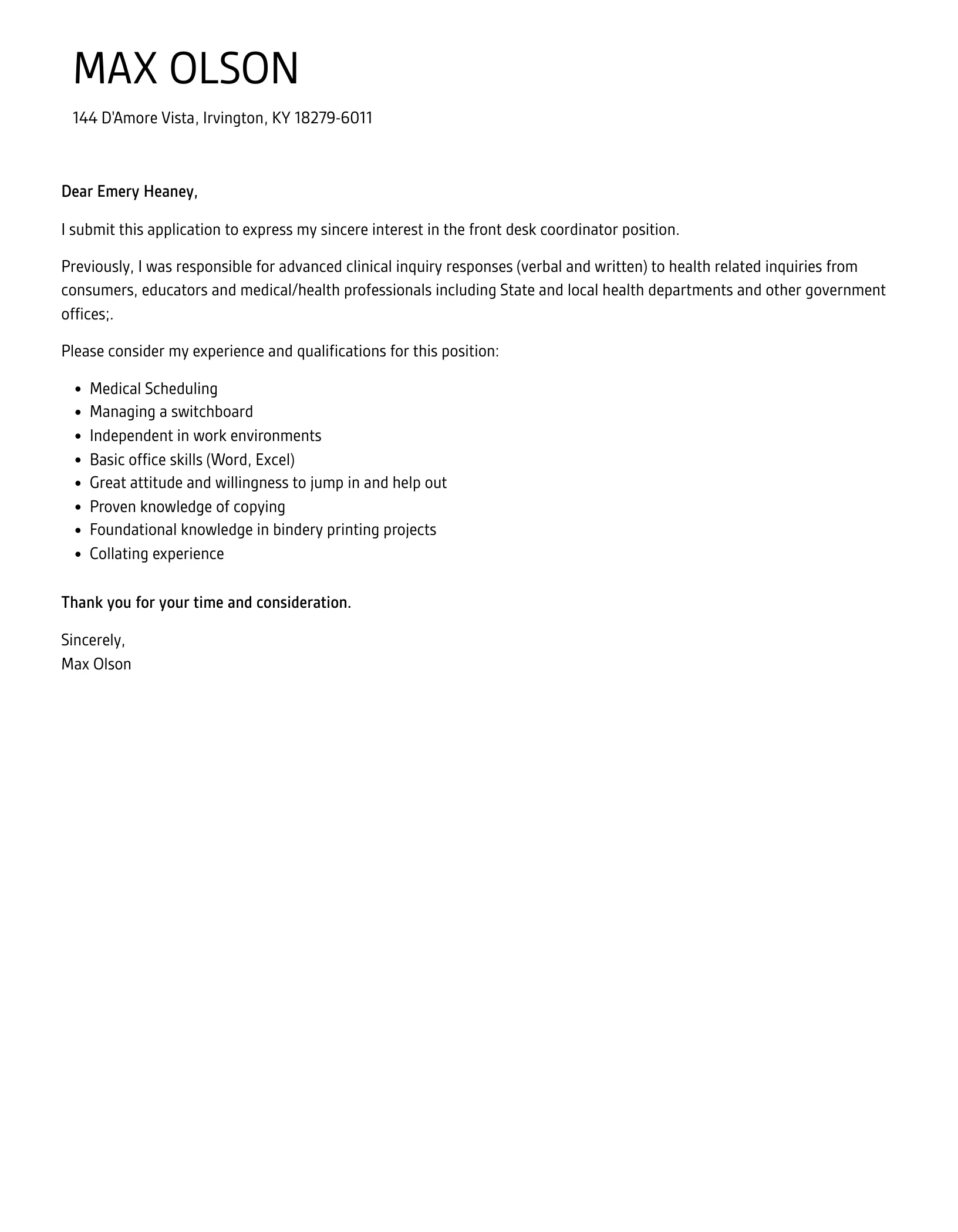
Highlighting Your Skills and Experience
Your front desk coordinator cover letter is your chance to shine. Begin by showcasing your most relevant skills and experiences. Think of the job description as your guide – identify the key requirements and match your abilities to them. For example, if the role emphasizes customer service, highlight your experience in handling inquiries, resolving issues, and ensuring customer satisfaction. Similarly, if the position requires proficiency in specific software or systems, be sure to mention those explicitly. Don’t just list your responsibilities; provide concrete examples of how you’ve excelled in previous roles. This section should serve as a compelling introduction, convincing the hiring manager that you possess the necessary qualifications to excel as a front desk coordinator. Remember to keep it concise and to the point, allowing the reader to quickly grasp your suitability for the position.
Tailoring Your Cover Letter to the Job Description
Generic cover letters are easily spotted and often discarded. To significantly increase your chances of success, tailor each cover letter to the specific job and company. Carefully read the job description and identify the key skills, experiences, and qualifications the employer is seeking. Then, adjust your cover letter to reflect these requirements. Use the same keywords and phrases that are used in the job description, whenever appropriate, to show that you understand the role and the company’s needs. This shows you’ve taken the time to understand their specific requirements. Customizing your cover letter demonstrates your genuine interest in the position and shows the hiring manager that you are not just sending out a mass application. By tailoring your letter, you demonstrate a proactive and thoughtful approach to the job search, setting you apart from candidates using a one-size-fits-all approach.
Researching the Company

Before writing your cover letter, research the company. Understanding the company’s mission, values, and culture will help you tailor your letter effectively. Visit their website, read about their recent news and initiatives, and check their social media profiles. This research allows you to demonstrate your genuine interest in the company and to align your cover letter with their goals. For instance, if the company emphasizes customer service excellence, you can highlight your experience in providing exceptional customer care. If they have won awards or are involved in community service, you can acknowledge these achievements, showing that you share their values. Mentioning something specific that you admire about the company also shows initiative and a desire to be part of their team. This level of preparation indicates your attention to detail and a proactive approach, both of which are valuable qualities for a front desk coordinator.
Formatting Your Cover Letter
The format of your cover letter can significantly impact a hiring manager’s first impression. Keep your cover letter professional, easy to read, and well-organized. Choose a clean, professional font such as Times New Roman, Arial, or Calibri, and use a font size between 10 and 12 points. Use standard margins (1 inch on all sides) and single-space the text. Break up large blocks of text into shorter paragraphs to enhance readability. Include a clear heading with your contact information (name, phone number, email, and LinkedIn profile, if you have one) and the date. Address the letter to a specific person if possible; otherwise, use a professional salutation such as “Dear Hiring Manager.” Maintain a formal tone throughout the letter and ensure there are no grammatical errors or typos. Proofread carefully before submitting your application. A well-formatted cover letter demonstrates your attention to detail and organizational skills, essential qualities for a front desk coordinator.
Opening and Closing Your Cover Letter
Your opening and closing paragraphs can make or break your application. The opening should immediately grab the reader’s attention. Start with a strong statement highlighting your interest in the role and the company. You can mention where you saw the job posting and why you are excited about the opportunity. Briefly state your key qualifications and why you are the ideal candidate. Your closing paragraph should reiterate your interest and express gratitude for the opportunity. Reiterate your enthusiasm and include a call to action, such as stating that you are available for an interview at their earliest convenience. Always thank the hiring manager for their time and consideration. A well-crafted opening and closing can leave a lasting positive impression, showcasing your communication skills and professionalism.
Proofreading and Editing

Before submitting your cover letter, proofread and edit it meticulously. Errors, whether grammatical, spelling, or formatting, can create a negative impression and undermine your credibility. Read the letter multiple times, and consider reading it aloud to catch any awkward phrasing or mistakes. Use a grammar and spell-checking tool, but don’t rely on it entirely; these tools can miss subtle errors. It’s also helpful to have a friend, family member, or career counselor review your letter. A fresh pair of eyes can spot errors you might have missed. Make sure that all the information is accurate, including the company name, the job title, and the hiring manager’s name. A polished, error-free cover letter reflects your professionalism and attention to detail, qualities that employers value highly.
Key Skills to Mention
When writing your cover letter, be sure to emphasize the key skills that align with the front desk coordinator role. These typically include excellent communication skills, both written and verbal. Highlight your ability to interact professionally with clients, vendors, and colleagues. Mention your proficiency in handling phone calls, managing emails, and greeting visitors. Customer service skills are crucial, so showcase your experience in resolving issues, providing information, and ensuring customer satisfaction. Organizational skills, such as the ability to manage schedules, handle paperwork, and maintain records, are also essential. If the job description mentions specific software or systems, such as Microsoft Office or specific CRM systems, make sure to include them. Adaptability, time management, and the ability to multitask are additional valuable skills. Demonstrating these skills will prove to the hiring manager that you are a good fit for the position.
Quantifying Your Achievements
Instead of simply listing your responsibilities, use quantifiable achievements to make your cover letter more impactful. Provide specific examples of how you have made a positive impact in previous roles. For instance, instead of saying “Managed phone calls,” you could say, “Managed an average of 50 phone calls daily, consistently ensuring all inquiries were addressed promptly and professionally.” If you improved any processes, state the outcome, such as “Implemented a new visitor management system, reducing wait times by 20%.” Quantifying your achievements with numbers, percentages, or specific results demonstrates your ability to drive results and provides concrete evidence of your capabilities. This approach makes your cover letter more compelling and allows the hiring manager to easily understand the value you can bring to the company. Use the STAR method (Situation, Task, Action, Result) to structure your examples to showcase your achievements effectively.
Using Action Verbs

Action verbs can make your cover letter more dynamic and engaging. Start your sentences with strong action verbs to clearly and concisely describe your accomplishments and skills. Instead of writing “Responsible for managing schedules,” use action verbs like “Managed schedules for…” or “Coordinated appointments for…”. Other effective action verbs include “achieved,” “organized,” “implemented,” “streamlined,” “resolved,” “supported,” “created,” and “developed.” Using action verbs makes your cover letter more impactful by showing what you did, rather than just what your responsibilities were. This technique adds energy to your writing and helps the hiring manager quickly understand your value as a potential employee. It shows you’re a proactive and results-oriented individual, which are qualities employers seek.
Demonstrating Enthusiasm and Professionalism
Your cover letter should reflect both your enthusiasm for the role and your professionalism. Express your genuine interest in the position and the company. Use language that shows your excitement and eagerness to contribute to the team. At the same time, maintain a professional tone throughout the letter. Avoid overly casual language, slang, or emojis. Your cover letter is a formal introduction, so use proper grammar, punctuation, and sentence structure. Demonstrate respect for the hiring manager and the company by using a professional tone and clear, concise language. Showing enthusiasm combined with professionalism creates a positive first impression and demonstrates your commitment to the role. This approach suggests that you are not only qualified but also a pleasant and reliable individual to work with.