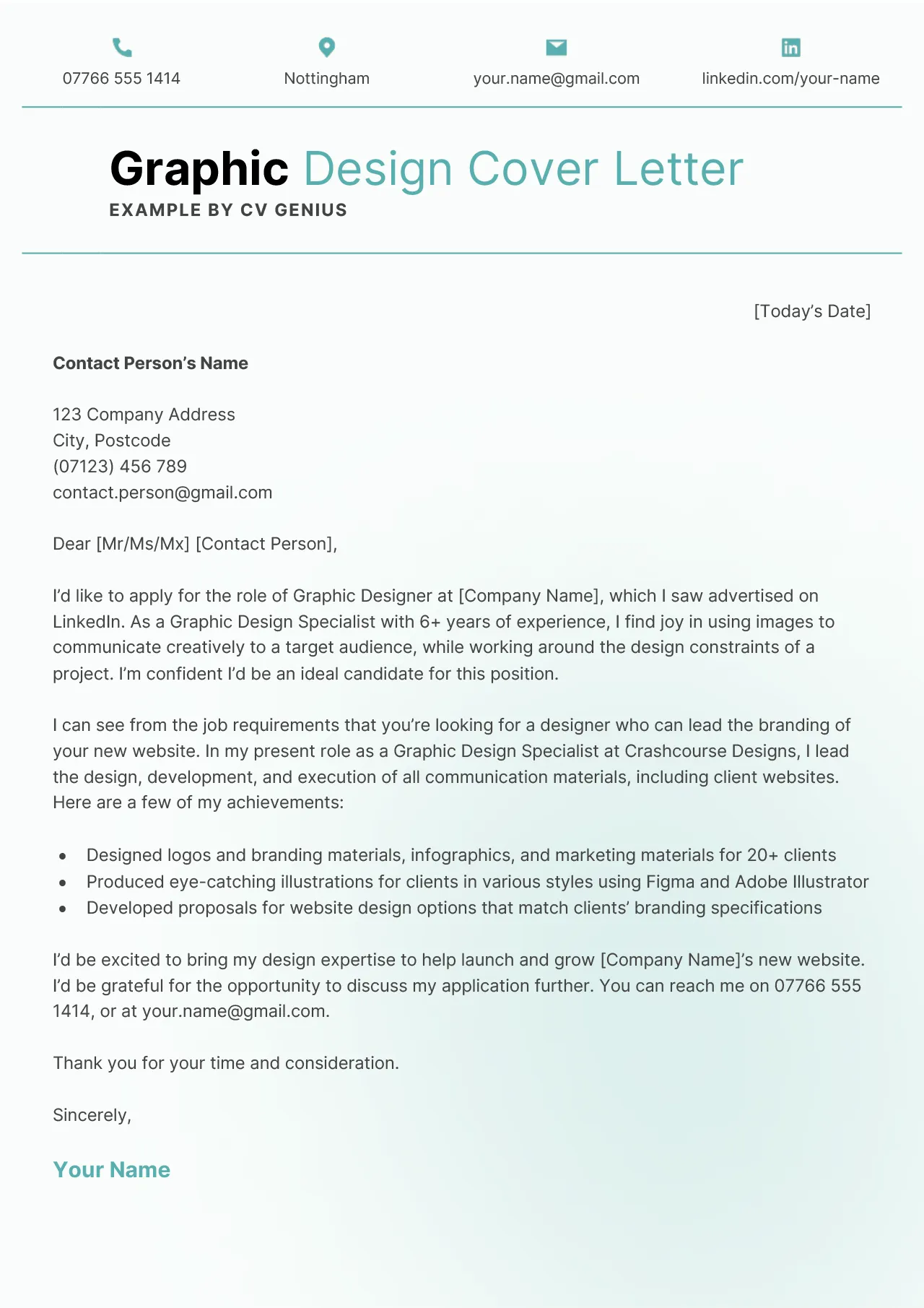
Why You Need a Stellar Graphic Designer Cover Letter
In the competitive world of graphic design, your cover letter is your first opportunity to make a lasting impression. It’s not merely a formality; it’s your chance to showcase your personality, passion, and understanding of the specific role and company you’re applying to. Think of it as the narrative behind your designs, a platform to explain your creative process and demonstrate your communication skills. A well-crafted cover letter can distinguish you from other applicants, regardless of how impressive your portfolio might be. It complements your portfolio by providing context to your work and highlighting your suitability for the position. Without a strong cover letter, your application could easily get lost in a pile of other submissions, so it’s essential to make it count. This allows the hiring manager to know more about you beyond your technical skillset.
The Core Components of a Graphic Design Cover Letter
A compelling cover letter for a graphic designer is more than just a formality; it’s a strategic tool to present your unique skills and experience. Every part of your cover letter contributes to your overall professional narrative, from the initial salutation to the final call to action. Structuring your cover letter in a clear and concise manner ensures the hiring manager can easily grasp your qualifications. Key components include a header, an engaging opening, a body that showcases your skills and experience, and a closing that reiterates your interest and encourages the next step. Each component serves a specific purpose, contributing to a holistic impression of you as a candidate. Your cover letter should reflect the quality of your work.
Header Information

Your header establishes the professional tone and should clearly display your name and contact information (phone number, email address, and ideally, your portfolio website or online profile link like LinkedIn). This part ensures that the hiring manager can easily reach you. Make sure this information is accurate and up-to-date. A well-formatted header also presents you as organized and detail-oriented, which are traits highly valued in graphic design. Use a clean, professional font and layout for your header; simplicity is key here. Don’t clutter it with unnecessary graphics or design elements; the focus should be on providing essential contact details in a readable and accessible way. Consider the header as your personal branding statement, showcasing your professional identity.
Your Contact Details
Ensure that your contact details are easily accessible and professional. Use a professional email address (e.g., yourname@email.com) rather than a casual one. Double-check your phone number for accuracy. Including a link to your online portfolio or LinkedIn profile is highly recommended; this allows the hiring manager to immediately access your work and professional background. Make sure your online portfolio is up-to-date and showcases your best work. These details should be prominently displayed at the top of your cover letter to facilitate easy communication and access to your professional profile. The ease with which a potential employer can reach you can greatly impact your chances of getting an interview.
The Recipient’s Information
Always address your cover letter to a specific person, if possible. Research the company to find the hiring manager’s name or the recruiter’s contact information. Addressing the cover letter to a specific person shows that you’ve done your research and are genuinely interested in the position. Avoid generic salutations like ‘To Whom It May Concern’ – they can make your application seem impersonal. If you can’t find a specific name, use a title like ‘Hiring Manager’ or ‘Recruiting Team’. Customizing this section demonstrates attention to detail and professionalism. Knowing who to address your letter to shows that you are willing to put in the extra effort.
Salutation

The salutation sets the tone of your letter. Use a formal salutation like ‘Dear Mr./Ms./Mx. [Last Name]’ if you know the recipient’s name. If you don’t have a specific name, ‘Dear Hiring Manager’ is a suitable alternative. Make sure your salutation matches the tone of the company and the job. Avoid overly casual greetings. A professional salutation immediately signals your seriousness and respect for the opportunity. If the job description specifies a particular way to address the recipient, make sure to follow it to show attention to detail. Getting this right is part of making a good first impression.
Crafting a Compelling Opening
Your opening paragraph is critical; it needs to grab the reader’s attention and make them want to read more. Start by mentioning the position you are applying for and how you found the job posting. Then, briefly state why you are a good fit. Consider including a strong statement about your passion for graphic design or a brief anecdote that highlights your relevant skills or experience. Make it clear from the outset why you are interested in the company. The opening should demonstrate your enthusiasm and set the stage for the rest of your cover letter. Avoid generic opening lines; tailor it to the specific job and company. This is your first chance to grab the attention of the hiring manager.
Highlighting Your Skills and Experience
This is where you showcase how your skills and experience align with the job requirements. Review the job description and identify the key skills and experiences the employer is looking for. Provide specific examples from your past work to demonstrate those skills. Use action verbs to describe your accomplishments and responsibilities. Focus on the most relevant aspects of your experience and tailor your examples to fit the job. Show, don’t just tell; provide concrete examples of projects you’ve worked on and the outcomes you achieved. This section should provide a comprehensive picture of your professional capabilities. Show your potential employer that you have the required skills and experience for the job.
Quantifiable Achievements

Whenever possible, quantify your achievements. Instead of saying ‘Improved social media engagement,’ say ‘Increased social media engagement by 40% in six months.’ Use numbers and data to back up your claims and demonstrate the impact of your work. Quantifiable achievements provide concrete evidence of your skills and make your application more compelling. Consider using metrics such as project completion rates, client satisfaction scores, or any other relevant data that showcases your success in previous roles. Including these details demonstrates that you are results-oriented and focused on delivering tangible value. Data-driven examples are more persuasive.
Showcasing Your Design Portfolio
Your portfolio is your primary selling tool as a graphic designer. In your cover letter, briefly mention your portfolio and direct the reader to it. Highlight specific projects that are most relevant to the job you’re applying for. Explain the purpose of those projects and the outcomes achieved. If there is a particular design style or software proficiency the job requires, be sure to showcase projects that highlight those skills. Make sure your portfolio is easily accessible and well-organized. A clear and concise description of your work is essential in making a strong impression. Provide a link to your online portfolio so the hiring manager can easily view your work. Ensure that your portfolio is easy to navigate and that your best work is featured prominently.
Tailoring Your Letter to the Job
Avoid using a generic cover letter. Tailor each cover letter to the specific job and company. Research the company’s values, mission, and recent projects. Use this information to customize your letter and show that you understand their brand and design aesthetic. Highlight how your skills and experience align with the company’s specific needs and values. Addressing the job requirements directly demonstrates your attention to detail and your genuine interest in the position. Personalization makes your application more compelling and shows that you are taking the time to create a custom application. This shows that you are genuinely interested in the role and the company.
Demonstrating Enthusiasm for the Company

Show your enthusiasm for the company by mentioning something specific that appeals to you about their work or culture. Demonstrate that you have researched the company and understand their brand. Mention any company projects or designs that you admire. Expressing genuine interest in the company and its values can set you apart from other applicants. Showing enthusiasm makes you appear more personable and highlights your willingness to contribute to the company’s goals. Refer to the company’s recent projects or initiatives to demonstrate that you have taken the time to learn about them. Let them know why you want to work for them.
The Closing and Call to Action
Your closing paragraph should reiterate your interest in the position and the company. Thank the hiring manager for their time and consideration. Include a clear call to action, such as stating that you are available for an interview and look forward to discussing your qualifications further. Proofread your letter carefully before sending it. Make sure all contact information is accurate. A strong closing paragraph can reinforce your enthusiasm and increase your chances of receiving an interview. Avoid casual closings, such as “Best” or “Sincerely.” Instead, opt for professional closings like “Sincerely,” “Best regards,” or “Thank you for your consideration.” The call to action encourages the hiring manager to take the next step.
Example 1 Cover Letter for a Junior Graphic Designer
This type of cover letter should emphasize your passion, eagerness to learn, and basic skills. Highlight any relevant coursework, internships, or personal projects. Showcase your understanding of design principles. Mention your proficiency in essential design software like Adobe Photoshop and Illustrator. Frame your limited experience in a positive light, highlighting your enthusiasm for the field and your willingness to develop skills. Mention any relevant courses, workshops, or online training to demonstrate your dedication to design. Keep your letter concise, focusing on your potential and eagerness to contribute. This is a great opportunity to showcase your enthusiasm and desire to learn.
Example 2 Cover Letter for a Senior Graphic Designer

A senior graphic designer cover letter should highlight extensive experience and proven leadership skills. Provide detailed examples of successful projects, including the scope of work, your responsibilities, and the results achieved. Demonstrate your ability to manage projects, lead teams, and mentor junior designers. Showcase your expertise in design strategies, brand development, and client management. Use data to back up your claims, such as project completion rates, revenue generated, or improvements in brand recognition. Your cover letter should clearly communicate your value as a seasoned professional. Prove that you have the skills and experience to deliver.
Example 3 Cover Letter for a Freelance Graphic Designer
Your cover letter as a freelance graphic designer should emphasize your independence, flexibility, and ability to manage multiple projects. Highlight your project management skills, client communication abilities, and your experience in handling various clients and industries. Showcase your self-motivation, organizational skills, and the ability to meet deadlines. Include testimonials or references from previous clients to demonstrate your reliability and the quality of your work. Provide examples of successful projects you’ve completed for other clients. Your cover letter should illustrate that you are a dependable professional who delivers high-quality results. Show how well you are able to manage projects independently and deliver high-quality results to your clients.
Example 4 Cover Letter for a Graphic Designer with Specialized Skills
If you have specialized skills such as UI/UX design, motion graphics, or 3D modeling, focus your cover letter on those areas. Highlight the relevant projects and results. Demonstrate your expertise in the specific software and tools required for the job. Show how your specialized skills can contribute to the company’s goals. Include examples of your designs that showcase these skills. For instance, if you specialize in UI/UX design, highlight your process of user research, wireframing, and prototyping. Make sure that you are using the right keywords that are aligned with the role you are seeking. This is an opportunity to show off your specialism.
Example 5 Cover Letter for a Graphic Designer Applying for a Creative Agency

A cover letter for a creative agency should highlight your adaptability, creativity, and teamwork skills. Showcase your ability to work in a collaborative environment and to deliver innovative solutions. Mention any experience with agency processes, client interaction, and project management. Include examples of your creative projects that are relevant to the agency’s work. Highlight your design thinking, ability to develop unique concepts, and understanding of marketing principles. Show how your creative vision aligns with the agency’s brand identity. Illustrate that you understand the agency’s environment and are able to contribute creatively.