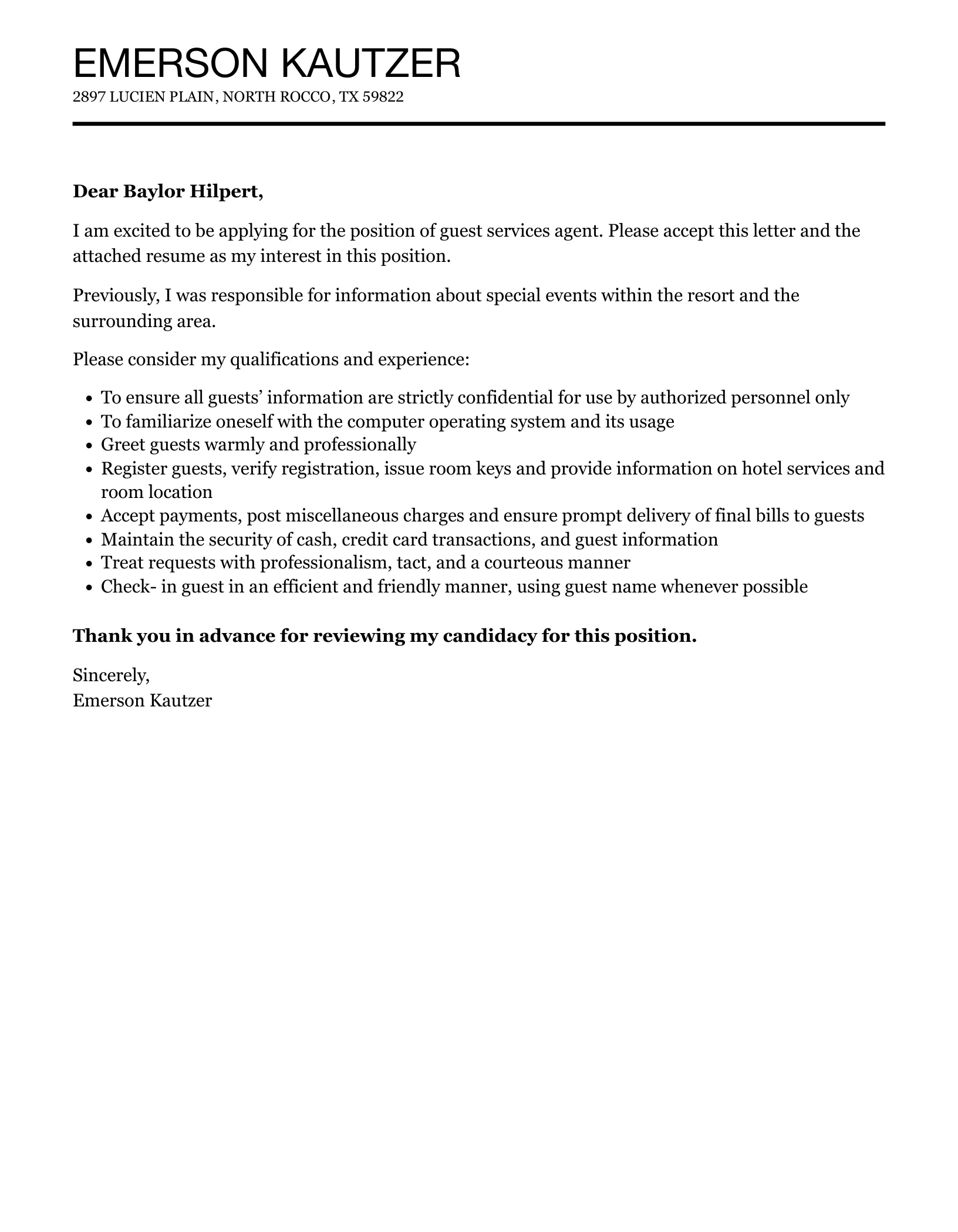
Why a Great Guest Service Cover Letter Matters
In the competitive world of guest services, a well-crafted cover letter is your initial handshake with potential employers. It’s your first opportunity to make a strong impression and demonstrate why you’re the ideal candidate for the role. A compelling cover letter not only introduces you but also highlights your skills, experience, and personality in a way that a resume alone cannot. Think of it as your personal sales pitch, designed to captivate the hiring manager and entice them to learn more about you. It gives you the chance to explain your motivations for applying, showcase your enthusiasm for the company, and emphasize your unique qualifications that align with the specific job requirements. By taking the time to create a tailored cover letter, you’re showing a genuine interest in the position and setting yourself apart from other applicants. A cover letter that gets you hired is one that is a blend of professionalism and personalization, crafted to make you the candidate the hiring manager remembers.
Highlighting Relevant Skills for Guest Service Roles
Guest service positions demand a specific set of skills that go beyond simply being friendly. To make your cover letter stand out, you need to explicitly showcase the skills most valued by employers in this field. These skills are not just about what you can do but how you do it. Highlighting the specific ways you’ve demonstrated these abilities in previous roles will significantly increase your chances of landing an interview. Tailoring your skills to match the job description is crucial; read the job description carefully and pick out the key requirements. Then, in your cover letter, provide concrete examples of how you’ve utilized those skills to achieve positive outcomes. Don’t just list your skills, demonstrate them through your experience. This approach shows the hiring manager that you’re not just claiming to have these skills; you’re proving it.
Communication and Interpersonal Skills

Effective communication is at the heart of guest service. This involves both verbal and written skills, including the ability to articulate clearly, listen attentively, and adapt your communication style to different individuals. Your cover letter should highlight instances where you have successfully used your communication skills to resolve issues, provide information, or build rapport with guests or customers. Strong interpersonal skills are also critical, meaning the ability to interact positively with others, demonstrate empathy, and build relationships. Showcase examples of how you’ve handled difficult situations, such as complaints or conflicts, with grace and professionalism. Mention your ability to work as part of a team, collaborate with colleagues, and contribute to a positive work environment.
Problem-Solving Abilities
Guest service representatives are often the first point of contact for problem resolution. Employers look for candidates who can quickly assess situations, identify the root cause of an issue, and implement effective solutions. In your cover letter, provide specific examples where you have demonstrated strong problem-solving skills. Describe the challenge you faced, the steps you took to address it, and the positive outcome that resulted from your actions. This can include resolving customer complaints, troubleshooting technical issues, or finding creative solutions to guest requests. Quantifying your achievements, such as the number of complaints resolved or the improvement in customer satisfaction scores, adds credibility to your claims. Demonstrate your ability to think on your feet, remain calm under pressure, and take initiative to find solutions.
Empathy and Patience
Empathy and patience are vital traits for success in guest service roles. Guests often reach out when they are frustrated or in need of assistance, and your ability to show compassion and understanding can make a significant difference in their experience. Highlight instances where you’ve demonstrated empathy and patience in your previous roles. This could include handling difficult customers with composure, actively listening to their concerns, and showing a genuine desire to help. Describe how you were able to de-escalate tense situations, offer support, and turn a negative experience into a positive one. Mention any training or experience you have in conflict resolution or customer service techniques that demonstrate your ability to handle challenging interactions with grace and professionalism. These qualities go a long way in establishing a positive work environment and are highly sought after.
How to Structure Your Guest Service Cover Letter

A well-structured cover letter guides the reader through your qualifications and keeps them engaged. The structure should be easy to follow, making it simple for the hiring manager to grasp your key strengths and why you are the best fit for the role. Proper formatting and organization are crucial for maintaining a professional image. The layout of your cover letter should be clean and easy to read, with clear sections and ample white space. Using a standard business letter format will also add to the professional look and feel. Avoid overly complex formatting or excessive use of fonts, colors, or graphics. Sticking to a classic, clean design will make your letter look neat and organized, letting your words do the talking. A well-structured cover letter is the first step towards getting your foot in the door.
Header and Contact Information
Your cover letter should start with a clear and professional header. This section should include your full name, address, phone number, and email address. Make sure your contact information is current and easily accessible. It’s also advisable to include the date, followed by the hiring manager’s name (if known), their title, and the company’s address. Double-check all details to ensure they are accurate. Using the correct format, and proper spelling and grammar, shows attention to detail and professionalism. It’s a small detail, but it leaves a lasting impression of your professionalism.
Greeting and Introduction
The greeting should be professional and tailored to the specific job and company. Start with a formal salutation such as “Dear Mr./Ms./Mx. [Last Name]” if you know the hiring manager’s name. If you don’t know the name, use a general salutation like “Dear Hiring Manager.” Your introduction should immediately grab the reader’s attention. Briefly state the position you’re applying for and how you learned about the opportunity. Then, in one or two concise sentences, provide a strong statement about your suitability for the role. This could be highlighting your most relevant skill or experience. A compelling introduction sets the tone for your letter and encourages the hiring manager to read on. Aim to make it engaging and relevant to the specific role.
Body Paragraph 1 Emphasizing Your Value

The first body paragraph should highlight your key skills and experiences that make you an ideal candidate. Start by summarizing your core qualifications relevant to the job requirements. Then, provide specific examples to illustrate your skills. Use the job description to guide you, focusing on the qualities and requirements that the employer values most. For each point, explain how you have demonstrated these skills in past roles, providing tangible results or outcomes. Use action verbs and quantify your achievements whenever possible, showcasing your value. This paragraph should make a solid case for why the employer should be interested in your application and why you are the perfect fit for the position. Use a tone that is confident, but not arrogant, and show enthusiasm for the opportunity.
Body Paragraph 2 Showcasing Achievements
This paragraph should showcase specific achievements that demonstrate your competence and value. Focus on results and quantifiable accomplishments that show your impact in previous roles. Provide evidence of your ability to exceed expectations, solve problems, and contribute to team success. Use the STAR method (Situation, Task, Action, Result) to structure your examples. Describe the situation you were in, the task you had to complete, the actions you took, and the positive results that came from your efforts. This method is a great tool for presenting your achievements in a clear and concise way. By providing concrete examples, you offer compelling proof of your abilities and demonstrate your value to the employer. Emphasize your contributions to the company’s goals, like improvements in customer satisfaction, streamlining of processes, or increased sales.
Body Paragraph 3 Highlighting Personality
In this paragraph, you can highlight your personality and explain why you’re a good fit for the company culture. Guest service positions often require employees to be friendly, approachable, and able to work well with others. Mention your enthusiasm for the company, its mission, or its products/services. This demonstrates that you are not just looking for a job, but you are genuinely interested in joining the organization. Demonstrate your understanding of the role’s importance in enhancing customer experience. You should also showcase any relevant soft skills, like teamwork, adaptability, and problem-solving. Illustrate your ability to adapt and grow, showing that you are capable of handling any challenges that may arise. When you show that you are not just a good fit, but also an enthusiastic person, you are much more likely to be considered for the position.
Call to Action Closing

Your closing should reiterate your interest in the position and encourage the hiring manager to take the next step. Express your enthusiasm for the opportunity and your confidence that you are the right person for the role. Provide a clear call to action, such as requesting an interview and expressing your availability. Thank the hiring manager for their time and consideration. Use a professional closing such as “Sincerely” or “Best regards,” followed by your name. It is also acceptable to include your phone number and email address for easy contact. The closing paragraph should leave a lasting positive impression and remind the employer of why you’re a good fit for the job.
Formatting and Tone Best Practices
Formatting and tone are critical elements that can significantly impact how your cover letter is received. Formatting involves the layout, font, and spacing of your letter, while tone refers to your writing style. Consistent formatting, and a well-defined tone will help make your cover letter more readable and professional. Ensure a clear and easy-to-read font like Times New Roman or Arial, use a font size between 10-12 points, and maintain consistent spacing throughout the document. Avoid overly complex formatting or excessive colors, which can distract the reader. Your tone should be professional yet personable. Write in a positive and enthusiastic manner, reflecting your passion for the role and the company. Avoid sounding overly formal or using jargon that might confuse the hiring manager. Be confident but not arrogant, and always maintain a respectful tone.
Tailoring Your Letter for Specific Jobs
One of the most effective strategies for a successful cover letter is tailoring it to each specific job application. A generic cover letter will not impress hiring managers. Instead, you should customize your cover letter to match the requirements and culture of each company and position. Carefully review the job description, paying attention to the skills, experiences, and qualifications the employer is seeking. Use the keywords from the job description in your cover letter. This shows that you’ve read the job posting and understand the needs of the role. Highlight the specific skills and experiences that are most relevant to the position and explain how you can contribute to the company’s goals. Research the company’s mission, values, and recent activities. Showing that you understand the company and are genuinely interested in working for them will increase your chances of getting hired.
Common Mistakes to Avoid

There are several common pitfalls that can undermine your cover letter. Avoiding these mistakes can significantly improve your chances of getting an interview. One common mistake is using a generic cover letter that is not tailored to the specific job. Generic letters often fail to demonstrate genuine interest in the role. Another common mistake is grammatical errors and typos. Proofreading is essential, as errors can make a poor impression and diminish your credibility. Avoid being too lengthy or including irrelevant information; keep your cover letter concise and focused on the most important qualifications. Do not simply repeat your resume; instead, elaborate on your experiences and provide examples to support your claims. Avoid negative language or complaining about previous employers or situations; stay positive and focus on your skills and achievements. Always avoid dishonesty or exaggerations, as these can lead to serious consequences. Present yourself professionally and honestly.
Proofreading and Editing for Perfection
Proofreading and editing are critical steps that can elevate your cover letter. A flawless cover letter demonstrates your attention to detail and professionalism. Start by proofreading your letter multiple times. Look for any grammatical errors, typos, spelling mistakes, or punctuation issues. Read your letter aloud to catch any awkward phrasing or sentences that don’t flow well. Ask a friend, family member, or career advisor to review your cover letter as well. A fresh pair of eyes can often spot errors that you might miss. Ensure your formatting is consistent, with proper spacing, font size, and style. Double-check all contact information, including the hiring manager’s name and the company’s address. Make sure that your letter is clear, concise, and effectively communicates your qualifications and interest in the position. Perfecting your cover letter can give you an advantage over others applying for the same position.