Why Cover Letters Still Matter
In today’s competitive job market, a well-crafted cover letter can significantly increase your chances of landing an interview. While some may question their relevance, cover letters offer a crucial opportunity to introduce yourself, highlight your qualifications, and demonstrate your enthusiasm for a specific role. They allow you to go beyond the bullet points of your resume and provide context, explaining your career goals, and showcasing your personality. For recent graduates, cover letters are especially important, as they provide a space to address the lack of extensive work experience, focusing instead on transferable skills, academic achievements, and extracurricular activities.
Cover Letter’s Purpose
The primary purpose of a cover letter is to introduce you to a potential employer and express your interest in a specific position. It serves as a first impression, providing a glimpse into your communication skills, writing ability, and personality. A cover letter should complement your resume, not simply repeat it. Instead of listing your skills and experiences, use the cover letter to elaborate on how your qualifications align with the job requirements and the company’s values. It is also an opportunity to demonstrate your understanding of the company’s needs and to showcase your enthusiasm for the role. The goal is to persuade the hiring manager to read your resume and consider you for an interview.
Importance of a Cover Letter for Recent Grads

For recent graduates, a cover letter is often the first impression they make on a potential employer and is really important. It provides a chance to bridge the gap between limited work experience and the job requirements. Cover letters help recent graduates showcase their academic accomplishments, relevant coursework, projects, and extracurricular activities. They allow you to explain how these experiences have equipped you with the skills and knowledge necessary for the position. Cover letters also offer a unique opportunity to express your passion for the field and demonstrate your eagerness to learn and contribute to the company. This is your chance to address any concerns about a lack of experience by emphasizing your adaptability, work ethic, and willingness to take on new challenges.
Key Components of a Winning Cover Letter
A winning cover letter is concise, well-structured, and tailored to the specific job and company. It should include several essential components designed to make a positive impression and convince the hiring manager to read your resume. Begin with your contact information, a personalized greeting, and a compelling opening paragraph that grabs the reader’s attention. The main body of the letter should highlight your relevant skills and experiences, quantifying your achievements whenever possible. Always address the employer’s needs, demonstrating your understanding of the company and the role. The closing should be professional, including a clear call to action that encourages the hiring manager to contact you for an interview.
Contact Information
Start your cover letter with your contact information, including your full name, phone number, email address, and LinkedIn profile URL (if you have one). Make sure this information is up-to-date and professional. Place your contact information at the top of the letter, either left-aligned or centered. Consider including the date of your letter and the hiring manager’s name and title, if known. Always double-check the accuracy of your contact details to ensure that employers can easily reach you.
Personalized Greeting

Avoid generic greetings like ‘To Whom It May Concern.’ Instead, address the hiring manager by name, which shows that you’ve taken the time to research the company and the role. If you cannot find the hiring manager’s name, try contacting the company’s HR department or searching on LinkedIn. A personalized greeting immediately makes your letter more engaging and demonstrates your attention to detail. If you are unable to find a specific person to address, consider using a title like ‘Dear Hiring Manager’ or ‘Dear [Department Name] Team’.
Opening Paragraph Hook
The opening paragraph is your chance to capture the reader’s attention. Instead of stating the obvious, start with a compelling statement that highlights your enthusiasm for the role and the company. Briefly mention the position you’re applying for and how you discovered it. You can also include a brief anecdote or a statement of your career goals. Consider highlighting a specific skill or achievement that aligns with the job requirements. The opening paragraph should be concise and make the hiring manager want to read more about you.
Highlighting Relevant Skills and Experiences
The body of your cover letter should highlight your relevant skills and experiences, connecting them to the job requirements. Review the job description carefully and identify the key skills and qualifications the employer is seeking. Provide specific examples of how you have demonstrated these skills, using the STAR method (Situation, Task, Action, Result) to illustrate your accomplishments. Quantify your achievements whenever possible, providing concrete data to support your claims. Tailor your skills, show how your skills match the job requirements.
Tailoring your Skills

Each cover letter should be tailored to the specific job you are applying for. Do not send out a generic cover letter. Carefully review the job description and identify the key skills and qualifications the employer is seeking. Highlight the skills and experiences that match those requirements, using relevant examples. Adjust the language, tone, and content of your cover letter to align with the company’s culture and values. Showing that you understand the role and the company is a great way to show your intentions.
Quantifying Achievements
Whenever possible, quantify your achievements to demonstrate the impact of your work. Use numbers, percentages, and data to support your claims. Instead of saying, ‘Improved customer satisfaction,’ say, ‘Increased customer satisfaction by 15% through implementing a new feedback system.’ Quantifying your achievements makes them more credible and impactful. It also shows the employer that you can produce results and contribute to the company’s success.
Addressing the Employer’s Needs
Show the employer that you understand their needs and how you can contribute to their success. Research the company and the role to identify their goals, challenges, and priorities. In your cover letter, explain how your skills and experiences align with these needs. Provide specific examples of how you have solved similar problems or achieved similar results in the past. This demonstrates that you are a valuable asset to the company and can make a positive impact from day one.
Researching the Company

Research the company thoroughly before writing your cover letter. Visit their website, read their mission statement, and browse their social media pages. This will give you a better understanding of their culture, values, and goals. Tailor your cover letter to reflect this knowledge, demonstrating that you understand the company’s needs and how you can contribute to their success. Researching the company also allows you to identify the hiring manager’s name and address the cover letter to the specific person.
Demonstrating Enthusiasm and Fit
Express your enthusiasm for the role and the company throughout your cover letter. Show genuine interest in the opportunity and explain why you are excited about the prospect of working there. This can be done by mentioning specific aspects of the company’s work that appeal to you, or by highlighting how your skills and experience align with their values. Be specific and show how your career goals align with the company’s mission.
Professional Closing and Call to Action
The closing paragraph should be professional and leave a lasting impression. It should reiterate your interest in the role and thank the hiring manager for their time and consideration. Include a clear call to action, such as requesting an interview or expressing your eagerness to discuss your qualifications further. Always end with a formal closing, such as ‘Sincerely’ or ‘Best regards,’ followed by your typed name.
Formal Closing

Use a professional closing such as ‘Sincerely,’ ‘Best regards,’ or ‘Thank you for your time and consideration.’ Avoid casual closings like ‘Thanks’ or ‘See you soon.’ The closing should be consistent with the overall tone of your cover letter and should reflect your professionalism.
Call to Action
Include a clear call to action that encourages the hiring manager to take the next step. Request an interview or express your eagerness to discuss your qualifications further. Make it easy for the hiring manager to contact you by including your contact information and indicating your availability. This shows that you are proactive and serious about the opportunity.
Proofreading and Formatting
Proofreading and formatting are crucial for creating a professional cover letter that makes a positive impression. Your cover letter is a reflection of your attention to detail, so it is important to ensure that your letter is free of errors and visually appealing. Take the time to format your cover letter properly and to proofread it carefully. Having a polished cover letter shows your professionalism and increases your chances of getting an interview.
Formatting Essentials

Use a professional and easy-to-read font, such as Times New Roman, Arial, or Calibri, with a font size between 10 and 12 points. Use consistent formatting throughout your cover letter, including margins, line spacing, and paragraph alignment. Use single-spacing within paragraphs and double-spacing between paragraphs. Keep your cover letter concise, ideally no more than one page. Use bullet points or numbered lists to make your key accomplishments stand out. A well-formatted cover letter is visually appealing and easy to read.
Proofreading for Errors
Proofread your cover letter carefully for any spelling, grammar, or punctuation errors. Mistakes can damage your credibility and make a negative impression on the hiring manager. Use a grammar checker and ask a friend or family member to review your letter. Read your cover letter aloud to catch any awkward phrasing or sentence structures. Pay attention to detail and ensure that your letter is error-free before submitting it.
Cover Letter Dos and Don’ts
Understanding the do’s and don’ts of cover letter writing can help you create a more effective and professional letter. Focus on highlighting your strengths, tailoring your letter to the specific job, and expressing your enthusiasm. Avoid common mistakes such as using generic language, repeating your resume verbatim, and including irrelevant information. By following these guidelines, you can improve your chances of landing an interview.
Do’s
- Tailor your cover letter to each job
- Highlight your relevant skills and experiences
- Quantify your achievements whenever possible
- Research the company and address the letter to a specific person
- Proofread carefully for errors
- Show enthusiasm for the role and the company
Don’ts
- Use generic language or templates
- Repeat your resume verbatim
- Include irrelevant information
- Focus on what you want, rather than what you can offer
- Make spelling or grammar errors
- Send a cover letter without proofreading
Cover Letter Examples for Recent Grads
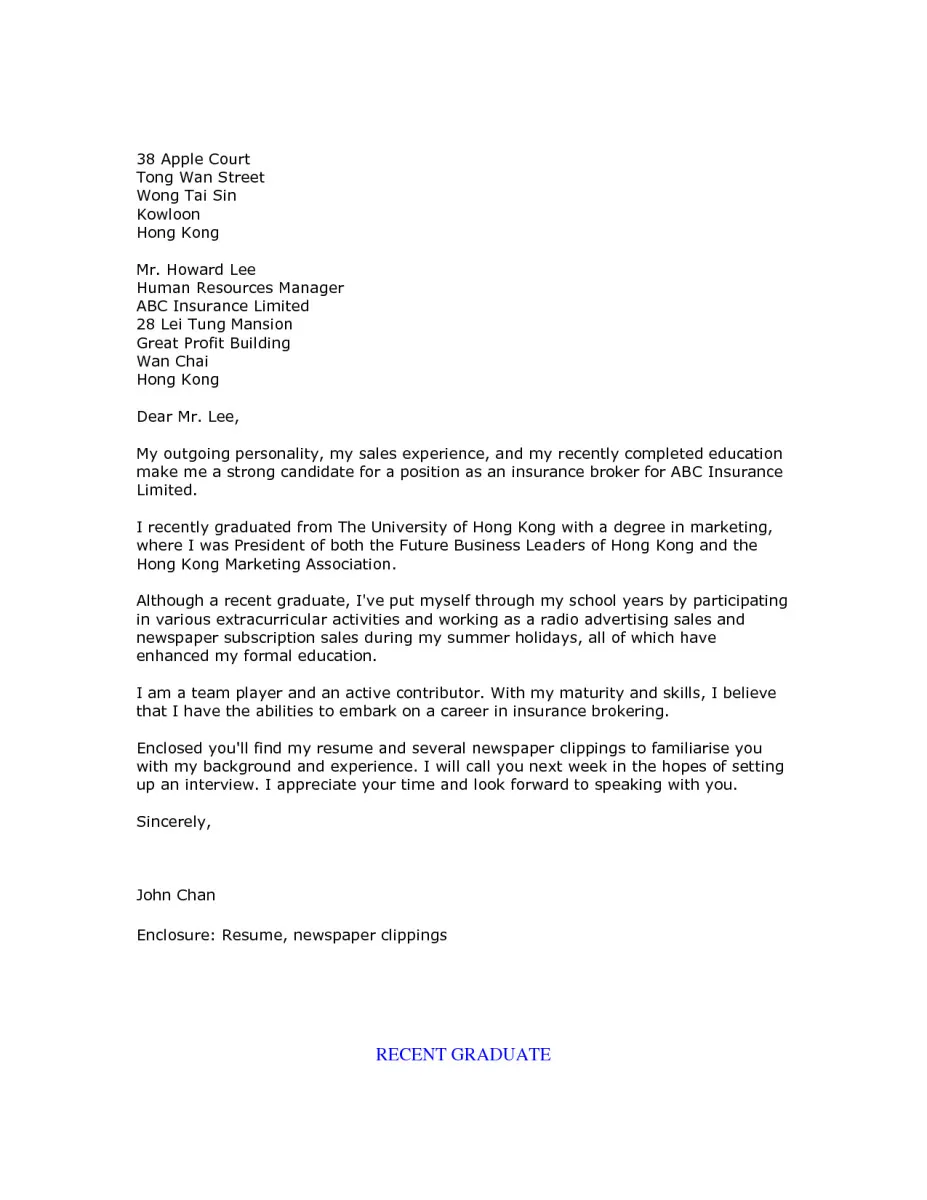
Reviewing cover letter examples can provide valuable insights and inspiration when writing your own. Look for examples tailored to your field of study, experience level, and desired job roles. Analyze the structure, language, and tone of successful cover letters to learn how to effectively highlight your qualifications and express your enthusiasm. Use these examples as a starting point and adapt them to your own unique situation and experiences. Tailor each letter to align with the job requirements and company culture.
Example 1
This section will show an example of a cover letter for a recent graduate. The cover letter will include the following elements
- Contact information, including the recent graduate’s name, phone number, email address, and LinkedIn profile URL.
- A personalized greeting, where the hiring manager is addressed by name.
- An opening paragraph that states the recent graduate’s name, the position they are applying for, and where they found the job posting.
- A paragraph that identifies the skills and experiences that align with the job requirements, including any projects and academic accomplishments.
- A closing paragraph to show the graduate’s interest in the position and to thank the hiring manager for their time and consideration.
Example 2
This section will showcase another example of a cover letter for a recent graduate that highlights different aspects of their qualifications. This cover letter is tailored to a different job role or company to demonstrate the adaptability of the recent graduate. The following elements are included
- Contact information, including the recent graduate’s name, phone number, email address, and LinkedIn profile URL.
- A personalized greeting, where the hiring manager is addressed by name.
- An opening paragraph that states the recent graduate’s name, the position they are applying for, and where they found the job posting.
- A paragraph that focuses on the skills and qualifications that align with the job requirements.
- A closing paragraph to reiterate their interest in the position and to thank the hiring manager.
How to Adapt Your Cover Letter for Different Jobs
Adaptability is key when writing cover letters. To increase your chances of success, you must tailor each cover letter to the specific job and company. Begin by thoroughly reviewing the job description, identifying the key skills, qualifications, and requirements. Then, highlight the relevant experiences from your background, using specific examples to demonstrate how you meet those requirements. Adjust the language, tone, and content of your cover letter to align with the company’s culture. You may have to adjust your examples, but this is important in order to show the hiring manager that you meet the requirements.