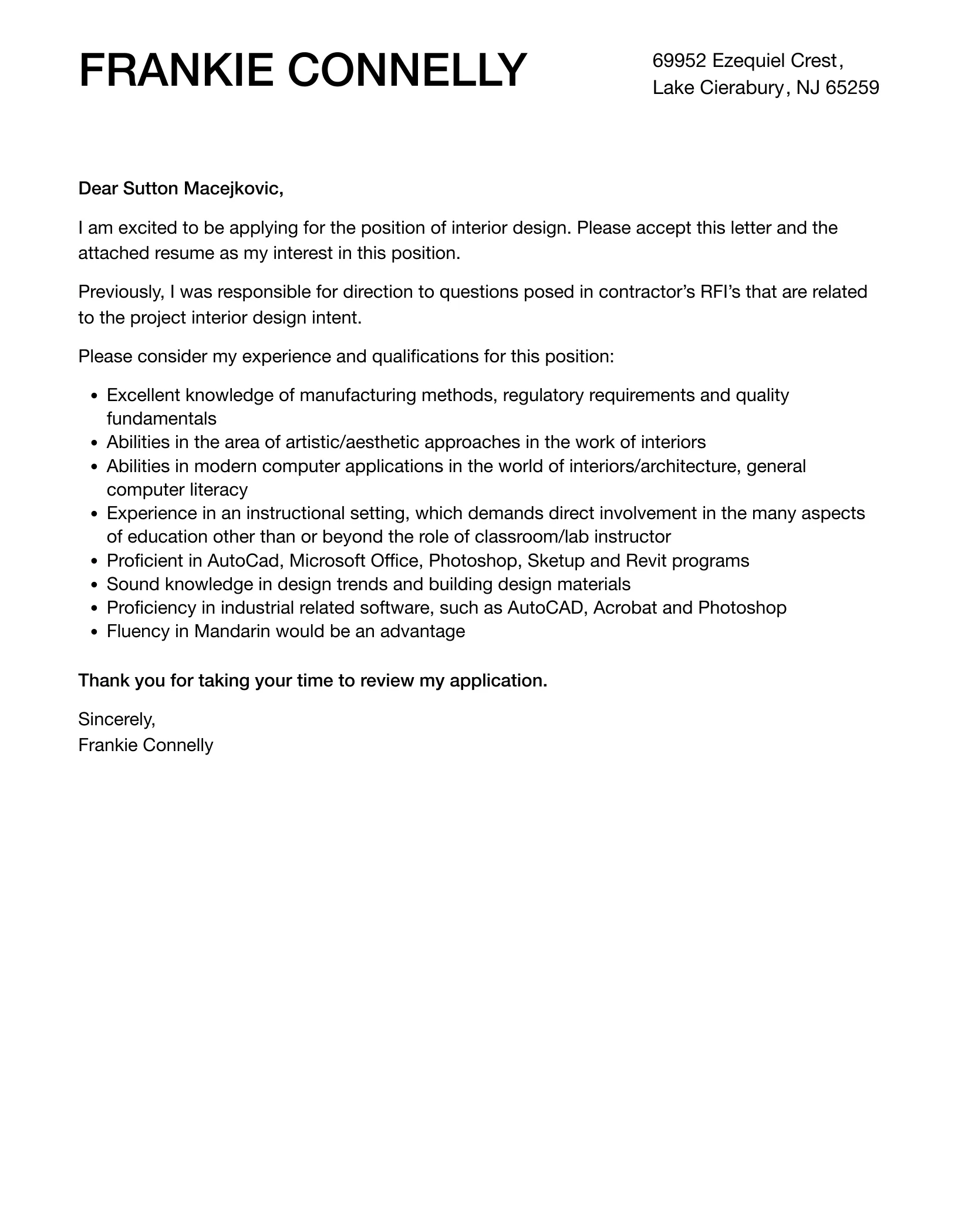
What is an Interior Design Cover Letter
An interior design cover letter is a crucial document accompanying your resume when applying for interior design positions. It serves as your initial introduction to a potential employer, providing a platform to showcase your personality, skills, and enthusiasm in a way that a resume alone cannot. It’s your opportunity to make a strong first impression and differentiate yourself from other applicants. Think of it as the story behind your resume, offering context and depth to your qualifications and career aspirations. A well-crafted cover letter is essential for landing your dream job in the competitive field of interior design.
The Purpose of an Interior Design Cover Letter
The primary purpose of an interior design cover letter is to persuade the hiring manager to review your resume and consider you for an interview. It’s about more than just listing your skills; it’s about demonstrating how your unique talents and experiences align with the specific requirements of the role and the values of the company. A well-written cover letter allows you to articulate your career goals, explain any gaps in your experience, and express your genuine interest in the position. It’s your chance to make a compelling case for why you are the perfect fit and should be chosen over other candidates.
Why a Cover Letter Matters for Interior Designers

In the creative field of interior design, a cover letter is especially important. It offers a chance to communicate your design aesthetic, creative vision, and passion for the field. Unlike some professions, interior design often requires a portfolio showcasing your work. A cover letter provides context for your portfolio, explaining your design choices, the thought process behind your projects, and the specific skills you employed. It allows you to connect your personality with your professional work, demonstrating to the employer that you not only have the skills but also the personality to thrive within their company culture.
Key Components of a Compelling Cover Letter
Crafting a compelling interior design cover letter requires attention to detail and a strategic approach. It’s essential to include specific elements that highlight your qualifications and make you stand out. This section will break down the key components, ensuring that your cover letter effectively communicates your value to potential employers. From the initial greeting to the closing, each part should be thoughtfully constructed to make a lasting impression.
Contact Information and Professional Greeting
Begin your cover letter with your contact information, including your name, address, phone number, and email. Then, address the hiring manager by name if possible; this shows that you’ve done your research and are taking a personalized approach. Use a professional greeting like “Dear Mr./Ms. [Last Name]” or “Dear Hiring Manager.” Avoid generic greetings like “To Whom It May Concern,” which can make your letter feel impersonal. This initial section sets the tone for your letter, so make sure it is clear, professional, and demonstrates your attention to detail. Image: https://example.com/professional-greeting.webp

Highlighting Your Skills and Experience

The body of your cover letter should showcase your relevant skills and experience. Tailor this section to the specific requirements of the job description. Mention the software you are proficient in (e.g., AutoCAD, SketchUp, Revit), your design specialties (e.g., residential, commercial, sustainable design), and your experience with project management, client communication, and budget management. Provide concise examples of your accomplishments and how they align with the employer’s needs. Use action verbs to describe your duties and achievements, such as “designed,” “managed,” “collaborated,” and “implemented.” Image: https://example.com/skill-and-experience.webp

Quantifiable Achievements and Project Success
Quantify your achievements whenever possible. Instead of simply stating that you “managed projects,” provide numbers or statistics to demonstrate your success. For example, state that you “managed projects with budgets up to $X” or “completed projects on time and within budget.” If you increased client satisfaction, mention the percentage increase. If your designs have won awards or been featured in publications, be sure to include that information. These quantifiable details will help the hiring manager understand the impact of your work and the value you can bring to their company.
Showcasing Your Design Philosophy and Style
Interior design is a highly creative field, so it’s crucial to showcase your unique design philosophy and style. Briefly describe your approach to design, including your design principles and the elements you prioritize. Mention your favorite design styles and how they influence your work. This helps the employer understand your design aesthetic and determine if it aligns with their company’s brand and the types of projects they undertake. This section should be concise and give a clear picture of your design sensibilities.
Expressing Enthusiasm and Company Alignment

Demonstrate your enthusiasm for the position and the company. Research the company’s values, mission, and recent projects. Mention specific aspects that appeal to you and explain why you are excited about the opportunity. This could involve aligning your design philosophy with the company’s approach, expressing admiration for their projects, or referencing their company culture. This shows the hiring manager that you’re not just looking for any job, but that you are genuinely interested in working for their specific company. This personalized approach makes you stand out.
Call to Action and Professional Closing
End your cover letter with a strong call to action, expressing your interest in an interview. Thank the hiring manager for their time and consideration. Reiterate your contact information and mention that you are eager to discuss your qualifications further. Use a professional closing like “Sincerely,” “Respectfully,” or “Best regards,” followed by your name. Ensure you proofread your letter one last time to catch any errors before sending it. This section confirms your interest and provides the next steps for the hiring process. Image: https://example.com/design-portfolio.webp

Common Mistakes to Avoid in Your Cover Letter
Avoiding common mistakes is critical to making a positive impression. Many applicants unknowingly undermine their chances by including certain errors. By understanding and avoiding these pitfalls, you can significantly improve the effectiveness of your cover letter and increase your chances of landing an interview.
Generic Content and Lack of Personalization

One of the biggest mistakes is using generic, cookie-cutter cover letters that are not tailored to the specific job or company. Generic letters fail to highlight your unique qualifications and fail to demonstrate genuine interest in the role. Always research the company and tailor your letter to the specific requirements and values they seek. Show that you understand the role, the company’s mission, and how your skills align with their needs. Personalize the content by mentioning specific projects or aspects of the company that resonate with you.
Typos and Grammatical Errors
Typos and grammatical errors are a major red flag. They demonstrate a lack of attention to detail and can give the impression that you are not serious about the application. Always proofread your cover letter multiple times. Use a grammar and spell-check tool, but also read it aloud to catch any awkward phrasing or mistakes. Ask a friend or family member to review your letter as well. Even a minor error can significantly detract from your application and undermine your professional image. Taking this step ensures your letter is polished and professional.
Focusing Solely on Responsibilities, Not Achievements
Listing your job responsibilities without highlighting your achievements is another common mistake. The cover letter should go beyond simply stating what you did in previous roles. Instead, focus on what you accomplished and the impact you made. Use the STAR method (Situation, Task, Action, Result) to describe your experiences. For each project or task, explain the situation, the task you were assigned, the actions you took, and the results you achieved. This approach demonstrates your abilities and the value you can bring to a potential employer, setting you apart from other candidates.
Formatting and Visual Appeal

The visual appearance of your cover letter can have a significant impact on how it is received. A well-formatted letter is easier to read and makes a better first impression. Pay attention to the layout, font, and overall presentation.
Choosing a Professional Font and Layout
Choose a professional and easy-to-read font such as Times New Roman, Arial, or Calibri. Ensure the font size is between 10 and 12 points. Use a simple, clean layout with clear headings, ample white space, and consistent formatting. Avoid excessive use of bolding, italics, or underlining. Keep the overall look clean, organized, and visually appealing. A well-formatted cover letter demonstrates your attention to detail and professionalism. Image: https://example.com/cover-letter-example.webp

Keeping it Concise and Easy to Read
Keep your cover letter concise and easy to read. Aim for a length of one page, and avoid long, dense paragraphs. Use clear, concise language and short sentences. Break up large blocks of text with bullet points or subheadings to improve readability. The hiring manager may review many applications, so it’s important to get your key points across quickly and effectively. Make every word count.
Interior Design Cover Letter Example

Here’s an example to help you get started and adapt your cover letter to each job application. Note that this is a template; you must tailor it to the specific job and company. [Your Name] [Your Address] [Your Phone Number] [Your Email] [Date] [Hiring Manager Name (if known), or Title] [Company Name] [Company Address] Dear [Mr./Ms./Mx. Last Name or Hiring Manager], I am writing to express my keen interest in the Interior Designer position at [Company Name], as advertised on [Platform]. With [Number] years of experience in the interior design field, coupled with a strong portfolio showcasing my expertise in [Specific Design Areas, e.g., residential, commercial, sustainable design], I am confident I can significantly contribute to your team. In my previous role at [Previous Company Name], I was responsible for [Key Responsibilities, e.g., managing projects, client communication, designing spaces]. I successfully [Quantifiable Achievement, e.g., completed projects on time and within budget, increased client satisfaction by X%]. My design philosophy is centered on [Your Design Philosophy, e.g., creating functional yet beautiful spaces, blending modern and classic styles, using sustainable materials]. I am particularly drawn to [Company Name] because [Reason, e.g., I admire your commitment to innovative designs, your focus on sustainability, your company culture]. I am eager to contribute my skills and passion to your projects. Thank you for your time and consideration. I have attached my resume and portfolio for your review and welcome the opportunity to discuss my qualifications further in an interview. Sincerely, [Your Name]
Example Cover Letter Breakdown and Analysis
This example provides a clear structure, personalized content, and a strong call to action. It begins with your contact information and a professional greeting, which sets the tone for the letter. The body highlights your skills, experience, and accomplishments. It showcases your unique design philosophy and demonstrates how your interests align with the company’s values. The example concludes with a call to action and a professional closing. Analyzing this cover letter example and understanding its different parts will assist you in writing your own effective cover letter.
Adapt Your Cover Letter for Each Application
One of the most important secrets of a successful cover letter is tailoring it to each job application. It’s not enough to simply use a generic template; you must customize your letter to reflect the specific requirements and values of each company. This demonstrates that you are genuinely interested in the role and that you have taken the time to understand the company’s needs.
Researching the Company and Tailoring Your Letter
Before writing your cover letter, thoroughly research the company. Visit their website, review their recent projects, and understand their mission and values. Identify the specific skills and experiences they are seeking in their job description. Then, tailor your cover letter to highlight the relevant skills and achievements. Mention specific aspects of the company’s work or culture that resonate with you. This shows that you have done your homework and are genuinely interested in the opportunity. Demonstrate your understanding of the company’s goals and show how your skills can help achieve those goals. Image: https://example.com/company-research.webp

Highlighting Relevant Skills for the Specific Role
The job description is the key to identifying the skills and experiences that are most important to the employer. Carefully review the job description and identify the keywords, skills, and qualifications they are seeking. In your cover letter, explicitly mention these keywords and provide examples of how you have demonstrated those skills in previous roles. Tailor your examples to align with the responsibilities and expectations outlined in the job description. By doing so, you will show the hiring manager that you are a great fit for the position. This approach increases your chances of getting noticed and securing an interview. Image: https://example.com/interior-design-cover-letter.webp

Proofreading and Editing Your Cover Letter
Proofreading and editing is a final but essential step in ensuring your cover letter is polished and professional. Errors can undermine your credibility and decrease your chances of getting an interview. Take the time to carefully review your letter for any typos, grammatical errors, or awkward phrasing.
Proofreading and Editing Your Cover Letter
After completing the cover letter, thoroughly proofread it. Use grammar and spell-check tools to identify and correct any obvious errors, but don’t rely on these tools alone. Read your letter aloud to catch any awkward phrasing or mistakes. Ask a friend, family member, or career counselor to review your cover letter. Getting a fresh pair of eyes on your letter can help you identify areas for improvement and ensure that it conveys the right message. Take the time to review your cover letter until it’s perfect.