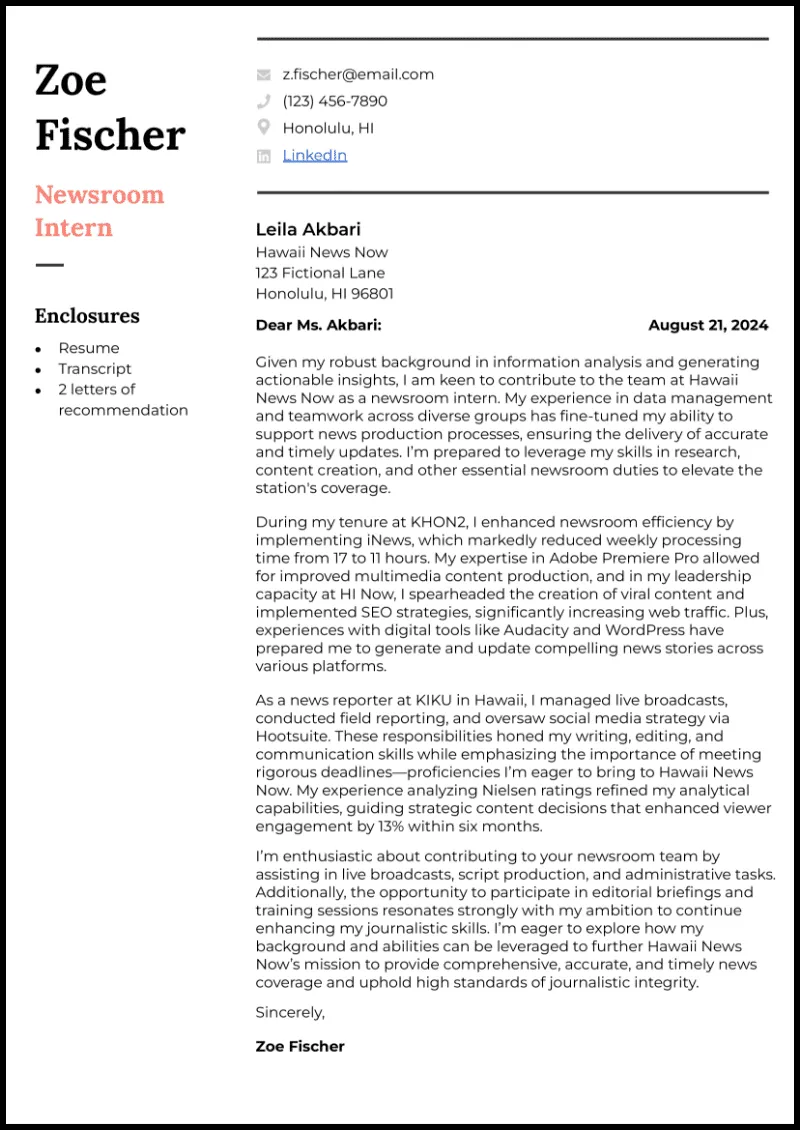
Understanding the Journalism Internship Cover Letter
A journalism internship cover letter is your first impression on a potential employer. It’s your opportunity to showcase your writing skills, enthusiasm for journalism, and relevant experience. Unlike a resume, a cover letter allows you to tell a story and demonstrate why you’re the perfect fit for the internship. A well-crafted cover letter can significantly increase your chances of landing an interview and ultimately, the internship. It is a crucial document that helps you stand out from other applicants. This guide will take you through the essential components of a compelling cover letter, providing you with actionable advice and examples to create your own.
Key Components of a Journalism Cover Letter
The most effective journalism cover letters typically include several key components. Each section plays a vital role in presenting you as a strong candidate. These components work together to form a cohesive narrative that demonstrates your suitability for the internship. We will explore the essential elements that make up a successful cover letter, from the header to the closing paragraph. This comprehensive understanding will enable you to construct a cover letter that not only meets the standard requirements but also effectively communicates your unique value proposition to the prospective employer. A strong cover letter is the first step in showcasing yourself to your potential employer.
Header Information

Your header should include your name, address, phone number, and email address. This information should be clearly and prominently displayed at the top of the letter. Ensure your contact information is accurate and up-to-date. This allows the employer to easily reach you for an interview. Ensure it is visually appealing and professional, setting the tone for the rest of your cover letter. A well-formatted header ensures the recruiter can effortlessly contact you. Use a clean, easy-to-read font for your header. Double-check all details before sending. See journalism_cover_letter_header.webp for an example.
Your Contact Details
This section comprises your personal information. Include your full name, current address, phone number, and a professional-looking email address. Avoid using informal or unprofessional email addresses. Always double-check for accuracy to avoid any miscommunication with the employer. This part is to ensure the employer can easily reach you. Ensure your contact details are formatted in a clear and easily accessible manner. This information is essential for the employer to contact you. It should be at the top of the document, making it easy for the hiring manager to find it quickly.
The Recipient’s Information
Below your contact details, include the name of the hiring manager (if known), their title, the company name, and the company’s address. Addressing the letter to a specific person shows that you’ve done your research and are genuinely interested in the opportunity. If you’re unsure of the hiring manager’s name, try to find it on the company’s website, LinkedIn, or by calling the company directly. Using the right name shows initiative and attention to detail, important qualities in journalism. If you can’t find a specific name, you can use a general greeting like ‘Dear Hiring Manager.’ This shows you put time into your application.
Opening Paragraph Grab Their Attention

The opening paragraph is your chance to make a strong first impression. Start with a captivating hook that immediately grabs the reader’s attention. Clearly state the position you are applying for and how you found out about it. Show genuine enthusiasm for the internship and the organization. Briefly mention a key skill or experience that makes you a strong candidate. Keep it concise and focused, aiming to entice the reader to continue reading. This initial paragraph should be compelling enough to make the reader want to know more about you and your capabilities. Refer to journalism_passion.webp for ideas.
Express Your Enthusiasm
Demonstrate your passion for journalism and why you are excited about the specific internship and the company. This is more than simply stating your interest; it’s about conveying genuine enthusiasm. Mention specific aspects of the company or the internship that appeal to you. Show that you’ve researched the organization and understand their mission, values, and work. Connect your passion to your skills and experiences, showing how you can contribute to the organization. Genuine enthusiasm is a key factor in setting you apart from other applicants. A demonstrated interest makes you stand out among the rest.
Highlight Relevant Skills & Experience
Focus on the skills and experiences that are most relevant to the internship requirements. Tailor your letter to match the job description. Mention your writing abilities, including any experience with different writing styles. Highlight any experience in research, interviewing, or multimedia journalism. Provide specific examples of your accomplishments and how they demonstrate your skills. Quantify your achievements whenever possible. This section is about proving you have what it takes to succeed. Showing your skills will improve your chances. Refer to journalism_skills.webp for a good idea.
Showcase Your Writing Abilities

As a journalism intern, strong writing skills are paramount. Use your cover letter to demonstrate your writing prowess. Showcase your ability to write clearly, concisely, and engagingly. Mention any specific writing projects or publications you’ve contributed to. Include brief excerpts or links to your published work if possible. Proofread your letter meticulously to ensure it is free of errors. Show that you are a detail-oriented writer. Your writing style is a crucial part of your application, and it needs to be perfect. Good writing skills can get you noticed. Use simple language and keep it under 600 words.
Mention Your Passion for Journalism
Your passion for journalism should shine through in your cover letter. Explain why you are drawn to the field and what motivates you. Mention specific areas of journalism that interest you (e.g., investigative reporting, sports journalism, photojournalism). Show your knowledge of current events and the media landscape. This shows you are dedicated to the craft. Emphasize your desire to learn and grow as a journalist. Refer to journalism_example.webp for a way to do this.
Tailor Your Cover Letter for Each Application
Never use a generic cover letter for every application. Tailor each letter to the specific internship and organization. Research the company and understand their values, mission, and work. Adjust your letter to reflect the job description and highlight the skills and experiences most relevant to the position. Demonstrate your genuine interest in the specific opportunity. Customize the letter to showcase your specific qualities. A customized cover letter shows you have a commitment to the job. Remember, a tailored cover letter has a greater impact.
Research the Company/Organization

Before writing your cover letter, thoroughly research the company or organization. Visit their website, read their publications, and learn about their mission and values. Understanding their work will help you tailor your letter and demonstrate your interest. Identify any recent news or projects the company has been involved in. Mention specific journalists or stories that have impressed you. Show the hiring manager that you know about their work. This step demonstrates your commitment to the role. You can also find a lot of information through LinkedIn.
Match Your Skills to the Job Description
Carefully review the job description and identify the key skills and qualifications the employer is seeking. Highlight your relevant skills and experiences, using the same keywords and phrases from the job description. Provide specific examples of how you’ve used these skills in the past. Make sure your letter emphasizes your qualifications. This ensures you’re directly addressing the employer’s needs. This demonstrates your understanding of the position and your ability to meet the requirements. The more you match the skills listed, the better chance you have of getting hired. This shows that you’re the perfect fit for the role.
Use Keywords Strategically
Incorporate relevant keywords from the job description throughout your cover letter. This helps your application get noticed by applicant tracking systems (ATS). It also demonstrates that you understand the requirements of the position. Use keywords naturally and strategically. Avoid keyword stuffing, which can make your letter sound unnatural. Integrate keywords into your sentences and phrases to highlight your relevant skills and experiences. By using keywords, you ensure that your qualifications are easily identified. This boosts your chances of getting your application reviewed by a human. This is another example of how important it is to match skills with job listings.
Formatting and Tone

Your cover letter should be well-formatted and easy to read. Use a professional font such as Times New Roman or Arial. Maintain consistent formatting throughout the document. Use clear and concise language. Keep paragraphs short and to the point. Adopt a professional and enthusiastic tone. Avoid using slang or overly informal language. Proofread carefully to ensure your writing is error-free. A professional tone and format are crucial. Refer to cover_letter_formatting.webp for examples.
Keep it Concise and Professional
Keep your cover letter concise and focused, aiming for one page in length. Highlight the most relevant information and avoid unnecessary details. Get to the point quickly. Avoid long, rambling sentences and paragraphs. Use strong action verbs to describe your skills and experience. Your letter should be easy to read and understand. A concise letter shows you value the reader’s time. Conciseness showcases your writing skills and communication style. A concise cover letter highlights only the important information.
Proofread Meticulously
Proofreading is critical. Errors in your cover letter can create a negative impression. Carefully review your letter for any grammatical errors, spelling mistakes, and typos. Have someone else proofread your letter to catch any errors you might have missed. Ensure that your contact information is accurate. A clean and error-free cover letter demonstrates attention to detail. Proofreading is vital. Refer to cover_letter_proofreading.webp for tips.
Closing the Letter

Your closing paragraph should summarize your key qualifications and restate your interest in the internship. Express your gratitude for the reader’s time and consideration. Reiterate your enthusiasm for the opportunity. Include a call to action, such as stating that you are available for an interview. Thank the reader for their time and consideration. Close your letter with a professional closing, such as ‘Sincerely’ or ‘Best regards’. This shows that you are a professional. Be sure to show your professionalism.
Express Gratitude
Always express your gratitude to the reader for considering your application. Thank them for their time and attention. Show your appreciation for the opportunity. This shows respect and professionalism. Make sure your gratitude is genuine. A simple ‘Thank you for your time and consideration’ is often enough. A show of thanks demonstrates respect. It’s a simple gesture but important. This gesture is greatly appreciated.
Include a Call to Action
End your cover letter with a clear call to action. State your availability for an interview. Express your eagerness to discuss your qualifications further. Provide your contact information again, if necessary. Make it easy for the employer to move forward. This could be as simple as ‘I am available for an interview at your earliest convenience.’ A call to action shows your interest. This prompts the reader to respond. It shows your interest and commitment to the job. This is a great way to conclude your letter.
Example of a Good Cover Letter for a Journalism Internship

Here is an example to guide your writing: [Your Name] [Your Address] [Your Phone Number] [Your Email Address] [Date] [Hiring Manager Name] (If Known) [Hiring Manager Title] [Company Name] [Company Address] Dear [Mr./Ms./Mx. Last Name], I am writing to express my keen interest in the Journalism Internship position at [Company Name], as advertised on [Platform]. As a passionate and aspiring journalist with a strong foundation in [mention relevant skills like writing, editing, research], I am eager to contribute to your team and learn from experienced professionals. In my previous role at [Previous Experience], I honed my abilities in [mention skills]. I am particularly drawn to [Company Name]’s commitment to [mention their values or specific projects], and I believe my skills and enthusiasm align perfectly with your mission. I am a quick learner, dedicated to producing high-quality work, and enthusiastic about contributing to [Company Name]’s continued success. Thank you for your time and consideration. I look forward to the opportunity to discuss my application further. Sincerely, [Your Name]. Refer to journalism_internship_tips.webp for more info.