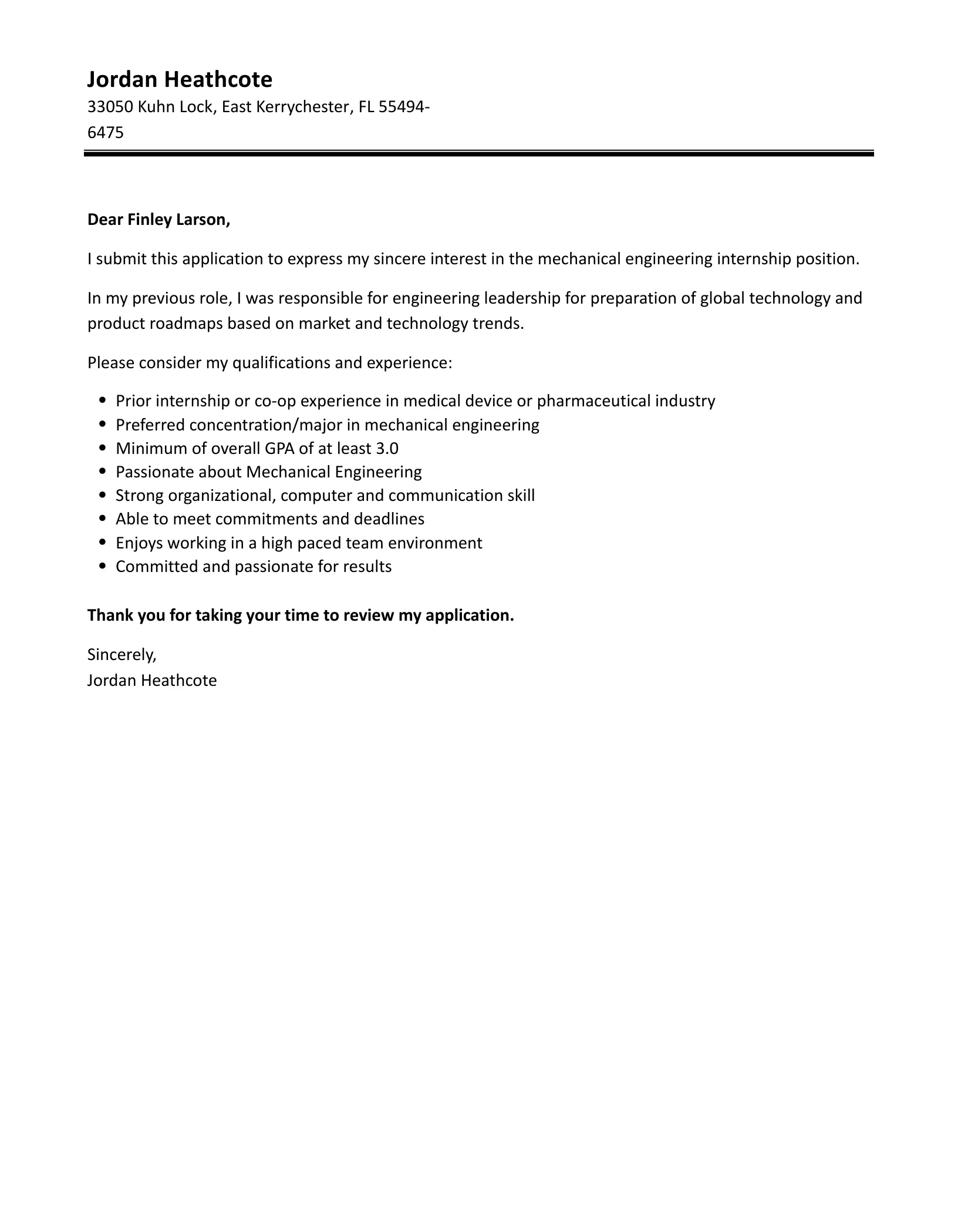
Why a Cover Letter is Crucial for Your Internship Application
In the competitive world of mechanical engineering internships, a well-crafted cover letter is often the key that unlocks the door to your dream opportunity. It’s more than just a formality; it’s your chance to make a compelling first impression and distinguish yourself from other applicants. A strong cover letter allows you to provide context to your resume, highlighting your skills, experiences, and motivations in a way that a resume alone cannot. It is your voice, your personality, and your unique selling proposition presented to the hiring manager. Without it, your application might be lost in the shuffle of countless others, missing the opportunity to showcase your potential and eagerness to learn. A cover letter is a crucial tool that can significantly increase your chances of landing an interview and ultimately, securing the internship.
Understanding the Purpose of a Cover Letter
The primary purpose of a cover letter is to introduce yourself to the hiring manager and explain why you’re the perfect fit for the mechanical engineering internship. It serves as a personalized introduction, demonstrating your interest in the specific role and the company. Unlike your resume, which lists your accomplishments, a cover letter allows you to elaborate on those achievements, providing context and showcasing your personality. It is also the place where you can explain your motivations, career goals, and what you hope to gain from the internship. By articulating your understanding of the company’s needs and how your skills align with those needs, you show that you’ve done your research and are genuinely interested in the opportunity. It’s a way to go beyond the facts and paint a vivid picture of you as a motivated, skilled, and enthusiastic candidate.
Highlighting Your Mechanical Engineering Skills

Your cover letter is the perfect platform to showcase your technical prowess. Begin by identifying the key skills required for the internship, usually listed in the job description. Then, select relevant skills from your repertoire and provide concrete examples of how you’ve utilized them. This might include designing components using CAD software, conducting simulations, or analyzing data. Don’t just list skills; demonstrate them through specific projects, coursework, or previous experiences. For example, if the internship requires proficiency in SolidWorks, mention a project where you designed a specific part using the software and the results you achieved. Quantify your achievements whenever possible. Instead of saying ‘Improved efficiency,’ state ‘Improved project efficiency by 15% by implementing…’ This adds credibility and illustrates the impact of your skills.
Showcasing Relevant Technical Skills
Focus on the technical skills most relevant to the specific internship. This might include CAD software (like AutoCAD, SolidWorks, or CATIA), simulation software (like ANSYS or COMSOL), programming languages (like Python or MATLAB), or knowledge of specific engineering principles (thermodynamics, fluid mechanics, etc.). Provide specific examples of how you’ve used these skills in projects or coursework. For instance, if the internship involves designing HVAC systems, mention any experience you have with relevant software or calculations. Highlight your ability to apply theoretical knowledge to practical problems. Even if your experience is limited, demonstrating a strong foundation and a willingness to learn is crucial. Mention any certifications or courses you’ve completed that demonstrate your proficiency.
Emphasizing Soft Skills for Engineering Success
While technical skills are essential, don’t neglect the importance of soft skills. Mechanical engineering is a collaborative field, and employers value candidates who can communicate effectively, work well in teams, and solve problems creatively. In your cover letter, highlight your soft skills with examples. Do you have experience working on team projects? Describe your role and contribution, emphasizing your communication and teamwork abilities. Have you faced a technical challenge? Explain how you approached the problem, demonstrating your problem-solving skills. Are you good at time management and meeting deadlines? Mention specific instances where you successfully managed multiple tasks. Showcasing soft skills is essential as it proves your ability to adapt to a new environment and work with others.
Tailoring Your Cover Letter to the Internship

A generic cover letter sent to multiple companies is easily spotted and often disregarded. To stand out, you must customize your cover letter for each mechanical engineering internship you apply for. This means carefully reviewing the job description and identifying the specific skills and experiences the employer is seeking. Then, tailor your letter to directly address those requirements. Highlight the skills and experiences that align with the internship’s needs, and use the language and keywords from the job description. If the job posting emphasizes a particular software, make sure you mention your proficiency with it. This shows the hiring manager that you’ve taken the time to understand the role and are genuinely interested in the opportunity. Tailoring your cover letter demonstrates that you are not just sending a generic application, but that you are truly interested in the position and the company.
Researching the Company and Internship Role
Before you start writing, research the company and the specific internship role. Understand the company’s mission, values, and recent projects. This information can help you tailor your cover letter and demonstrate your genuine interest. Visit the company’s website, read news articles, and explore their social media profiles. Learn about the team you might be joining and the types of projects you’d be working on. The more you know, the better you can align your skills and experiences with the company’s needs. In your cover letter, mention something specific that interests you about the company or the internship. This shows that you’ve done your homework and are truly invested in the opportunity. Understanding the role involves reading the job description carefully and identifying the key responsibilities and required skills.
Matching Skills to Internship Requirements
Once you understand the company and the internship role, match your skills and experiences to the requirements. Carefully analyze the job description and identify the keywords and phrases used to describe the ideal candidate. Then, go through your resume and identify the skills and experiences that match those requirements. In your cover letter, explicitly mention how your skills and experiences align with the internship’s needs. Provide specific examples to support your claims. For instance, if the job description mentions experience with CAD software, and you have such experience, describe a project where you used it and the results you achieved. This is where you can demonstrate that you are not just a qualified applicant, but the perfect fit for the specific role.
Structuring Your Mechanical Engineering Cover Letter

A well-structured cover letter is easy to read and highlights your key qualifications. Begin with a clear and concise heading that includes your contact information and the date. Address the letter to the hiring manager or the specific contact person, if possible. If you don’t know the name, you can use a general greeting like ‘Dear Hiring Manager.’ The body of your letter should be divided into three to four paragraphs. The first paragraph is your introduction, where you state the position you are applying for and express your enthusiasm. The second and third paragraphs should highlight your relevant skills and experiences, providing specific examples to support your claims. The final paragraph is your conclusion, where you reiterate your interest and thank the hiring manager for their time and consideration. Keep the tone professional, enthusiastic, and concise.
Crafting a Compelling Opening Statement
The opening statement is your first chance to grab the hiring manager’s attention. It should be concise, engaging, and clearly state the position you’re applying for. Instead of a generic introduction, start with a statement that highlights your enthusiasm for the internship and the company. Consider mentioning a specific project or aspect of the company that interests you. State your intention to apply for the mechanical engineering internship, and briefly mention your relevant qualifications. You can also mention where you found the job posting. The goal is to make the hiring manager want to read more. Make the opening statement compelling and show genuine enthusiasm.
Demonstrating Your Relevant Experiences
The body of your cover letter is where you showcase your relevant experiences. Focus on experiences that align with the internship requirements. Instead of simply listing your past roles, provide context and explain what you did and what you achieved. Use the STAR method (Situation, Task, Action, Result) to structure your examples. Describe the situation, the task you were assigned, the actions you took, and the results you achieved. This helps the hiring manager understand your contributions and the impact you made. Quantify your achievements whenever possible. For example, ‘Improved the efficiency of a system by 15%’. Use action verbs to describe your accomplishments. Focus on results and the value you brought to each project or role. Use examples of design, problem solving and teamwork, and tailor to the role requirements.
Quantifying Achievements and Results

Whenever possible, quantify your achievements and results. Using numbers and data makes your cover letter more compelling and demonstrates the impact you’ve made in previous roles or projects. For example, instead of saying ‘Improved project efficiency,’ say ‘Improved project efficiency by 15% by streamlining the design process.’ If you worked on a team project, mention the project’s goals, your contributions, and the results you achieved. Quantify the outcomes by using percentages, dollars, or other measurable metrics. If you designed a component, mention the reduction in weight or cost. Even small improvements can make a big impact when quantified. This shows the hiring manager that you are results-oriented and have a strong understanding of engineering principles.
Expressing Your Enthusiasm and Interest
Your cover letter should convey your genuine enthusiasm for the mechanical engineering internship and the company. Show that you’ve done your research and are genuinely excited about the opportunity. Mention specific aspects of the company or the internship that appeal to you. This could be a particular project, the company’s culture, or the opportunity to learn new skills. Use enthusiastic language and avoid generic phrases. Tailor your language to reflect your personality and let your passion shine through. Express your willingness to learn and contribute to the team. A cover letter is a representation of your personality; show that you’re a proactive individual with a great passion.
Writing a Strong Closing Statement
The closing statement is your final chance to leave a lasting impression. Reiterate your interest in the internship and thank the hiring manager for their time and consideration. Express your eagerness to learn more about the opportunity and the company. Include a call to action, such as stating that you look forward to hearing from them soon or that you are available for an interview at their earliest convenience. It’s important to remain positive, and show appreciation. Ensure your contact information is clear and easy to find. A strong closing statement reiterates your enthusiasm, reinforces your key qualifications, and makes it easy for the hiring manager to take the next step.
Proofreading and Formatting Your Cover Letter

Proofreading and formatting are crucial steps that can significantly impact the overall impression of your cover letter. Carefully proofread your letter for any grammatical errors, spelling mistakes, or typos. Ensure that the formatting is clean and professional. Use a standard font, such as Times New Roman, Arial, or Calibri, and keep the font size consistent. Use clear headings and subheadings to organize your content. Pay attention to the margins and spacing to make your letter easy to read. Ensure that your contact information is accurate and up-to-date. Ask a friend, family member, or career counselor to proofread your letter before submitting it. It’s best to proofread a couple of times before submitting, and use tools like Grammarly for assistance. Make sure your cover letter is easy on the eyes and presents your application in a professional manner.
Common Mistakes to Avoid
Avoid common mistakes to enhance your application’s appeal. Using generic language, focusing solely on your needs, and neglecting to proofread are key pitfalls to steer clear of. Ensure your cover letter is tailored to the specific internship and avoids generic phrases. Instead, provide specific examples of your skills and experiences. Avoid focusing only on what you want from the internship; instead, emphasize what you can bring to the company. Always proofread your letter carefully for any grammatical errors or typos. Proofreading is a crucial step; a well-proofread letter reflects attention to detail, whereas errors can indicate a lack of professionalism. Addressing these common mistakes can significantly improve your application’s impact.
Using Generic Language
Generic language makes your cover letter sound uninspired and fails to make a strong impression. Avoid using generic phrases and clichés that could apply to any candidate. Instead, provide specific examples of your skills and experiences. Instead of saying ‘I am a hard worker,’ describe a situation where your hard work led to a successful outcome. Avoid using overly broad statements that don’t provide any specific information. Tailor your language to reflect your personality and your genuine interest in the internship. Generic language demonstrates a lack of effort and may make your application less competitive. Instead, make an effort to personalize the message and be specific.
Focusing Solely on Your Needs

While it’s important to express your interest in the internship, avoid making your cover letter all about what you want from the experience. Focus on how you can contribute to the company and what you can offer. Emphasize your skills and experiences and how they align with the internship’s requirements. Instead of saying ‘I want to learn new skills,’ say ‘I am eager to apply my knowledge of [specific skill] to contribute to your team’s projects.’ Show the hiring manager that you understand their needs and that you are eager to contribute to their success. Focusing solely on your needs makes your cover letter seem self-centered and less appealing. Instead, focus on what you can do for the company and how you can make a positive impact.
Neglecting to Proofread Your Letter
Neglecting to proofread your cover letter is a significant mistake that can damage your chances of landing the internship. Typos, grammatical errors, and spelling mistakes can make your application seem unprofessional and demonstrate a lack of attention to detail. Always proofread your letter carefully before submitting it. Ask a friend, family member, or career counselor to proofread it for you. Ensure that all your contact information is accurate and up-to-date. Use a spell-checker and grammar-checker, but don’t rely on them entirely. Proofreading is essential to ensure your cover letter is polished and presents you in the best possible light. Errors can make your application look careless and reduce your chances of getting an interview.
Leveraging Resources for Cover Letter Success
Take advantage of available resources to improve your cover letter. Seeking feedback from professionals, utilizing cover letter templates, and examples are all effective ways to enhance your application. These resources provide valuable insights into cover letter writing best practices. Networking and seeking advice are good ways to see how others approach the process. A well-crafted cover letter can be your ticket to a mechanical engineering internship, and using available resources increases your chances of success. Leverage these tools to create a strong and compelling cover letter.
Seeking Feedback from Professionals

Seeking feedback from professionals is a highly effective way to improve your cover letter. Career counselors, professors, and experienced engineers can provide valuable insights and constructive criticism. They can help you identify any weaknesses in your letter and suggest ways to make it more compelling. Ask for feedback on your letter’s clarity, structure, grammar, and content. Incorporate the feedback you receive to enhance your cover letter. Seeking professional feedback can improve your cover letter and increase your chances of landing an interview. Remember, even a small change can make a big difference, and a second opinion is very helpful.
Utilizing Cover Letter Templates and Examples
Cover letter templates and examples can be a valuable starting point for writing your own cover letter. They provide a framework for structuring your letter and offer examples of effective language and formatting. However, don’t simply copy and paste from a template. Customize the template to reflect your skills and experiences. Make sure your letter is tailored to the specific internship you are applying for. While templates and examples can be a useful starting point, remember to make your cover letter unique to you. A generic cover letter can easily be spotted, so it is important to show genuine interest and skills. This ensures that your letter stands out and makes a lasting impression.