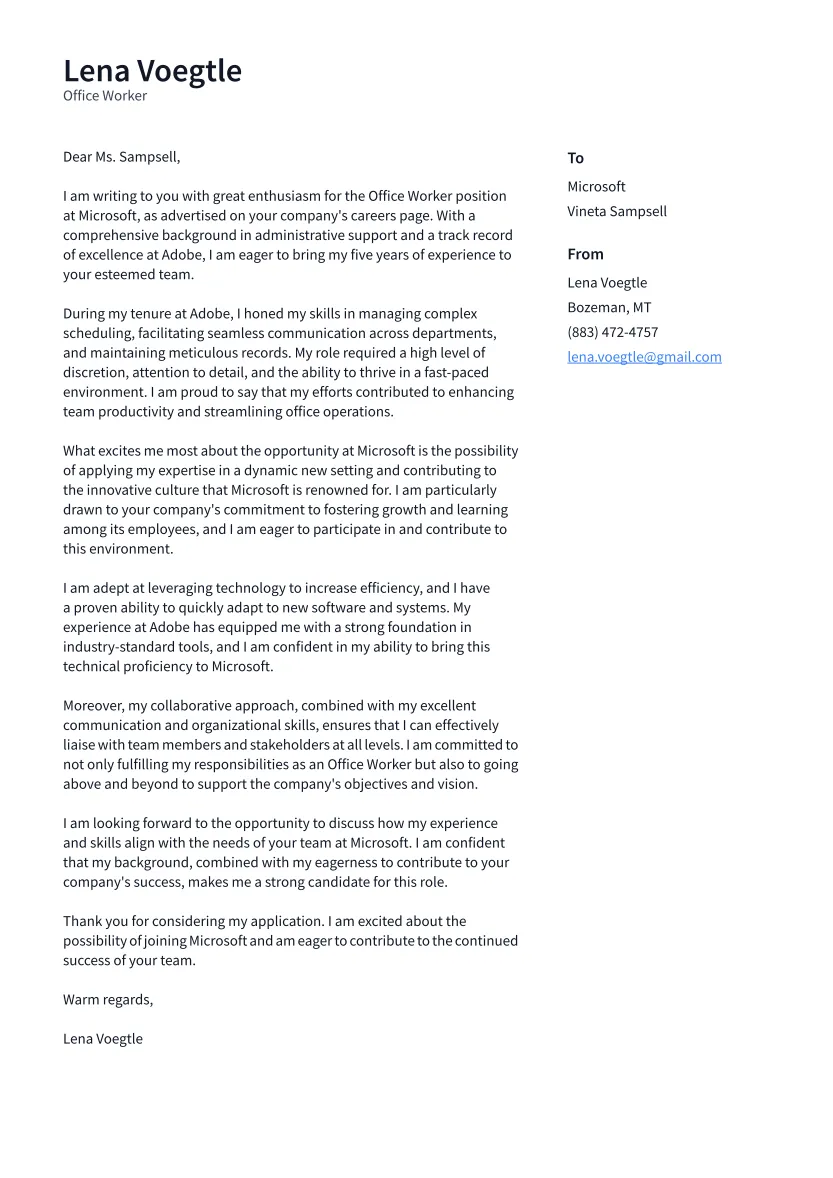
Crafting Your Office Worker Cover Letter
A well-crafted office worker cover letter is your first opportunity to impress a potential employer and secure an interview. It’s more than just a formality; it’s a strategic document designed to showcase your skills, experience, and enthusiasm for the position. In a competitive job market, a compelling cover letter can be the deciding factor in whether your application gets noticed. This guide will walk you through the essential steps to create a cover letter that not only meets but exceeds expectations, increasing your chances of landing your dream office worker role. Proper preparation and attention to detail are critical, and we’ll cover everything from understanding the purpose of a cover letter to formatting and proofreading techniques.
Understanding the Purpose of a Cover Letter
The primary purpose of an office worker cover letter is to introduce yourself to the hiring manager and highlight why you are the perfect fit for the job. Unlike a resume, which provides a factual overview of your work history and skills, a cover letter allows you to tell a story. It’s your chance to elaborate on your qualifications, demonstrate your personality, and express your genuine interest in the company and the specific role. Think of it as a personal introduction that complements your resume. It’s an opportunity to explain any gaps in your employment history, address specific job requirements, and showcase your communication skills. Effectively, a well-written cover letter gives you a significant advantage over other applicants.
Highlighting Your Skills and Experience

Your office worker cover letter should prominently feature your relevant skills and experience. Carefully review the job description and identify the key requirements. Then, select the skills and experiences from your background that align with those needs. Don’t simply list your skills; provide specific examples of how you’ve used them to achieve positive results. Use the STAR method (Situation, Task, Action, Result) to structure your examples and demonstrate your problem-solving abilities and achievements. Showcasing your skills effectively proves to the hiring manager that you not only possess the necessary qualifications but also understand the demands of the job and are likely to succeed.
Key Skills for Office Workers
Office workers require a diverse set of skills to excel in their roles. Your cover letter should emphasize these key competencies to demonstrate your readiness for the job. Focus on the areas that are most relevant to the position you’re applying for. While different roles may have specific needs, some fundamental skills are universally valued by employers.
Administrative Skills
Administrative skills are fundamental to office worker roles. These include managing calendars, scheduling appointments, organizing files (both physical and digital), and handling correspondence. Demonstrate your proficiency in these areas by providing specific examples. For instance, you could mention your experience in managing a complex calendar system for multiple executives or organizing a filing system that improved efficiency by a certain percentage. Highlight experience with specific software like Microsoft Office (Word, Excel, PowerPoint, Outlook) as well.
Communication Skills

Strong communication skills are essential for interacting with colleagues, clients, and vendors. Your cover letter should showcase your ability to communicate effectively both verbally and in writing. Provide examples of how you’ve used these skills in past roles. Did you effectively resolve a customer complaint? Did you lead a team meeting and communicate important information clearly? Did you write professional emails that resulted in a positive outcome? Highlighting your communication skills reassures the hiring manager that you can represent the company professionally.
Software Proficiency
In today’s office environments, proficiency in various software applications is crucial. List the software programs you are proficient in, such as Microsoft Office Suite (Word, Excel, PowerPoint, Outlook), Google Workspace (Docs, Sheets, Slides, Gmail), and any industry-specific software relevant to the job. Specify your level of proficiency (e.g., beginner, intermediate, advanced). If you have experience with database management systems, customer relationship management (CRM) software, or other relevant tools, be sure to mention it. Remember, demonstrating your tech skills can significantly increase your chances of getting hired.
Structuring Your Office Worker Cover Letter
A well-structured cover letter is easy to read and highlights the most important information. Follow a standard format to ensure your letter is clear, concise, and professional. Proper structure makes your letter more appealing to the hiring manager, increasing the chances of them reading the entire document. Each section serves a specific purpose, and together, they create a compelling case for your candidacy. Ensure that your structure is logical and easy to follow to make your cover letter as effective as possible.
Header and Contact Information

Begin your cover letter with a header that includes your name, address, phone number, and email address. Also, include the date and the hiring manager’s name and address if you know it. Ensure that the contact information is accurate and up-to-date. This section allows the hiring manager to quickly identify you and easily reach out to you if they choose to move forward. Using a professional-looking header ensures the first impression is a positive one.
Greeting the Hiring Manager
Address the hiring manager by name whenever possible. If you can’t find the hiring manager’s name, use a professional salutation, such as “Dear Hiring Manager.” Avoid generic greetings like “To Whom It May Concern.” Personalizing your greeting shows that you have put in the effort to research the company and role, and that you are committed to making a good impression. This simple step immediately shows you have taken the time to pay attention to the details.
The Opening Paragraph
The opening paragraph is your chance to grab the reader’s attention. State the position you are applying for and where you saw the job posting. Briefly mention your key skills and experience and express your enthusiasm for the role and the company. This paragraph should set the tone for the rest of your cover letter, piquing the hiring manager’s interest and encouraging them to read on. A strong opening will make your cover letter stand out from the crowd.
Showcase Your Value Proposition

In the body of your cover letter, elaborate on your skills and experience. Explain how your qualifications align with the job requirements and the company’s needs. Highlight your achievements and provide specific examples to demonstrate your capabilities. Focus on what you can bring to the company and the value you would add to the team. Tailor your cover letter to the specific role and demonstrate a clear understanding of the job responsibilities. This section is your opportunity to convince the hiring manager that you are a perfect fit for the company.
Emphasize Relevant Experience
Use the body of your cover letter to delve deeper into your work history. Instead of simply listing your job duties, highlight the experiences that are most relevant to the position. Use the STAR method (Situation, Task, Action, Result) to provide concrete examples of your accomplishments. When you demonstrate the impact of your actions, it builds a strong case for why you should be hired. Give quantifiable results whenever possible. Show, don’t just tell, what you have achieved in previous roles.
Quantify Your Achievements
Whenever possible, quantify your achievements to demonstrate your impact. Instead of saying “Improved efficiency,” say “Improved office efficiency by 15% within six months.” Quantifiable results make your accomplishments more credible and showcase your ability to deliver results. Use numbers, percentages, and specific metrics to illustrate your successes. These concrete examples are more powerful than vague descriptions, leaving a strong and memorable impression on the hiring manager.
Tailoring Your Cover Letter

A generic cover letter that is sent to every company and position you apply for will likely be discarded. Tailoring your cover letter to each specific job and company is crucial. It shows that you have taken the time to understand the role and the company, and that you are genuinely interested in the opportunity. Customizing your cover letter will also help you stand out from other applicants. This personalization is critical for making a positive impression.
Researching the Company
Before writing your cover letter, research the company. Visit their website, read their mission statement, and check out their social media profiles. Understand their values, culture, and recent activities. This knowledge will help you tailor your cover letter to their specific needs and demonstrate your genuine interest. By researching, you can customize the letter to speak directly to the company’s values and objectives. Being well-informed will help you build a stronger case for why you would be a good fit.
Customizing for the Role
Carefully review the job description and identify the key requirements. Then, highlight the skills and experiences from your background that directly align with those requirements. Customize your cover letter to address these specific needs, demonstrating how your qualifications make you a strong candidate. Use the same keywords and phrases from the job description to show that you understand what the employer is looking for. Make sure your qualifications match with the needs of the role.
Formatting and Presentation

The appearance of your cover letter is just as important as its content. Use a clean, professional font such as Times New Roman, Arial, or Calibri. Ensure your letter is easy to read with clear formatting, including appropriate spacing and margins. Avoid using excessive colors, graphics, or fancy fonts, as this can detract from the overall professionalism. A well-formatted cover letter shows that you pay attention to detail. Keep it organized, consistent, and visually appealing. This ensures that the information is easily accessible and highlights your professionalism.
Proofreading and Editing
Before submitting your cover letter, proofread it carefully for any grammatical errors, spelling mistakes, and typos. Errors can damage your credibility and give the impression that you lack attention to detail. Have a friend or family member review your cover letter for a fresh perspective. Proofreading is a must to avoid mistakes. Use spell-check and grammar-check tools, but don’t rely on them entirely. Always read your letter multiple times, and make sure the letter is clear and concise. An error-free cover letter will increase your chances of getting an interview.
Call to Action and Closing
In your closing paragraph, reiterate your interest in the position and express your enthusiasm for the opportunity. Include a call to action, such as inviting the hiring manager to contact you for an interview. Thank the hiring manager for their time and consideration. Use a professional closing, such as “Sincerely” or “Best regards.” This is your final chance to make a positive impression. Keep it professional, concise, and confident.
Thank You and Contact Details

End your cover letter with a gracious thank you to the hiring manager for considering your application. Reiterate your contact information, including your phone number and email address, to make it easy for them to reach you. Make sure your contact information is easy to find and accurate. This final touch demonstrates your professionalism and leaves the hiring manager with a positive lasting impression. Ensuring your contact details are readily available shows respect for their time and a genuine interest in the position.