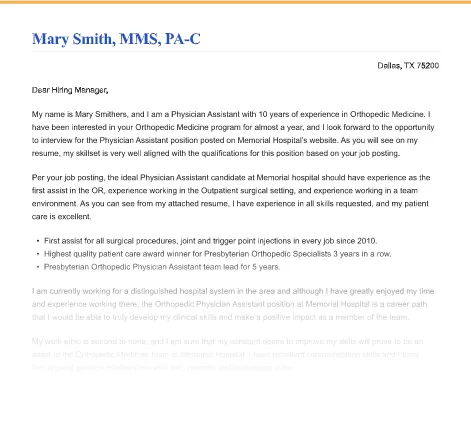
Understanding the Physician Assistant Cover Letter
A Physician Assistant (PA) cover letter is more than just a formality; it’s your first opportunity to make a strong impression on a potential employer. It serves as a personal introduction, providing a glimpse into your qualifications, experiences, and motivations. This document allows you to highlight aspects of your resume and explain how your skills align with the specific requirements of the job you’re applying for. Unlike a resume, which is a straightforward list of accomplishments, a cover letter gives you the space to demonstrate your personality, enthusiasm, and unique value proposition. It’s where you can showcase your passion for healthcare, your understanding of the employer’s needs, and your commitment to providing excellent patient care. A well-crafted cover letter can significantly increase your chances of landing an interview and ultimately securing your desired PA position. It’s a crucial tool in your job search arsenal that should be treated with the utmost care and attention to detail.
Why a Cover Letter Matters
In a competitive job market, a cover letter can be the deciding factor in whether your application gets noticed. It provides a platform to differentiate yourself from other candidates by going beyond the basic information in your resume. A cover letter allows you to articulate your career goals, explain why you’re interested in a specific role, and showcase your understanding of the healthcare organization’s mission and values. It demonstrates your communication skills, attention to detail, and genuine interest in the position. Moreover, a cover letter helps you address any potential gaps or weaknesses in your resume, offering context and providing a more complete picture of your qualifications. This level of personalization and insight is often missing from a resume alone, making your cover letter an essential component of a successful job application strategy. Without a compelling cover letter, your application may be overlooked, regardless of your qualifications.
Highlighting Your Skills and Experience

When crafting your cover letter, focus on highlighting the skills and experiences most relevant to the specific job you’re applying for. Start by carefully reviewing the job description and identifying the key requirements and qualifications. Then, select the experiences and skills from your background that directly align with these needs. Use specific examples to illustrate how you’ve demonstrated these skills in the past. For instance, if the job description emphasizes patient communication, describe a situation where you effectively explained a complex medical procedure to a patient or resolved a conflict with a patient. If the job requires experience in a particular specialty, provide details about your clinical rotations or previous roles in that area. By providing concrete examples and quantifying your accomplishments whenever possible, you can demonstrate your value to the employer and make a compelling case for why you’re the ideal candidate. Focus on using keywords from the job description to optimize your letter for applicant tracking systems (ATS).
Key Sections of a Physician Assistant Cover Letter
A well-structured cover letter should follow a standard format, ensuring clarity and professionalism. This generally includes a header with your contact information, the date, and the employer’s contact information. The letter itself should consist of an opening paragraph, several body paragraphs, and a closing paragraph. Each section serves a specific purpose. The opening should immediately grab the reader’s attention and state the position you’re applying for, as well as where you saw the job posting. The body paragraphs are where you showcase your qualifications, experience, and skills, providing detailed examples of your accomplishments. The closing paragraph should reiterate your interest in the position, express your enthusiasm for the opportunity, and include a call to action, such as stating your availability for an interview. Following a logical structure makes your letter easy to read and helps you communicate your message effectively.
Header and Contact Information
The header of your cover letter is the first thing the hiring manager will see, so it’s important to present it professionally. Include your full name, address, phone number, and email address at the top left or right of the document. Ensure that your email address is professional and easy to read. Immediately below your information, include the date and then the employer’s contact information, which should include the hiring manager’s name (if known), their title, the company name, and the company address. This format demonstrates your attention to detail and respect for the recipient. If you can’t find the hiring manager’s name, try to find it on LinkedIn, or call the company. If not, use the title of the person you will be reporting to.
Addressing the Hiring Manager

Addressing the hiring manager by name is a crucial element of a professional cover letter. It shows that you’ve taken the time to research the company and personalize your application. If you know the hiring manager’s name, use it in your salutation, such as “Dear Mr. / Ms. [Last Name].” If you’re unsure of the hiring manager’s name, try to find it on the company website or on LinkedIn. Using a generic greeting like “To Whom It May Concern” or “Dear Hiring Manager” is acceptable, but it’s less personal and can make your letter seem less tailored to the specific opportunity. When you address the hiring manager by name, it shows that you care enough to personalize your letter, and that goes a long way in demonstrating your genuine interest in the position.
Opening Paragraph Hooking the Reader
The opening paragraph is your chance to capture the hiring manager’s attention and make a strong first impression. Start by stating the position you’re applying for and where you saw the job posting. Then, use this paragraph to briefly introduce yourself and highlight your most relevant qualifications or experiences. The goal is to immediately grab the reader’s interest and make them want to continue reading. Mentioning a specific accomplishment, a skill that aligns with the job requirements, or your enthusiasm for the company can be effective. Keep it concise, focusing on the key points that will make you stand out. Avoid generic phrases or clichés; instead, aim for a compelling and engaging opening that sets the tone for the rest of your letter.
Body Paragraphs Showcasing Qualifications
The body paragraphs are where you elaborate on your qualifications and showcase your skills and experience. Each paragraph should focus on a specific aspect of your qualifications, linking it directly to the requirements outlined in the job description. Use the STAR method (Situation, Task, Action, Result) to provide detailed examples of your accomplishments. Describe the situation you were in, the task you were assigned, the actions you took, and the positive results you achieved. Quantify your achievements whenever possible to demonstrate your impact. For example, instead of saying “I improved patient satisfaction,” you could say, “I improved patient satisfaction scores by 15% through implementing a new communication protocol.” Use keywords from the job description to help your letter pass through applicant tracking systems (ATS) and make your qualifications easily understood by the hiring manager.
Mentioning Relevant Certifications and Licenses

In the body of your cover letter, be sure to mention any relevant certifications and licenses that are required for the Physician Assistant role you are applying for. This is particularly important in the healthcare field, where credentials are essential. Clearly state your certification (e.g., NCCPA certification) and any relevant licenses (e.g., state medical license) that you possess. Include the date you received them and, if applicable, the expiration date. Additionally, if you have any specialty certifications (e.g., ACLS, BLS, or certifications related to specific medical areas), make sure to include these as well. Listing your certifications and licenses demonstrates your qualifications and assures the employer that you meet the necessary requirements to practice as a PA. You can integrate this information in a paragraph that highlights your key skills and experiences, or you can dedicate a separate sentence or bullet point to this information.
Quantifying Achievements with Data
To make your cover letter even more impactful, quantify your achievements whenever possible. Instead of simply stating that you have excellent patient communication skills, provide specific examples with measurable results. Did you improve patient satisfaction scores by a certain percentage? Did you reduce patient wait times? Did you increase the number of patients seen per day? By providing concrete data, you demonstrate the tangible value you brought to previous positions. Use numbers to showcase your accomplishments and highlight your contributions. This can include the number of patients you’ve treated, the success rate of your procedures, or any improvements you made in efficiency or patient care. Quantifiable data makes your accomplishments more credible and demonstrates your ability to achieve results.
Tailoring Your Letter to the Job
Tailoring your cover letter to each job application is critical for showing genuine interest and demonstrating that you are a good fit for the specific position. Generic cover letters that are not tailored to the job requirements are easily identified and often discarded. Start by carefully reviewing the job description and identifying the key skills, experiences, and qualifications the employer is seeking. Then, customize your cover letter to address these specific requirements. Use keywords from the job description, highlight the experiences and skills from your background that directly align with the job’s needs, and provide specific examples that demonstrate your accomplishments. Explain why you’re interested in this particular role and this specific healthcare organization. By tailoring your cover letter, you demonstrate that you’ve taken the time to understand the job and are genuinely interested in the opportunity.
Researching the Employer

Before you write your cover letter, research the employer thoroughly. Understanding the healthcare organization’s mission, values, and goals will help you tailor your cover letter and show your genuine interest in the opportunity. Visit the company website, read about their services, and learn about their culture. Search for news articles or press releases to stay informed about recent developments. If possible, research the hiring manager or other key personnel within the organization. Referencing specific details about the organization in your cover letter demonstrates that you’ve done your homework and are genuinely interested in joining their team. This also allows you to align your skills and experience with the organization’s specific needs and values.
Matching Skills to Job Requirements
The most effective cover letters directly match your skills and experiences to the requirements outlined in the job description. Carefully analyze the job description to identify the key qualifications, skills, and experiences that the employer is looking for. Make a list of these requirements and then review your resume and background to find examples that demonstrate how you have met those requirements in the past. In your cover letter, explicitly connect your skills and experiences to the specific needs of the job. Use keywords from the job description throughout your letter. This will make it easier for the hiring manager to see the relevance of your qualifications. Provide concrete examples and quantifiable results to illustrate how you have successfully used your skills in previous roles. This clear alignment will show the employer that you are a strong candidate for the position.
Formatting and Design for Professionalism
The format and design of your cover letter are crucial for creating a professional and polished document. Choose a clean and readable font, such as Times New Roman, Arial, or Calibri, and use a font size between 10 and 12 points. Maintain consistent formatting throughout the document. Use single spacing within paragraphs and double spacing between paragraphs. Left-align your text and avoid centering or justifying it unless it is a formal business letter. Ensure your letter has clear margins (typically 1 inch on all sides) and is free of grammatical errors and typos. Proofread your letter carefully before submitting it, and consider having a friend or colleague review it as well. A well-formatted and error-free cover letter shows attention to detail and professionalism.
Proofreading and Editing Your Cover Letter

Proofreading and editing your cover letter is an essential step in the writing process. Errors in grammar, spelling, or punctuation can undermine your credibility and make a negative impression on the hiring manager. Before submitting your letter, carefully proofread it for any mistakes. Read it aloud to catch any awkward phrasing or errors that you might miss when reading silently. Use a grammar and spell-checking tool, but don’t rely on it completely. Make sure your sentences are clear, concise, and well-structured. Pay attention to the flow of your letter and ensure that your ideas are presented logically. If possible, ask a friend, family member, or career counselor to review your cover letter as a fresh set of eyes can often spot errors that you may have missed. A polished and error-free cover letter demonstrates professionalism and attention to detail.
Using Action Verbs to Strengthen Your Letter
Using strong action verbs can make your cover letter more impactful and highlight your accomplishments. Instead of using passive language, opt for active verbs that convey a sense of initiative and achievement. Here are examples of effective action verbs for a Physician Assistant cover letter: Assessed, Administered, Diagnosed, Treated, Educated, Managed, Implemented, Improved, Coordinated, Collaborated, Developed, Researched, Evaluated, Performed, Prescribed, Resolved, Supervised, Trained. Begin your sentences with these action verbs to describe your responsibilities and accomplishments. For example, instead of writing, “I was responsible for patient care,” write, “I administered patient care.” This approach makes your letter more dynamic and demonstrates your capabilities effectively. Using strong action verbs adds power to your writing and helps your letter stand out.
Closing Your Letter with Confidence
The closing paragraph of your cover letter is your final opportunity to leave a positive impression. Reiterate your interest in the position and express your enthusiasm for the opportunity. Summarize your key qualifications and reiterate why you are a good fit for the role. Then, include a call to action, such as stating that you are available for an interview and providing your contact information. If you have any specific skills or experiences that you think would be particularly beneficial for the position, feel free to mention them briefly in the closing. End your letter with a professional closing, such as “Sincerely” or “Best regards,” followed by your typed name. A confident and professional closing paragraph reinforces your enthusiasm and increases your chances of getting the interview.
Expressing Enthusiasm and Availability

In your closing paragraph, it’s important to express your enthusiasm for the opportunity and your availability for an interview. Reiterate your genuine interest in the position and the company. You can mention something specific that you like about the role or the organization, showing that you have thoroughly researched the opportunity. Clearly state that you are available for an interview at the hiring manager’s earliest convenience. Include your contact information (phone number and email address) to make it easy for the employer to reach you. By expressing your enthusiasm and availability, you demonstrate your strong interest in the position and increase the likelihood of being contacted for an interview.
Proper Salutations and Sign-Off
The salutation and sign-off of your cover letter contribute to your overall professional image. As mentioned earlier, if you know the hiring manager’s name, use it in your salutation, such as “Dear Mr. / Ms. [Last Name].” If you are unsure of the hiring manager’s name, a generic greeting such as “Dear Hiring Manager” is appropriate. At the end of your letter, use a professional sign-off, such as “Sincerely,” “Best regards,” or “Respectfully.” Avoid informal closings. After your sign-off, leave a few lines for your signature if you plan to print and mail the cover letter. Then, type your full name beneath the signature line. Your salutation and sign-off should be consistent with the level of formality of the cover letter, and this attention to detail further demonstrates your professionalism.
Common Mistakes to Avoid
Avoid these common mistakes to ensure your cover letter makes a positive impression. Do not make grammatical errors and typos. Ensure that your cover letter is not too generic, which shows a lack of effort or interest. Do not exceed the recommended length (usually one page). Avoid clichés and repetitive phrases. Do not include negative comments about previous employers or positions. Avoid exaggerating your skills or experiences. Do not send a cover letter that is not tailored to the specific job; customize it for each application. Ensure your letter is easy to read and well-organized. Ensure that the tone of the letter is professional and enthusiastic, not demanding. Proofread your cover letter carefully before submitting it, and consider having a friend or colleague review it as well.
Crafting a compelling Physician Assistant cover letter requires careful attention to detail and a strategic approach. By following these guidelines, you can create a cover letter that effectively highlights your skills, experiences, and qualifications, setting you apart from the competition and increasing your chances of securing your dream PA position. Remember to tailor your letter to each job, proofread carefully, and always put your best foot forward.