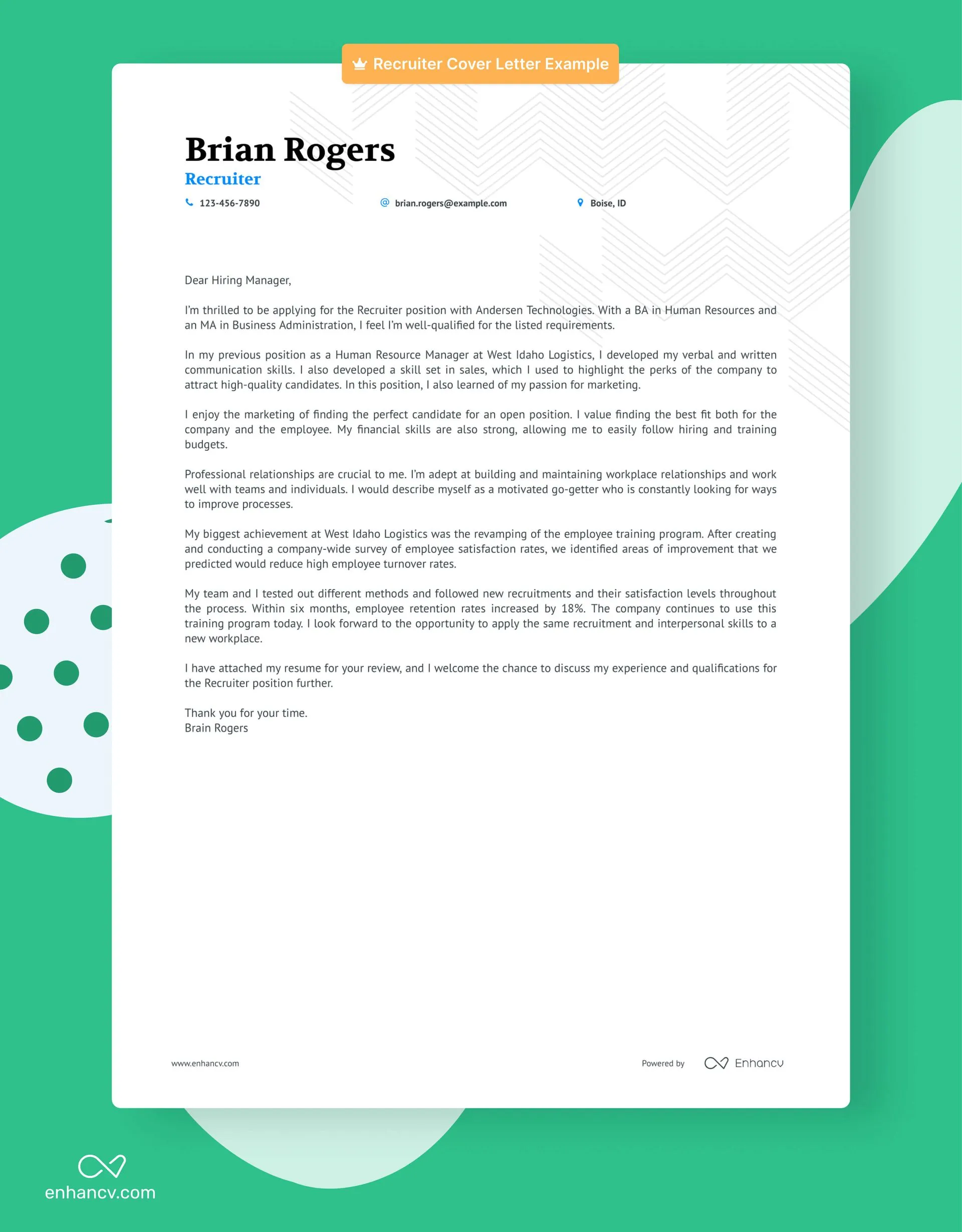
Crafting a Compelling Recruiter Cover Letter
A recruiter cover letter is your first chance to make a strong impression. It’s more than just a formality; it’s a strategic document that can significantly increase your chances of landing an interview. A well-crafted cover letter complements your resume, providing a narrative that highlights your skills, experience, and personality. It allows you to connect with the recruiter on a personal level, showcasing why you’re the ideal candidate for the specific role. This guide will help you understand the key components of a compelling recruiter cover letter and how to tailor it to maximize your impact.
Understanding the Recruiter’s Perspective
To write an impressive cover letter, you need to understand the recruiter’s perspective. Recruiters are busy professionals who are constantly sifting through numerous applications. They’re looking for candidates who can quickly demonstrate that they meet the essential requirements of the job. They also want to see that you’ve taken the time to research their company and understand their needs. A cover letter that immediately captures their attention and clearly articulates your value proposition will stand out from the crowd. Think about what the recruiter is looking for – someone who can fill the role efficiently and effectively, and someone who is a good fit for the company culture.
Researching the Company and Role

Before you start writing, research the company and the specific role. Visit their website, read their mission statement, and understand their values. Explore their social media profiles to gain insights into their culture and recent activities. Carefully review the job description, paying close attention to the keywords, responsibilities, and required skills. This research will enable you to tailor your cover letter, demonstrating that you understand the company’s needs and how your skills align with the role. Showcasing your knowledge of the company demonstrates genuine interest and a proactive approach that recruiters appreciate. (See image researching-company.webp)
Highlighting Relevant Skills and Experience
Your cover letter should clearly and concisely highlight the skills and experience that make you a strong fit for the role. Focus on the qualifications mentioned in the job description and provide specific examples of how you’ve demonstrated these skills in previous roles. Use action verbs to describe your accomplishments and quantify your achievements whenever possible. Avoid simply restating your resume; instead, elaborate on your key accomplishments and explain how they relate to the specific requirements of the job. Use this as your chance to tell the story behind your resume, illustrating your expertise and enthusiasm. (See image highlighting-skills.webp)
Tailoring Your Cover Letter to the Job Description
A generic cover letter is easily identifiable and rarely effective. Customize each cover letter to the specific job you’re applying for. Analyze the job description and identify the key skills, qualifications, and experiences the employer is seeking. Then, use your cover letter to showcase how your background aligns with those requirements. This level of personalization shows that you’ve taken the time to understand the role and are genuinely interested in the opportunity. Address the specific needs of the company and demonstrate how you can contribute to their success. Showcasing your understanding of the company’s needs is the key.
Quantifying Achievements with Data

Whenever possible, quantify your achievements with data. Recruiters are impressed by tangible results. Instead of saying you ‘improved efficiency,’ say you ‘reduced processing time by 15%’. Instead of saying you ‘increased sales,’ state that you ‘increased sales by 20% within six months’. Quantifiable achievements provide concrete evidence of your skills and abilities, making your cover letter more compelling and memorable. Using numbers adds credibility and helps recruiters quickly understand the value you can bring to their organization. Use percentages, numbers, and specific examples to make your accomplishments stand out.
Showcasing Soft Skills and Personality
While technical skills are important, recruiters also look for soft skills and personality traits that make you a good fit for the company culture. Highlight your communication skills, teamwork abilities, problem-solving skills, and leadership qualities. Use the cover letter to showcase your personality and enthusiasm for the role. Briefly explain your career aspirations and why you’re passionate about recruiting. Demonstrate your ability to collaborate, communicate effectively, and adapt to different situations. Showing these abilities can significantly improve your chances of getting hired. This demonstrates to the recruiter that you are more than just a list of skills, and can potentially add to the company’s culture.
Formatting and Structure for Impact
The format of your cover letter is just as important as the content. Use a clear and professional format with a readable font and appropriate spacing. Keep your cover letter concise and easy to scan. Use bullet points to highlight key accomplishments or skills. Break up large blocks of text with headings and subheadings. Ensure your cover letter is visually appealing and easy to read. A well-formatted cover letter reflects your attention to detail and professionalism. A clean format helps the recruiter quickly grasp the essential information. (See image cover-letter-formatting.webp)
Choosing the Right Tone and Style

The tone and style of your cover letter should be professional but also reflect your personality. Avoid overly formal language or jargon. Use a conversational tone that is engaging and easy to read. Tailor your writing style to the company’s culture. Research the company’s tone of voice on their website and social media to help you understand how you should write your cover letter. Maintain a positive and enthusiastic tone throughout your letter. This approach shows you’re not only a good candidate, but also that you care about the position.
Proofreading and Editing for Perfection
Proofreading and editing your cover letter is crucial. Typos, grammatical errors, and formatting mistakes can undermine your credibility and make you appear unprofessional. Carefully review your cover letter for any errors before submitting it. Use spell-check and grammar-check tools, but also read through your letter several times to catch any mistakes that automated tools might miss. Ask a friend or colleague to review your cover letter for feedback. A polished, error-free cover letter demonstrates your attention to detail and commitment to excellence.
Making a Strong First Impression
Your cover letter is your first introduction to a potential employer, so make it count! A strong opening paragraph is essential for grabbing the recruiter’s attention. The closing should leave a lasting positive impression. The body of your letter should effectively highlight your skills and experience. Be prepared for an interview by researching common interview questions. The way you structure your letter is just as important as the content. (See image strong-first-impression.webp)
Writing a Powerful Opening Paragraph

Your opening paragraph should immediately grab the recruiter’s attention and make them want to read more. State the position you’re applying for and briefly explain why you’re interested in the role. Highlight a key achievement or skill that aligns with the job requirements. Show enthusiasm and confidence in your opening. A compelling opening creates intrigue and encourages the recruiter to continue reading. Avoid generic phrases such as ‘I am writing to express my interest…’ and instead, make a strong statement about your qualifications or your understanding of the company’s needs.
Creating a Memorable Closing
Your closing paragraph should reiterate your interest in the role and express your enthusiasm for the opportunity. Thank the recruiter for their time and consideration. Include a call to action, such as ‘I look forward to the opportunity to discuss my qualifications further’ or ‘I am eager to learn more about this exciting opportunity.’ Provide your contact information and make it easy for the recruiter to reach you. A well-crafted closing leaves a lasting positive impression and increases your chances of moving forward in the hiring process.
Examples of Impressive Cover Letters
Cover Letter Example 1: For a Junior Recruiter Role

Dear [Hiring Manager Name],
I am writing to express my keen interest in the Junior Recruiter position at [Company Name], as advertised on [Platform]. With my strong communication skills, organizational abilities, and passion for connecting talented individuals with exceptional opportunities, I am confident I can make a significant contribution to your team.
In my previous role at [Previous Company], I gained hands-on experience in sourcing candidates, screening resumes, and coordinating interviews. I assisted in filling over [Number] positions, consistently exceeding targets by [Percentage]. I am proficient in using applicant tracking systems (ATS) such as [ATS Name] and have a solid understanding of recruitment best practices.
I am particularly drawn to [Company Name]’s commitment to [Company Value] and its reputation for [Company Reputation]. I am eager to learn from experienced professionals and contribute to your team’s success. I am confident that my enthusiasm, skills, and dedication align perfectly with the requirements of this role.
Thank you for your time and consideration. I look forward to the opportunity to discuss my qualifications further. You can reach me at [Phone Number] or [Email Address].
Sincerely, [Your Name]
Cover Letter Example 2: For a Senior Recruiter Role
Dear [Hiring Manager Name],
I am writing to express my strong interest in the Senior Recruiter position at [Company Name], as advertised on [Platform]. With over [Number] years of experience in full-cycle recruiting, a proven track record of sourcing and placing top talent, and a deep understanding of [Industry/Area of Expertise], I am confident I can significantly contribute to the success of your organization.
In my previous role as [Your Title] at [Previous Company], I was responsible for leading the recruitment efforts for [Number] departments, successfully filling over [Number] roles within [Timeframe]. I implemented a new sourcing strategy that improved time-to-hire by [Percentage] and reduced recruitment costs by [Percentage]. I have extensive experience in managing complex recruitment projects, conducting interviews, negotiating offers, and building strong relationships with hiring managers and candidates.
I am particularly impressed by [Company Name]’s innovative approach to [Company Initiative] and its commitment to [Company Value]. I am passionate about building high-performing teams and am excited by the opportunity to leverage my skills to drive recruitment success at [Company Name].
Thank you for your time and consideration. I look forward to the opportunity to discuss my qualifications further. You can reach me at [Phone Number] or [Email Address].
Sincerely, [Your Name]
Cover Letter Example 3: For a Technical Recruiter Role
Dear [Hiring Manager Name],
I am writing to express my strong interest in the Technical Recruiter position at [Company Name], as advertised on [Platform]. With my proven track record of successfully sourcing and placing top-tier technical talent across various specializations, and a deep understanding of the tech industry, I am confident I can significantly contribute to the growth of your engineering team.
In my previous role at [Previous Company], I specialized in recruiting for [Specific Technologies/Roles], where I was responsible for managing the entire recruitment lifecycle, from sourcing to offer. I have a deep understanding of different programming languages, software development methodologies, and tech trends. I have successfully filled [Number] technical roles within the past [Timeframe], consistently meeting or exceeding hiring goals. I excel at building relationships with both hiring managers and candidates, and I am adept at assessing technical skills and cultural fit.
I am particularly drawn to [Company Name]’s commitment to innovation and its reputation for developing cutting-edge technology in the [Industry] space. I am eager to contribute my expertise to your team and help [Company Name] continue to attract and retain top technical talent.
Thank you for your time and consideration. I look forward to the opportunity to discuss my qualifications further. You can reach me at [Phone Number] or [Email Address].
Sincerely, [Your Name]
Common Mistakes to Avoid

Avoiding common mistakes can significantly improve the quality of your cover letter and increase your chances of getting an interview. Here are some important mistakes to avoid. These errors can immediately disqualify you. Make sure you pay attention to every aspect of your cover letter. (See image cover-letter-mistakes.webp)
Ignoring the Specifics of the Role
Failing to tailor your cover letter to the specific job description is a major mistake. Recruiters can easily spot generic cover letters that are not customized for the role. This shows a lack of attention to detail and a lack of genuine interest in the position. Address the specific requirements of the job and demonstrate how your skills and experience align with those requirements. Show the recruiter that you have the specific qualifications to fill the role.
Using a Generic Cover Letter
Using a generic cover letter that can be sent to any company or position is a clear sign that you haven’t invested enough time and effort into your application. Generic cover letters often lack the specific details and personalization needed to impress a recruiter. Personalize your cover letter by highlighting your key skills and experiences relevant to the role and by demonstrating your understanding of the company’s values and mission. Show the recruiter why you specifically want to work for their company.
Focusing Too Much on Yourself
While it’s important to highlight your skills and experience, avoid making your cover letter too self-focused. Instead of simply listing your achievements, explain how your skills can benefit the company. Focus on what you can do for the employer, not just what you’ve done in the past. Frame your accomplishments in terms of the value you can bring to the company. Show the recruiter why you would be an asset.
Frequently Asked Questions (FAQ)
Here are some frequently asked questions to help you better understand the components of a strong recruiter cover letter. These FAQs can help you refine your cover letter and improve your overall job application strategy. (See image cover-letter-faq.webp)
What should I include in a recruiter cover letter?
Your cover letter should include an introduction that states the position you are applying for, a brief overview of your key qualifications, examples of your skills and accomplishments, your understanding of the company, and a call to action. Also, the cover letter is a great place to show your personality, which will increase your chances of getting hired.
How long should a recruiter cover letter be?
Keep your cover letter concise and to the point. Aim for one page, or approximately 250-400 words. Focus on the most relevant information and avoid unnecessary details. Remember that recruiters are busy professionals, so make it easy for them to quickly understand your qualifications.
What are some good phrases to use?
Use phrases that are specific and relevant to the job. Instead of saying ‘I am a hard worker,’ try ‘I consistently exceeded targets by X%.’ Use action verbs to describe your accomplishments, such as ‘managed,’ ’led,’ ‘implemented,’ and ‘achieved.’ Demonstrate your enthusiasm by saying, ‘I am excited about this opportunity.’ Make sure your phrases match the company’s tone and voice.