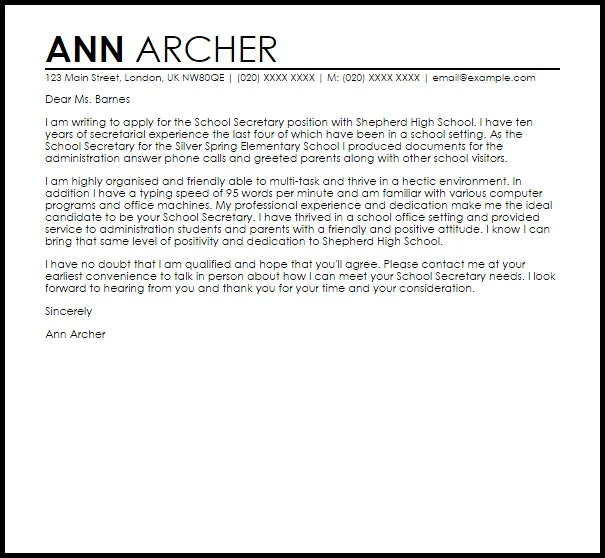
What is a School Secretary Cover Letter
A school secretary cover letter is a crucial document that accompanies your resume when applying for a school secretary position. It serves as your introduction to the hiring manager and provides an opportunity to highlight your relevant skills, experience, and enthusiasm for the role. Unlike a resume, which provides a factual overview of your qualifications, a cover letter allows you to express your personality and explain why you are the ideal candidate. It is a chance to showcase your communication skills, demonstrate your understanding of the school’s needs, and make a positive first impression. A well-crafted cover letter can significantly increase your chances of securing an interview and ultimately landing the job.
Why a School Secretary Cover Letter is Important
The importance of a school secretary cover letter cannot be overstated. It is often the first piece of communication a hiring manager receives from you, setting the tone for their perception of your application. A compelling cover letter demonstrates your professionalism, attention to detail, and genuine interest in the position. It provides a platform to explain any gaps in your employment history, elaborate on specific achievements, and tailor your qualifications to the specific requirements outlined in the job description. Moreover, a cover letter showcases your writing skills, which are essential for a school secretary role that involves communication with parents, students, and staff. By effectively communicating your value proposition, you increase your chances of standing out from other applicants.
Key Components of a School Secretary Cover Letter

A well-structured cover letter is essential for making a strong impression. It should be clear, concise, and tailored to the specific school and position you are applying for. The key components of a school secretary cover letter include the following sections, each playing a vital role in showcasing your suitability for the role and guiding the reader through your qualifications. By thoughtfully addressing each element, you create a compelling narrative that highlights your unique strengths and makes a lasting positive impression.
Your Contact Information
Begin your cover letter with your contact information, typically placed at the top left of the page. This includes your full name, address, phone number, and professional email address. Ensure your contact information is current and easily accessible. This allows the hiring manager to quickly reach you if they wish to schedule an interview. Avoid using an unprofessional email address; instead, opt for a formal one that reflects your professionalism. Make sure to use a font and format consistent with your resume.
Date
Below your contact information, include the date you are submitting your application. This helps the reader know when you applied for the position and allows them to keep track of the application’s timeliness. Ensure the date is formatted correctly, using a standard format such as Month Day, Year (e.g., October 26, 2023).
Hiring Manager’s Information

If possible, address the cover letter to a specific person—the hiring manager or the principal of the school. Research the school’s website or use LinkedIn to find the name and title of the individual responsible for hiring. Addressing the letter to a specific person demonstrates that you have taken the time to research the school and shows your attention to detail. If you cannot find a name, use a professional salutation such as “Dear Hiring Manager.”
Professional Greeting
Use a professional and courteous greeting. When addressing a specific person, use “Dear Mr./Ms./Mx. [Last Name].” If you are unable to find the name, use “Dear Hiring Manager” or “Dear [School Name] Hiring Committee.” Avoid informal greetings like “Hi” or “Hello.”
Opening Paragraph
In the opening paragraph, clearly state the position you are applying for and how you learned about it. Express your interest in the role and the school. Briefly mention your key qualifications and what makes you a good fit. The opening paragraph should capture the reader’s attention and set the stage for the rest of your cover letter. Highlight a specific skill or accomplishment that aligns with the job requirements to create an immediate connection with the hiring manager.
Highlighting Relevant Skills and Experience

This is the most crucial section of your cover letter. In one or two paragraphs, highlight your skills and experience that are most relevant to the school secretary position. Carefully review the job description and tailor your cover letter to the specific requirements and responsibilities outlined. Provide specific examples of how you have successfully performed similar tasks in the past. Quantify your achievements whenever possible, using numbers and data to demonstrate your impact.
Administrative Skills
Emphasize your administrative skills, such as managing schedules, handling correspondence, organizing files, and preparing reports. Provide specific examples of how you have effectively managed administrative tasks in previous roles. Mention any software or systems you are proficient in, such as Microsoft Office Suite, Google Workspace, or school-specific administrative software. Showcase your ability to maintain efficient office systems and handle a variety of administrative responsibilities.
Communication Skills
School secretaries require excellent communication skills to interact with students, parents, teachers, and staff. Highlight your written and verbal communication skills, including your ability to write professional emails, answer phones, and communicate information clearly and concisely. Mention any experience you have with conflict resolution or handling difficult conversations. Demonstrate your ability to communicate effectively with a diverse audience.
Organizational Skills

Showcase your organizational skills, including your ability to prioritize tasks, manage multiple projects simultaneously, and maintain a tidy and efficient workspace. Provide examples of how you have successfully organized events, managed calendars, or implemented organizational systems. Mention any experience with record-keeping, data entry, or maintaining confidential information. Demonstrate your ability to handle multiple tasks efficiently and effectively.
Experience in Education
If you have experience working in a school or educational environment, highlight it. Mention any previous roles as a school secretary, administrative assistant, or other positions that involved working with students, parents, or teachers. Discuss your understanding of school policies, procedures, and regulations. Showcase your familiarity with educational software, systems, and terminology. Demonstrate your passion for education and your ability to support the school’s mission.
Quantifying Achievements
Whenever possible, quantify your achievements to demonstrate your impact. Instead of saying “Improved office efficiency,” say “Streamlined office processes, resulting in a 15% reduction in administrative errors.” Use numbers, data, and statistics to showcase your accomplishments. Quantifying your achievements makes your cover letter more impactful and demonstrates your ability to deliver results. Examples of quantifiable achievements include processing a certain number of applications, improving communication response times, or reducing administrative costs.
Expressing Enthusiasm and Fit

In the middle section, express your enthusiasm for the specific school and the role. Research the school’s mission, values, and any recent achievements. Explain why you are interested in working for that school and how your skills and experience align with its needs. Discuss what appeals to you about the school’s culture and how you can contribute to its success. Demonstrating genuine enthusiasm and showing that you have taken the time to understand the school’s values will help you to stand out from the competition.
Closing the Cover Letter
The closing of your cover letter is as important as the opening. It should reinforce your interest in the position, express your availability for an interview, and thank the reader for their time and consideration. The closing paragraph should leave a lasting positive impression and motivate the hiring manager to take the next step.
Formal Closing
Use a professional and formal closing such as “Sincerely,” “Respectfully,” or “Best regards.” Avoid informal closings like “Thanks” or “Cheers.” Maintain a tone of professionalism and respect throughout the entire letter, demonstrating your commitment to the role and the school.
Signature

If you are submitting a hard copy of your cover letter, leave space for your handwritten signature above your typed name. For electronic submissions, you may simply type your full name. Ensure your signature is legible and professional, reflecting the seriousness with which you approach the application process.
Proofreading and Editing
Before submitting your cover letter, carefully proofread and edit it for any errors in grammar, spelling, punctuation, and formatting. Ask a friend or colleague to review your cover letter for a fresh perspective. Ensure that your cover letter is free of typos and grammatical errors. Proofreading shows attention to detail and a commitment to presenting yourself professionally. A well-written, error-free cover letter greatly enhances your chances of making a positive impression on the hiring manager.
In conclusion, a well-crafted school secretary cover letter is an essential tool for any aspiring candidate. It provides an opportunity to make a compelling case for your candidacy, highlight your relevant skills and experience, and express your enthusiasm for the role. By following the guidelines outlined in this guide and tailoring your cover letter to the specific requirements of each position, you can significantly increase your chances of landing an interview and securing your dream job as a school secretary. Good luck with your job search!