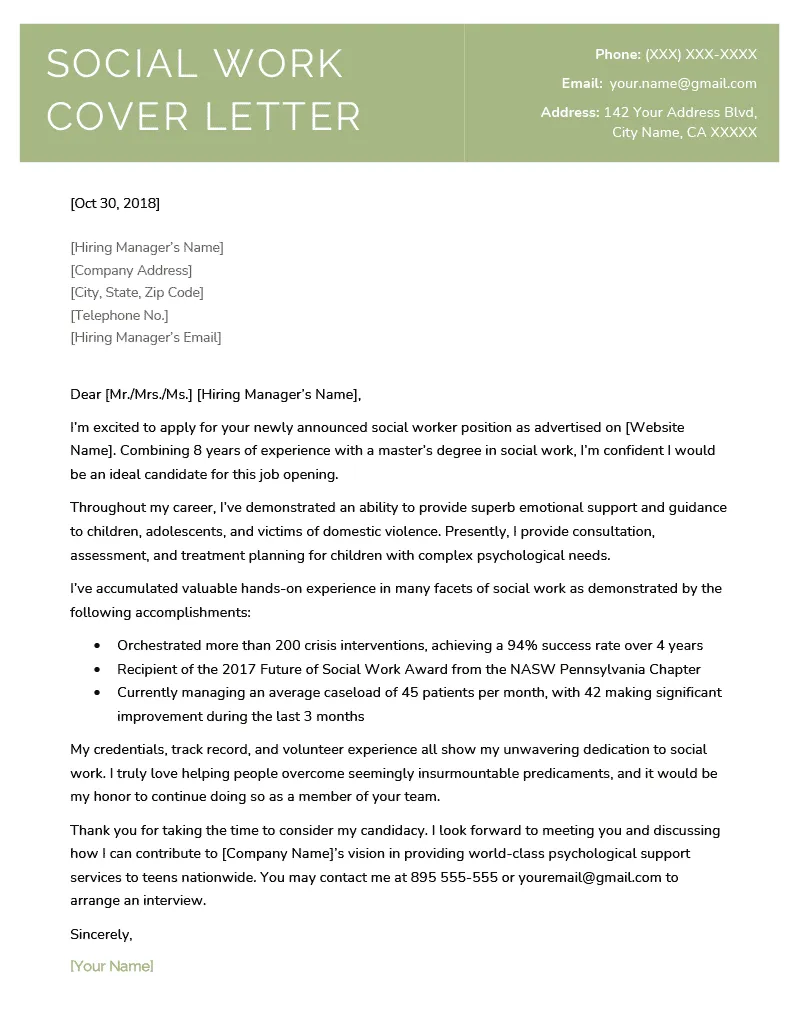
Understanding the Importance of a Social Work Cover Letter
In the competitive field of social work, a well-crafted cover letter is not just an optional extra; it’s a vital tool that can significantly influence the outcome of your job application. This document offers a prime opportunity to showcase your personality, enthusiasm, and qualifications beyond what’s presented in your resume. It’s your chance to make a strong first impression and convince potential employers that you are the perfect match for their organization and the specific role. A compelling cover letter demonstrates your genuine interest and dedication to the field of social work, setting you apart from other applicants. Therefore, investing time and effort in crafting a thoughtful and personalized cover letter is an investment in your career. It allows you to articulate your unique value proposition and demonstrate how your skills and experiences align with the employer’s needs and mission. This guide provides the must-know tips.
Why a Cover Letter Matters in Social Work
A cover letter serves as your introduction to a potential employer, providing a space to expand on the facts listed in your resume. Unlike a resume, which primarily focuses on achievements and credentials, a cover letter lets you communicate your enthusiasm for the role and your commitment to the field. It demonstrates your communication skills, providing the opportunity to express yourself in a clear and concise manner. A well-written letter can highlight your unique skills and experiences, helping you to stand out from other candidates. In social work, a cover letter can also demonstrate your understanding of the organization’s mission and values and how you can contribute to their goals. It is your chance to show the hiring manager that you’ve researched the position and understand the specific needs and requirements. It gives you the ability to show how your personal values align with the organization’s, proving that you’re not only qualified but also a great fit for the team. Cover letters are a very important tool for social workers.
Key Components of a Compelling Social Work Cover Letter

Header and Contact Information
Your cover letter should begin with a professional header. This section typically includes your contact information, as well as the recipient’s details. Accurate and up-to-date contact information is essential so that potential employers can reach you easily. Ensure your email address is professional and appropriate for job applications. Double-check that your phone number is correct and that your voicemail message is professional and ready for potential employers. Accuracy in this section is crucial as it is the first information a hiring manager sees and any errors can create a negative first impression. It is very important to include your name, address, phone number, and email address at the top of the document. Also include the date of the letter. The header serves as a quick reference for the employer.
Applicant’s Information
This section, located at the top of your cover letter, should contain your full name, address, phone number, and email address. This is the information the employer will use to contact you. Ensure all information is current, accurate, and professional. Your email address should be a professional one, like your first and last name; avoid using nicknames or informal addresses. Review this section meticulously to ensure no errors, as any mistakes here can undermine your credibility and professionalism. Maintain consistency with the information provided on your resume to avoid any confusion. If you have a LinkedIn profile, consider including the URL in this section to provide the employer with an additional way to learn more about your experience and qualifications.
Recipient’s Information

Directly below your information, include the recipient’s details. This usually consists of the hiring manager’s name, title, the organization’s name, and the address. If you know the hiring manager’s name, it’s best to use it; if you don’t, research or call the organization to find out. Addressing the letter to a specific person shows that you’ve taken the time to research the role and the organization, which can significantly improve your chances. If you cannot find a specific name, use a general title like ‘Hiring Manager’ or ‘Recruitment Team’. Always ensure the information is accurate and up-to-date to show your attention to detail and respect for the employer’s time. It is very important to tailor the letter to each job application.
Professional Greeting and Opening Statement
Start your cover letter with a professional greeting, such as “Dear Mr./Ms./Mx. [Last Name]”. If you don’t know the hiring manager’s name, use a general greeting like “Dear Hiring Manager”. The opening statement should immediately grab the reader’s attention and state the position you’re applying for. Briefly mention where you saw the job posting and why you’re interested in the role and the organization. This section sets the tone for the rest of the letter and gives the reader a clear indication of why you are contacting them. A strong opening statement shows you’ve done your research and are genuinely interested in the opportunity. Make your first sentence compelling and relevant, highlighting what makes you a good fit for the position. Keep the greeting and opening concise and focused on the specific job and the organization. Ensure that you tailor your opening to match the organization’s style and culture.
Crafting a Strong Body Paragraph
The body of your cover letter is where you showcase your skills, experience, and how they align with the job requirements. This section should be well-structured and easy to read. Begin by highlighting your most relevant experiences and qualifications, focusing on how they align with the job description. Provide specific examples of your accomplishments and quantify them whenever possible. Use the STAR method (Situation, Task, Action, Result) to describe your experiences. Demonstrate your understanding of the organization’s mission and how your values align with theirs. Show your passion for social work and your commitment to making a difference in the lives of others. The body is the most important part of the letter, so take your time and make sure that you show your skills. It is very important to proofread it once you are done with it.
Highlighting Relevant Skills and Experience

Carefully review the job description and identify the key skills and experiences the employer is seeking. Then, use your cover letter to highlight how your qualifications match their needs. Provide concrete examples of how you’ve utilized these skills in previous roles or volunteer experiences. Mention specific projects, tasks, or responsibilities that showcase your abilities. Use action verbs to describe your accomplishments and responsibilities, making your letter more dynamic and engaging. Tailor your skills section to the specific requirements of each job, ensuring you’re demonstrating the most relevant information. Show the hiring manager that you are the best candidate for the job. Consider including a brief summary of your education, licenses, and certifications that are relevant to the position. Use the same keywords from the job description in your letter, showing that you understand their needs and requirements.
Quantifying Accomplishments
Whenever possible, quantify your accomplishments by using numbers and data to demonstrate the impact of your work. Provide specific figures, percentages, or statistics to illustrate your achievements. For example, instead of saying you ‘managed a caseload,’ state that you ‘managed a caseload of 50 clients, providing weekly counseling sessions and support.’ If you improved client outcomes, mention the percentage improvement. Did you reduce waiting times? Quantify it. Did you increase the number of clients served? Include the figures. Quantifying accomplishments helps to make your accomplishments more tangible and shows potential employers the tangible results you can bring to their organization. This is a great way to distinguish yourself from other candidates, showing the hiring manager exactly what you did in the past.
Demonstrating Passion and Fit
Expressing your genuine passion for social work is critical in your cover letter. Share why you are drawn to this profession, what motivates you, and what you find most rewarding. Highlight your understanding of the organization’s mission, values, and the population they serve. Explain how your personal values align with theirs, showing that you are not just qualified but also a great cultural fit. Mention any specific programs, initiatives, or aspects of their work that particularly appeal to you, and explain why. Show how your skills and experience align with the organization’s goals. Let the reader know why you’re specifically interested in working for their organization. Your enthusiasm should be evident throughout the letter, making a lasting impression. Demonstrating your passion shows the hiring manager that you have the right attitude and mindset to make an impact.
Tailoring the Letter to the Specific Role

Every cover letter should be tailored to the specific job and organization you are applying for. Generic cover letters are easily identified and often discarded. Carefully read the job description and use it as a guide to highlight the skills, experiences, and qualities the employer is seeking. Research the organization’s mission, values, and recent activities to show that you understand their work and goals. Customize each letter with relevant examples of how your skills and experience match the job requirements and the organization’s needs. Avoid using generic phrases and instead, use specific details. Show that you’ve put in the time and effort to understand the role and how you can contribute. Personalization demonstrates your genuine interest and attention to detail, which are very important in the social work field. It is very important to tailor the letter to each job application.
Writing a Powerful Closing
The closing paragraph is your final opportunity to make an impression. It should reiterate your interest in the position and your enthusiasm for the organization. Clearly state your desire for an interview and make it easy for the employer to contact you. Always thank the reader for their time and consideration. End with a professional closing, such as “Sincerely” or “Best regards,” followed by your name. Before submitting the cover letter, re-read it and make sure that it is clear and concise. A strong closing paragraph reinforces your key qualifications and leaves a positive lasting impression. A compelling closing can be the deciding factor in getting you an interview.
Expressing Enthusiasm and Call to Action
In your closing, clearly express your enthusiasm for the position and your eagerness to discuss your qualifications further. State your availability for an interview and provide your contact information once again. Include a call to action, prompting the reader to take the next step. For example, “I am very excited about this opportunity and look forward to hearing from you.” or “I am very interested in this opportunity and I would welcome the chance to discuss my qualifications in more detail. Thank you for your time and consideration. I look forward to hearing from you soon”. The call to action encourages the employer to take the next steps in the hiring process. The closing should be professional and confident, leaving the reader with a positive final impression. Avoid overly casual or informal language.
Proofreading and Formatting

Proofreading and formatting are essential steps that should never be skipped. Errors in grammar or spelling can undermine your professionalism and credibility. Before sending your cover letter, carefully proofread it for any errors. Read it aloud to catch any awkward phrasing or inconsistencies. Consider having a friend, mentor, or career advisor review your letter. Ensure your formatting is consistent and professional. Use a clean, easy-to-read font, like Arial or Times New Roman. Maintain consistent margins, spacing, and indentation throughout the document. Ensure that the document is well-organized and easy to follow. Proper formatting and proofreading demonstrate attention to detail, which is a highly valued skill in social work.
Common Mistakes to Avoid in a Social Work Cover Letter
Certain mistakes can significantly diminish the effectiveness of your social work cover letter. Being aware of these pitfalls can help you create a more compelling and professional application. Always avoid making any mistakes so that you can make a great first impression. Generic cover letters, focusing on “I”, and using incorrect grammar and spelling are some of the most common mistakes. Make sure that you avoid these.
Generic vs Personalized Letters
Avoid using generic cover letters that are not tailored to the specific job or organization. Generic letters fail to demonstrate your genuine interest and often appear impersonal. Instead, always personalize each cover letter by researching the organization, understanding their mission, and highlighting how your skills and experience align with their specific needs and values. Personalizing your cover letter shows that you’ve taken the time and effort to understand the role and the organization, making a much stronger impact on the hiring manager. Take the time to personalize your cover letter for each job that you are applying for.
Focusing on “I” instead of “We”

While it’s important to highlight your individual skills and achievements, avoid using excessive “I” statements throughout your cover letter. Balance the use of “I” with “we” to show your understanding of teamwork and collaboration, which are essential in social work. Discuss your contributions within a team setting when possible. Use the right balance of first-person pronouns to showcase your qualifications while demonstrating your ability to work effectively as part of a team. Make sure that you are not only focusing on yourself but also on the team. In social work, teamwork is very important.
Using Incorrect Grammar or Spelling
Always proofread your cover letter for any grammatical or spelling errors. Typos and grammatical errors can damage your credibility and make you appear unprofessional. Before submitting, thoroughly review your letter for any errors, and consider having a friend or career advisor review it as well. Pay close attention to sentence structure, punctuation, and word choice. Use tools like spell-check and grammar-check, but don’t rely on them entirely. It’s important to manually check the document. Proofreading is a vital step in ensuring that your cover letter makes a positive impression. A cover letter with mistakes is very unprofessional, so make sure that you avoid any mistakes.