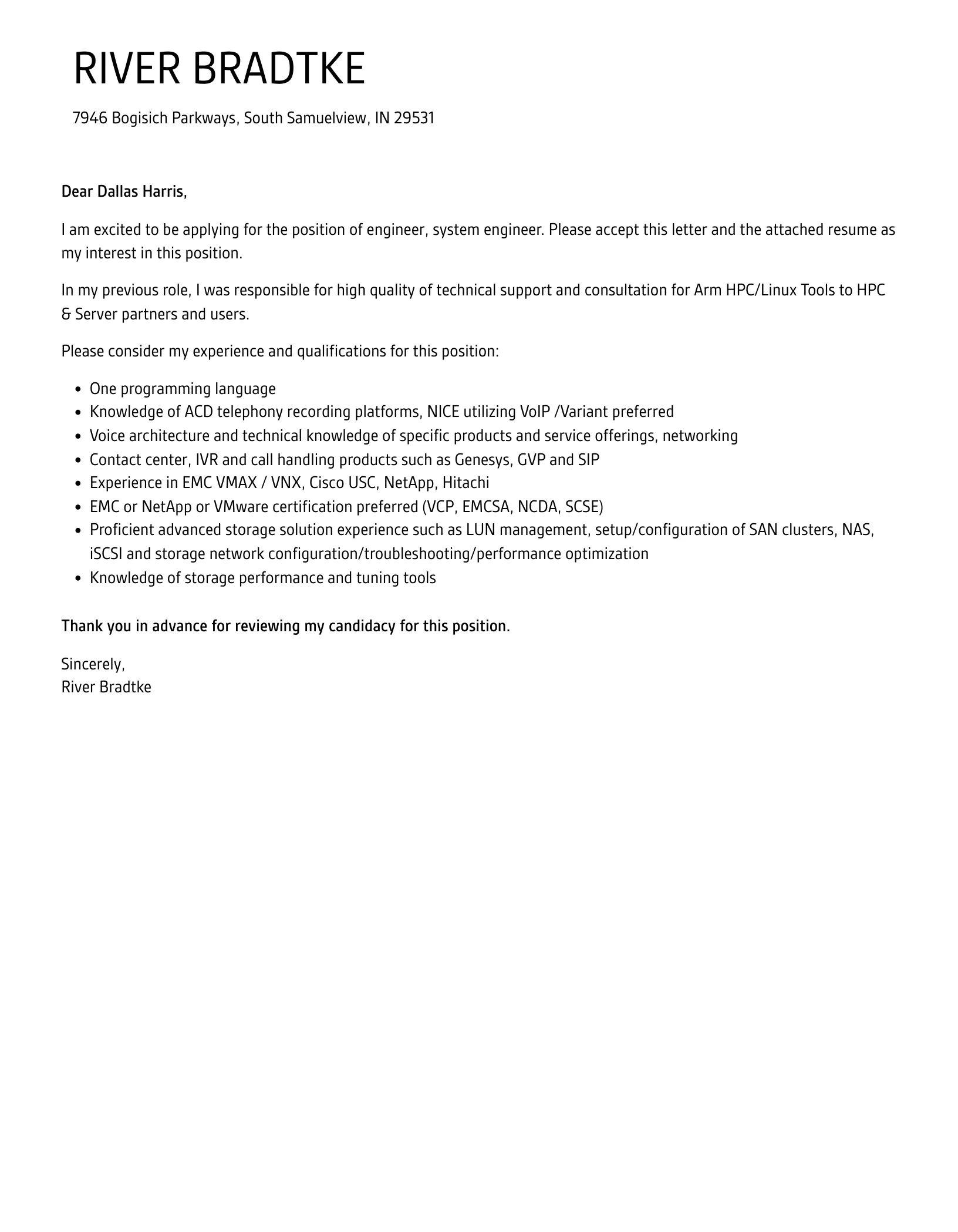
Why You Need a Systems Engineer Cover Letter
A well-crafted cover letter is an essential tool in your job search arsenal, especially when applying for systems engineer positions. It’s not just a formality; it’s your chance to make a strong first impression and convince the hiring manager that you’re the right fit for the role. In a field where technical skills are paramount, the cover letter allows you to go beyond your resume and demonstrate your personality, enthusiasm, and communication skills. It provides context to your experience, allowing you to highlight achievements and explain how your qualifications align with the specific requirements of the job. Without a cover letter, you risk being just another resume in a pile of applicants. A compelling cover letter showcases your unique value proposition and increases your chances of getting an interview.
Highlighting Your Skills and Experience
The core of your systems engineer cover letter should be a compelling showcase of your skills and experience. This is where you convince the hiring manager that you have what it takes to excel in the role. Focus on the most relevant skills and experiences as they pertain to the specific job description. Don’t simply rehash your resume; instead, provide detailed examples that illustrate how you’ve applied your skills to achieve tangible results. Quantify your accomplishments whenever possible; use numbers, percentages, or specific metrics to demonstrate the impact you’ve made in previous roles. By tailoring your cover letter to each job and providing concrete evidence of your capabilities, you demonstrate your serious interest and increase your chances of standing out from other candidates.
Technical Skills to Showcase

Systems engineers require a diverse set of technical skills. Your cover letter should prominently feature these skills, highlighting your proficiency in areas that align with the job requirements. Common technical skills to emphasize include expertise in operating systems (Windows, Linux, etc.), virtualization technologies (VMware, Hyper-V), cloud computing platforms (AWS, Azure, Google Cloud), networking protocols (TCP/IP, DNS, DHCP), and security principles. Also include experience with scripting languages like Python or PowerShell to automate tasks, as well as knowledge of hardware and software troubleshooting. When describing your technical skills, provide specific examples of how you’ve utilized them in past projects, detailing the outcomes achieved and technologies employed. This helps the hiring manager understand the depth of your technical expertise.
Experience with Systems Design
Experience with systems design is crucial for a systems engineer, so be sure to highlight this aspect in your cover letter. Describe any projects where you were involved in designing, implementing, and maintaining complex IT infrastructure. This can include server setups, network configurations, and data center management. Detail the methodologies you used for systems design, such as defining requirements, selecting appropriate technologies, and creating documentation. If you have experience with system architecture, emphasize this, as it shows your ability to understand how different components of a system work together. Also discuss any experience with capacity planning, performance monitoring, and optimization strategies. Providing specific examples of successful systems designs and implementations will make your cover letter more impactful.
Troubleshooting and Problem-Solving Abilities
Troubleshooting and problem-solving are core competencies of a systems engineer. Your cover letter should demonstrate your ability to diagnose and resolve complex technical issues efficiently. Share examples of situations where you successfully identified and fixed system failures, network outages, or performance bottlenecks. Detail the steps you took to troubleshoot the problem, including the tools and techniques you used. Highlight your analytical skills and your ability to think critically under pressure. If you’ve resolved issues that had a significant impact on business operations, be sure to include those examples. Also, demonstrate your ability to follow a systematic approach to problem-solving, which includes gathering information, analyzing root causes, and implementing effective solutions. This showcases your ability to handle challenges and maintain system stability.
Soft Skills to Emphasize

While technical skills are essential, systems engineers also need strong soft skills to collaborate with teams, communicate effectively, and manage projects successfully. Highlighting these skills in your cover letter can significantly boost your application. Focus on demonstrating your ability to work collaboratively, communicate technical information to non-technical stakeholders, and manage projects with various deadlines. Provide examples of when you have successfully worked as part of a team to achieve shared goals. Also, showcase your ability to adapt to changing priorities, manage your time, and take ownership of your responsibilities. By integrating these soft skills into your narrative, you present yourself as a well-rounded candidate who can contribute to a positive and productive work environment.
Communication and Teamwork
Communication and teamwork are vital for systems engineers. Emphasize your ability to communicate complex technical information clearly to both technical and non-technical audiences. Provide examples of when you have written technical documentation, presented project updates, or explained system configurations to stakeholders. Demonstrate your ability to actively listen and understand the needs of others. Showcasing your ability to collaborate effectively within a team is equally important. Give instances of when you contributed to a team, sharing your expertise, assisting colleagues, or resolving conflicts. Highlighting your teamwork abilities will illustrate your capacity to work cohesively with diverse groups and enhance overall project success. Effective communication and teamwork abilities significantly contribute to project success and team cohesion.
Problem-Solving and Analytical Skills
Problem-solving and analytical skills are essential for systems engineers. Show your proficiency in approaching complex issues systematically. Mention instances where you utilized critical thinking to analyze problems, identify root causes, and propose effective solutions. Share how you have used data and metrics to troubleshoot system performance issues. Describe how you have applied your analytical skills to evaluate system performance, identify bottlenecks, and recommend improvements. Highlight your capability to break down complex problems into manageable components, evaluate multiple solutions, and make data-driven decisions. Demonstrating a strong aptitude for problem-solving and analytical thinking enhances your ability to handle demanding challenges within the engineering field.
Formatting Your Systems Engineer Cover Letter

Proper formatting is key to making your cover letter easy to read and visually appealing. A well-formatted letter demonstrates professionalism and attention to detail. Choose a clean, professional font such as Arial, Calibri, or Times New Roman. Keep the font size between 10 and 12 points to ensure readability. Use standard margins (1 inch on all sides) to create a balanced layout. Break up long blocks of text with concise paragraphs, bullet points, and headings to make your letter easier to scan. Ensure there is adequate spacing between paragraphs and sections. Proofread your cover letter multiple times to eliminate any typos or grammatical errors. A well-formatted cover letter shows that you respect the reader’s time and are detail-oriented. Adhering to these formatting guidelines will help ensure your cover letter is both informative and visually appealing.
Contact Information and Professional Formatting
Include your contact information at the top of your cover letter, using a standard format. Start with your full name, followed by your phone number, email address, and LinkedIn profile URL (if you have one). Ensure your email address is professional. If it is not, create a new one. The contact information should be clearly presented, allowing recruiters to quickly reach you. Maintain a consistent format throughout your cover letter. Use clear headings and subheadings to organize your content. Employ a business letter format with the date, the hiring manager’s name (if you know it), and the company’s address. Use a formal salutation such as “Dear Mr./Ms. [Last Name]” or “Dear Hiring Manager.” Maintain a professional tone throughout the letter, avoiding slang or casual language. Proofread everything, including your contact information, for accuracy before submitting it.
Body Paragraphs Content
The body of your cover letter is where you sell yourself to the hiring manager. Structure the body with concise paragraphs that highlight your key skills, experiences, and achievements. Each paragraph should have a clear purpose and support your overall goal of convincing the reader you are the best candidate. Avoid generic statements and instead provide specific examples that illustrate your abilities. Focus on the skills and experiences most relevant to the job description and tailor each letter to the specific role. By carefully crafting your body paragraphs, you can create a compelling narrative that captures the reader’s attention and makes them want to learn more about you.
First Paragraph: Grab Their Attention

The first paragraph of your cover letter should immediately grab the reader’s attention. Start with a strong statement that indicates your interest in the position and the company. You can reference something specific about the role or the company that excites you. Briefly highlight a key achievement or skill that aligns directly with the job requirements. Show your enthusiasm and make it clear why you are excited about the opportunity. Avoid generic opening lines like “I am writing to express my interest.” Instead, try something more engaging, such as, “I am writing to express my enthusiastic interest in the Systems Engineer position at [Company Name], as advertised on [Platform].” Or, “Having followed [Company Name]’s innovative work in [Specific Area], I am eager to contribute my expertise to your team.” This will get the reader’s attention and set the tone for the rest of your letter. By making a strong first impression, you increase the likelihood of the hiring manager reading your entire cover letter.
Second Paragraph: Showcase Your Achievements
The second paragraph is the opportunity to demonstrate your accomplishments. Choose two or three key achievements that directly relate to the job’s requirements. Start each accomplishment with an action verb to create a dynamic effect. For each achievement, describe the situation, the actions you took, and the results achieved. Quantify your accomplishments whenever possible using numbers, percentages, or specific metrics. This provides tangible evidence of your impact. For example, instead of saying “Improved system performance,” say, “Improved system performance by 20% by optimizing server configurations.” By showcasing concrete achievements, you show the hiring manager the value you would bring to the role. Focus on examples that highlight your problem-solving skills, technical expertise, and ability to contribute to the organization’s goals. This will leave a lasting impression.
Third Paragraph: Explain Your Interest
In the third paragraph, explain your interest in the company and the specific role. Show that you have researched the company and understand its mission, values, and recent projects. Explain why you are excited about the opportunity and how you see yourself contributing to the company’s success. Highlight aspects of the company or the role that particularly appeal to you. It shows that you are not just looking for any job but are genuinely interested in joining their team. Connect your skills and experiences to the company’s needs, explaining how you can address their challenges or contribute to their goals. Demonstrate your understanding of the company culture and how you can contribute to it. This demonstrates your enthusiasm and genuine interest in the position and the organization.
Closing the Letter

The closing of your cover letter is a crucial part of your application. It’s your last opportunity to make a positive impression and encourage the hiring manager to contact you. Keep your closing concise and professional, reiterating your interest in the role. Avoid overly casual language. A strong closing will summarize your qualifications and express confidence. This creates a lasting positive impression.
Call to Action
End your cover letter with a clear call to action. Clearly express your interest in an interview and state your availability for a discussion. Provide a direct statement, such as, “I am eager to discuss my qualifications further and welcome the opportunity to interview at your earliest convenience.” Thank the hiring manager for their time and consideration. Make it easy for the hiring manager to contact you by including your contact information in the closing. A well-crafted call to action shows your enthusiasm and increases your chances of moving forward in the hiring process. This reinforces your interest and makes it easy for the hiring manager to take the next step.
Cover Letter Examples for Systems Engineers
Reviewing cover letter examples can be extremely helpful in understanding how to structure and format your own. Numerous online resources provide templates and examples that you can adapt to fit your needs and experience. By studying these examples, you can learn about best practices, common phrasing, and how to effectively highlight relevant skills. Pay attention to how the examples highlight accomplishments, quantify results, and demonstrate technical and soft skills. Remember to tailor these examples to your specific skills and the requirements of the job. Adapt the language and format to your personal style. Also, make sure you personalize each cover letter to each job application. Using a well-crafted template can save you time and effort while ensuring your cover letter meets industry standards.
Example 1 Systems Engineer

Here is an example of a systems engineer cover letter:
[Your Name] [Your Address] [Your Phone Number] [Your Email]
[Date]
[Hiring Manager Name] [Hiring Manager Title] [Company Name] [Company Address]
Dear [Mr./Ms./Mx. Last Name],
I am writing to express my enthusiastic interest in the Systems Engineer position at [Company Name], as advertised on [Platform]. With over [Number] years of experience in designing, implementing, and maintaining complex IT infrastructures, I am confident that my skills and expertise align perfectly with your requirements. For example, in my previous role at [Previous Company], I spearheaded a project that resulted in a 30% improvement in system uptime. I am proficient in VMware, cloud platforms (AWS, Azure), and various scripting languages (Python, PowerShell).
During my time at [Previous Company], I was responsible for [mention a key responsibility or accomplishment]. I am proficient in [mention 2 or 3 technical skills]. I am eager to learn more about this opportunity. Thank you for your time and consideration. I look forward to the opportunity to discuss my qualifications further.
Sincerely, [Your Name]
Example 2 Systems Engineer
Here is a second example of a cover letter:
[Your Name] [Your Address] [Your Phone Number] [Your Email]
[Date]
[Hiring Manager Name] [Hiring Manager Title] [Company Name] [Company Address]
Dear [Mr./Ms./Mx. Last Name],
I am writing to express my interest in the Systems Engineer position at [Company Name]. I possess a strong background in IT infrastructure management. In my previous role at [Previous Company], I successfully led the migration of our entire server environment to the cloud, which resulted in a 25% reduction in operational costs. I’m proficient in cloud technologies, server management, network configurations, and security protocols. I am adept at troubleshooting network issues and implementing security measures.
I was responsible for [mention a key responsibility or accomplishment]. I am passionate about implementing efficient and reliable IT solutions. Thank you for your time and consideration. I look forward to an interview.
Sincerely, [Your Name]
Systems Engineer Cover Letter Mistakes to Avoid
Avoiding common mistakes is crucial for a successful cover letter. Make sure you tailor each cover letter to the specific job description. Avoid using generic templates. Generic cover letters do not show a genuine interest. Focus on relevant skills. Do not include information that isn’t directly related to the job requirements. Proofread carefully before submitting. Typos and grammatical errors can reflect poorly. Avoid exaggerating your skills or experience. Be honest and accurate. Do not be overly casual in your tone. Maintain a professional demeanor. Don’t simply restate your resume. Use the cover letter to expand upon your achievements and illustrate how your skills align with the job’s requirements. By avoiding these mistakes, you increase the chances of your application making a positive impression. Be professional, detailed, and tailored for maximum impact.