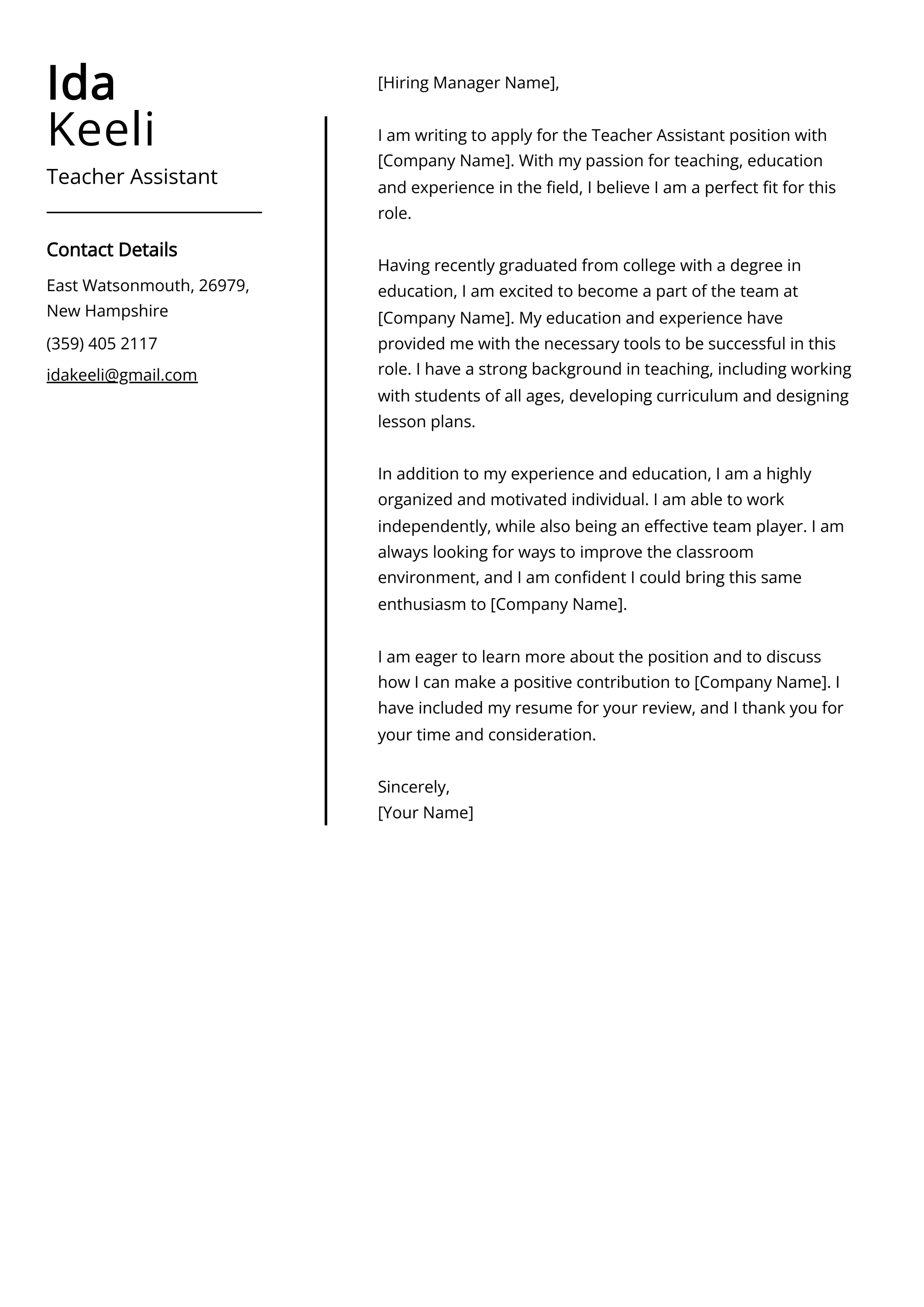
Why a Teaching Assistant Cover Letter is Crucial
In the competitive landscape of education, securing a Teaching Assistant (TA) position requires more than just a stellar resume. A well-crafted cover letter serves as your personal introduction, offering a unique opportunity to showcase your personality, passion, and qualifications. It’s your chance to go beyond the bullet points and connect with the hiring manager on a more personal level. A compelling cover letter can be the deciding factor in whether you get an interview or your application lands in the rejection pile. It allows you to explain why you’re the perfect fit for the role and the specific institution, demonstrating your understanding of their needs and values. Think of it as your first opportunity to shine and make a lasting impression, highlighting your strengths and articulating your enthusiasm for supporting student success. Without a strong cover letter, you might miss out on opportunities that align with your skills and aspirations.
Understanding the Role Teaching Assistant
Before crafting your cover letter, it’s essential to fully grasp the responsibilities of a Teaching Assistant. TAs play a vital role in supporting both instructors and students, contributing to a positive and effective learning environment. Your duties might include grading assignments, leading discussion groups, providing individual student support, preparing classroom materials, and assisting with administrative tasks. Showing your understanding of these diverse responsibilities in your cover letter, and demonstrating that your skills and experience align with them, will significantly increase your chances of success. Research the specific requirements of the position you are applying for and tailor your letter to reflect how you can meet those needs. For instance, if the role emphasizes online learning support, highlight your experience with relevant technologies and platforms. If it requires strong communication skills, provide examples of how you’ve successfully interacted with students and colleagues. Understanding the role will allow you to demonstrate your qualifications in an engaging manner.
Key Sections Your Teaching Assistant Cover Letter

A well-structured cover letter is easy to read and effectively conveys your key qualifications. It’s important to structure the letter logically, using clear language and concise paragraphs to ensure that the hiring manager can quickly grasp your key strengths and qualifications. Consider the following sections to make sure you cover all the important aspects of your candidacy.
Your Contact Information
Begin with your full name, address, phone number, and professional email address at the top of the letter. Ensure the contact information is up-to-date and professional. Using a clear, easy-to-read format is important here; this makes it simple for the hiring manager to contact you promptly. Double-check that your email address is appropriate for professional correspondence and that your voicemail greeting is also professional. If applying electronically, the header should be clean and professional-looking.
Hiring Manager’s Information
Always address the hiring manager directly if possible. Research the name and title of the person who will be reviewing your application, this shows your genuine interest in the position. If you can’t find a specific name, use a professional salutation such as “Dear Hiring Committee” or “Dear [Department Name] Hiring Team.” Avoid generic greetings like “To Whom It May Concern,” as they make your letter feel impersonal. This demonstrates your initiative and attention to detail, setting a positive tone from the outset.
The Salutation Making a Good First Impression

Start your cover letter with a professional salutation. If you know the hiring manager’s name, use “Dear Mr./Ms./Mx. [Last Name].” If not, use a general but polite greeting such as “Dear Hiring Manager” or “Dear [Department Name] Team.” A professional salutation shows respect and sets a positive tone for the rest of the letter. Correct spelling and accuracy in the salutation demonstrate attention to detail, which is essential for any TA role. Ensure you spell the hiring manager’s name correctly, as this is a small but significant way to make a positive first impression.
The Opening Paragraph Grabbing Attention
The opening paragraph is crucial for grabbing the reader’s attention. State the position you’re applying for and where you saw the advertisement. Briefly mention why you are interested in the role and the institution. Highlight one or two key qualifications or experiences that make you stand out. Tailor this paragraph to show your understanding of the role and how your skills align with the job requirements. For example, mention your passion for education or your experience working with students. This immediate connection will encourage the hiring manager to read on.
Highlighting Your Qualifications
The main body of your cover letter is where you showcase your qualifications. This is where you will delve into your relevant skills and experiences, demonstrating why you are the best candidate for the position. Provide specific examples from your past experiences. Use the STAR method (Situation, Task, Action, Result) to provide context, explain what you did, and highlight the positive outcomes. Always align your skills and experiences with the specific requirements listed in the job description. If the job description emphasizes experience with lesson planning, provide examples of successful lesson plans you’ve created or contributed to. Show how your skills match the role’s responsibilities.
Showcasing Relevant Experience

Focus on experiences directly related to the TA role. This includes any prior experience in teaching, tutoring, mentoring, or academic support. Provide specific examples of your contributions, such as how you helped students improve their grades or developed innovative teaching methods. Quantify your achievements whenever possible, for example, stating the number of students you mentored or the percentage by which you improved student performance. Mention any relevant internships, volunteer work, or research assistant positions. When describing your experiences, emphasize the skills and qualities that are most relevant to the role, such as communication, problem-solving, and organization.
Quantifying Your Achievements
Use numbers and data to demonstrate your impact and effectiveness. Instead of saying “I helped students,” state “I helped students improve their grades by 15% through targeted tutoring sessions.” When quantifying your achievements, focus on outcomes and results, such as the number of students you supported, the percentage of improvement in their performance, or any positive feedback you received. This provides concrete evidence of your abilities and makes your qualifications more compelling. Use data to make your accomplishments tangible and demonstrate your value as a Teaching Assistant. This type of detail will make your application stand out.
Emphasizing Your Skills
Clearly articulate the skills that make you a strong candidate for the Teaching Assistant position. The skills section is crucial to demonstrate that you possess the abilities needed to excel in the role. These skills are not merely a list; they should be presented in the context of your experiences and achievements. Show, don’t just tell, by providing examples of how you’ve utilized each skill in a real-world setting. Highlight your abilities in communication, classroom management, curriculum development, and technology proficiency. Tailor your skills to match the specific requirements outlined in the job description, using the keywords from the job posting to demonstrate your suitability. Showing the hiring manager that you possess the core competencies required is important.
Teaching Assistant Skills to Highlight

- Classroom Management
- Communication and Interpersonal Skills
- Curriculum Development
- Technology Proficiency
Classroom Management
Demonstrate your ability to create and maintain a positive and productive learning environment. Mention your experience with managing student behavior, organizing classroom activities, and ensuring that lessons run smoothly. Provide specific examples of how you have handled challenging situations or conflicts in the classroom. Highlight your organizational skills and your ability to multitask. Show how you’ve created a supportive and inclusive learning environment where all students feel comfortable participating. Explain how you ensure a conducive learning environment is available.
Communication and Interpersonal Skills
Highlight your ability to communicate effectively with students, instructors, and colleagues. Mention your experience with explaining complex concepts, providing constructive feedback, and actively listening to student concerns. Include any experience with group work, discussions, or presentations. Provide specific examples of how you have adapted your communication style to suit different audiences. This ability is critical for building positive relationships and ensuring students understand and engage with the course material. Describe instances where you provided constructive criticism or mediated conflicts. Show how your communication skills facilitate a collaborative learning environment.
Curriculum Development

If you have experience developing or assisting with curriculum, be sure to showcase it. Highlight your knowledge of instructional design, lesson planning, and assessment methods. Mention your experience with creating engaging and effective learning materials, such as presentations, worksheets, or online resources. Provide examples of how you have adapted and improved course content to meet the needs of students. If you have contributed to curriculum development, emphasize your understanding of learning objectives and assessment strategies. Demonstrate your ability to create resources that enhance student learning and align with educational standards.
Technology Proficiency
In today’s educational landscape, technology proficiency is crucial. Highlight your experience with learning management systems (LMS) such as Canvas or Blackboard, as well as any other relevant software or tools. Mention your experience with online teaching platforms, virtual classrooms, and educational software. This will greatly increase your prospects for the position. Provide specific examples of how you have used technology to enhance student learning, such as creating interactive lessons, managing online assignments, or facilitating virtual discussions. It’s important to show you can integrate technology into your teaching practices.
Addressing the Specific Job Requirements
Carefully review the job description and address each requirement in your cover letter. This demonstrates that you have the essential skills and qualifications sought by the employer. For each listed requirement, provide specific examples of how your experience and skills align. Use the same keywords and phrases as the job description to clearly illustrate that you meet their needs. The better you can address the specific job requirements, the more likely you are to grab the attention of the hiring manager.
Demonstrating Enthusiasm and Passion

Let your enthusiasm for the role and the institution shine through. Express your genuine interest in supporting students and contributing to the educational environment. Mention any specific programs, research areas, or values of the institution that resonate with you. Express your passion for teaching and your commitment to student success. Showing your passion for education will make you stand out from other candidates.
The Closing Paragraph Call to Action
In the closing paragraph, reiterate your interest in the position and thank the hiring manager for their time and consideration. Include a call to action, such as stating that you are eager to discuss your qualifications further in an interview. Express your availability for an interview and provide your contact information one last time. This strong conclusion leaves a positive impression and increases your chances of being contacted.
Proofreading and Editing Your Cover Letter
Before submitting your cover letter, thoroughly proofread and edit it for any errors in grammar, spelling, or punctuation. Errors can undermine your credibility and professionalism. Have a friend or career counselor review your letter for clarity and accuracy. Ensure that your letter is well-organized, easy to read, and free of typos. Carefully review your cover letter for any inconsistencies or inaccuracies. This extra step will ensure your cover letter makes the best possible impression.
Formatting Your Teaching Assistant Cover Letter
Use a professional and easy-to-read font, such as Times New Roman, Arial, or Calibri. Keep the font size between 10 and 12 points. Ensure that your letter is well-spaced and properly formatted, with consistent margins and line spacing. Use clear headings and subheadings to organize the information and make it easy for the hiring manager to scan. Maintain a professional tone and style throughout the letter. Following a simple template can also help ensure your cover letter looks well-formatted. A well-formatted letter shows attention to detail and professionalism.
Cover Letter Template for Teaching Assistant
While it’s important to tailor your cover letter to each specific job, using a template can help you get started and ensure you include all the necessary elements. Search online for cover letter templates designed for teaching assistant positions. Modify the template to reflect your personal information, skills, and experiences. Always customize the template to fit the specific requirements of the job description and the values of the institution. Make sure your cover letter is original and showcases your unique qualifications.